
by Kenneth F. Sheets
After having described in his first chapter both John the Baptist and Jesus, and their relationship to one another, the Apostle John presented the account of Jesus’ first “miracle,” His first public sign, of His true person and nature. Mary, the mother of Jesus, and Jesus and his disciples, had been called to a marriage in Cana of Galilee. There, Jesus, at the request of his mother, would change water into wine, unfermented grape juice, when the supply of this common drink became insufficient to the needs of those attending. Though nothing in the actual words of John indicates in any way that the “grape juice” which Jesus made had fermented, thus producing ethyl alcohol with its intoxicating effects, John’s description of this “beginning of signs” by Jesus has been twisted and perverted to justify unGodly human behavior.
Ignorance and Self-Authority Causes Misinterpretation
As is typical of much misinterpretation of passages of Scripture, John’s account has been wrongly “reinterpreted” from its true meaning and significance by humans who themselves never applied any degree of intensive analytical personal study to this passage. Typically, these individuals had satisfied themselves with the erroneous “studies” and “interpretations” of other humans, other humans:
– who themselves did not possess sufficient knowledge of John’s Greek language,
– or who were ignorant of fermentation as a chemical reaction and the ease by which this reaction can be prevented from occurring,
– or who simply chose to apply, for their own selfish purposes, their own meaning and significance to the words, usually those of a translation.
Failure to Understand the Scriptures As They Were Written Causes Misinterpretation
Few interpreters, even those considered by themselves and others to be capable of accurately comprehending NT Greek, actually possessed sufficient and accurate knowledge for properly understanding John’s record, especially since they were essentially ignorant of and failed to consider the chemistry and physics of the fermentation reaction as God designed it. Though they could “read” John’s Greek wording and “translate” it into English, or some other receptor language, they did not possess the knowledge and the mindset which are essential for accurate evaluation of the text not only in its ancient Greek wording, but also according to its actual ancient setting and according to the thinking of all those involved at that ancient time. Instead, most modern interpreters have insisted upon applying word definitions and connotations, especially those of an English translation, which had derived through many centuries of human history and human violation of God’s design. Certainly, they used “trusted” Greek lexicons, usually very abbreviated editions, to give them word definitions, but they failed to apply the knowledge that every lexicon is a production of human minds, and those human minds that compiled the lexicons were themselves subject to misunderstanding and misrepresentation of the meanings of the 1st century.
Failure to Apply the Integral Greek-Hebrew Relationship Causes Misinterpretation
In addition, many who have been entrusted to “teach” this language have never learned the inseparable relationship between the Greek and Hebrew languages. Rare is the recognition of the fact that the Greek language is a direct descendant of Adamite, now called Hebrew, and that Greek came into existence by the combination of Hebrew and one of the nonalphabetic languages which God had created at Babel, where He, the Creator, formed the new nonalphabetic languages by “mixing” (bälăl) components of His original Adamite, the language which He built into Adam and Eve. The pervasive influence of evolutionary thinking has almost completely misled modern linguistic studies into considering Hebrew to be a relatively “late” language instead of seeing it as God has represented it in His record as the original perfect language which He built into His first two humans. Adamite, then, and its alphabet became the basis upon which all future alphabetic languages were built, even changing cuneiformic and pictographic languages into alphabetic, and many Greek words, even in the Scriptures, are derived directly or indirectly from Hebrew. Regardless of this integral relationship between Hebrew and Greek, and especially with Hebrew as the primary, virtually every Bible college and seminary, even among those considered to be “better,” promotes the study of NT Greek over, and often to the total exclusion of, Hebrew. They have failed to recognize the pervasive influence of evolutionary thinking upon their linguistic value system, and thus, instead of correcting the error, they contribute to its continuance. If this error were corrected, a functional knowledge of Biblical Hebrew would clarify not only many of the expressions of the Hebrew and Greek Scriptures but also a great many of those in English translations. At the same time, this accurate correlation of Hebrew and Greek would increase the knowledge and understanding, and the firmness, of believers, and it would change the value and the manner and perspective of teaching these Biblical languages to and among “believers.”
Failure to Seek the Author’s Actual Word Meanings Causes Misinterpretation
Modern humans rarely, if ever, recognize that the meanings resident in their minds regarding the words, phrases, and grammatical constructions of the NT texts are not necessarily what the writers of the text intended. Instead of seeking the author’s intended meaning, they act as if they have authority over the words of the “holy men of God” who recorded the Creator’s revelation. Certainly, such a perspective of Scripture is the very antithesis of God’s design, but humans maintain this perspective despite its inescapable results, results that have destroyed many believers and nonbelievers alike as they were influenced by erroneous interpretations which led them into erroneous concepts of God and His perfect design. This is the case with John’s account of the wedding at Cana.
Human Desire to Justify Their Own Ideas and Perspectives Causes Misinterpretation
This “beginning of miracles,” literally, “beginning of signs,” occurred at a wedding in Cana of Galilee when the supply of wine was exhausted and Jesus filled the need by changing water into wine. In the years since John wrote, many have misinterpreted his record, some mistakenly and others purposely, but all with an extremely destructive result. Certainly, any misinterpretation or misapplication of God’s revelation results in destruction to some degree, but, with its roots so deep in the humanist concept where man justifies his own actions and desires, misunderstanding and misuse of John 2:1-11 has been especially destructive. Many, seeking to justify their own use of alcoholic beverages, or the same use by others, have resorted to this text as the primary foundation for their perspectives, but rare is the individual who has applied himself or herself to intensive analytical study of the passage. Almost every reader and interpreter is satisfied to use the writings of other humans, whether they be encyclopedia articles, lexical aids, commentaries, or whatever, to establish his or her view of what actually occurred at the wedding in Cana. As obvious as it should seem, most modern readers overlook the plain fact that the great bulk of material related to this text rests upon a single primary assumption, an assumption where the original usage and meaning of a word was changed by later generations to validate their own erroneous concepts of God and His design. In virtually any other field of study involving ancient documents, or indeed, any documents, such a practice would be regarded as nonsensical, but in the study of Scripture, it is not only commonly acceptable, it is often the rule.
Failure to Accurately Understand the Word “Wine” Causes Misinterpretation
The single primary assumption which has misled so many in their understanding of John’s record is that when the word “wine” occurs in Scripture, it always refers to fermented, that is, alcoholic, wine. The Scriptures do contain numerous references to wine where any normal interpretation of the text indicates that the wine there described must have been alcoholic, because the effects associated with the wine are effects described by the modern words “drunken,” or “intoxicated,” or “under the influence.” However, not all uses of the word “wine” in Scripture, whether in the Old or New Testament, fit the “drunkenness” association, but humans have forced upon these texts their own modern presumption of the word “wine” as referring to a fermented, alcoholic drink. Two passages have been especially subjected to this presumptive error: Genesis 9:20-27, where Noah became “drunken” from drinking “wine,” and John 2:1-11, the text under consideration here. Both of these passages have been greatly misunderstood and both have been used to misrepresent the character of holy and righteous men, Noah and the LORD Jesus Christ.
A Wrong Concept of “Wine” Has Led to Wrong Presentations of Godly Noah
The Noahic passage is discussed in a separate document, but a major point related to the danger of erroneous interpretation of the two records must be made. Few, who attribute to Noah the violation of God’s design wherein he allowed himself to be overcome by alcoholic wine, realize that they are contradicting God’s statements that Noah was, in His eyes, “righteous,” and singularly so, an evaluation which God expressed both before and after the Flood. Thus, someone is wrong, and the error does not rest with God’s record. Instead, humans have followed the errors of other humans and applied to the text concepts and ideas which did not accurately communicate what the Creator was actually saying. This error could have been corrected, but men prefer to follow men, and they all fall into the same pit, resisting anything that resembles a confession of error on their part. So, the mistaken idea that Noah “became drunk,” with all its associated theological error and destruction, continues, because men and women, who claim to be men and women of God, choose to study the words of men, instead of applying themselves to study the actual record of God.
A Wrong Concept of “Wine” Has Led to Wrong Presentations of Jesus Himself
The misinterpretation situation with John 2:1-11 is very similar to that of Genesis 9:20-27. Virtually all readers and interpreters of these two passages have applied only their surface knowledge of the words to conclude that both Noah and the individuals attending the wedding where Jesus changed water to wine had become “drunk” by drinking alcoholic wine, but this conclusion is not true. The words of Noah regarding his own condition after drinking “grape juice” and the words of John regarding the condition of the wedding attenders after drinking diluted “grape juice” give no indication that the “drinkers” had become “drunken” by drinking alcoholic wine. Both such interpretations are rooted not only in an ignorance of the actual Hebrew and Greek words but also in an ignorance resulting from superficial study of the actual situations described.
The Godly Character of the Wedding Attenders Must Be Considered
One primary factor in evaluating the nature of the supposed drunkenness at the Cana marriage is the recognition of the persons invited to attend. The character of Mary, the mother of Jesus, was well established; she was a distinctively Godly woman, and this would have been known to the family who invited her. In addition, the character of Jesus, and his disciples, as distinctively Godly individuals, would have been well known, though only a few days had passed since they had joined with Him. Thus, the character of Mary and Jesus and His disciples, and any other Godly individuals attending, would have been a deterrent to drunkenness and all the “uninhibited,” unGodly behavior associated with the intake of ethyl alcohol, especially as these multiple Godly individuals obviously rejected the intake of ethyl alcohol, just as the Scriptures had prohibited, with its influence toward unGodly behavior, even in very low concentrations. Indeed, the family presenting the marriage feast was more likely somewhat “Godly,” and the spectacle of public drunkenness being encouraged or promoted by them would have brought censure from most other Hebrews of their day.
The True Nature of the “Wine” and Its Desirability Must Be Considered
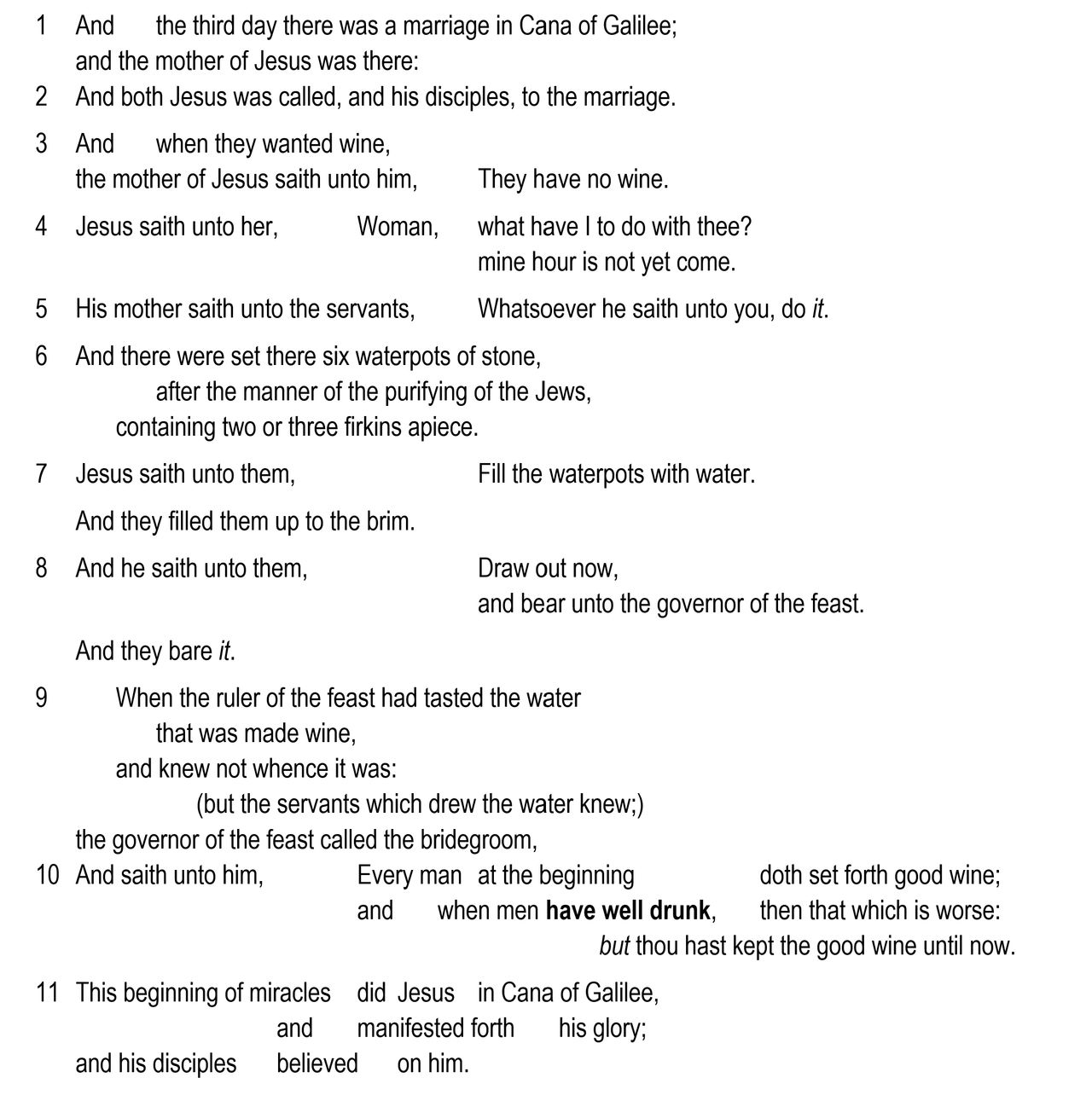
Still further, the provision of “wine” for a large group of attenders would have been, at the very least, a substantial expense to the “bridegroom,” and thus, the grape juice would have been diluted with water. The original sugar content of the grape juice, about 16%, and desirable taste of grapes would have flavored the water, making the diluted juice not only thirst quenching but sweet and enjoyable to the ones drinking. However, if the grape juice had already fermented, then the sugar content would have been eliminated by the fermentation chemical reaction and the taste would have changed as well. Then, while the dilution of unfermented grape juice forms a still enjoyable drink, the dilution of fermented grape juice forms an undesirable drink lacking in both desirable flavor and sweetness, and, before the wedding attenders had “well drunk,” that is, before their thirsts had been satiated, “satisfied,” they would all, especially those who did not normally drink fermented beverages, have been very sensitive to the poor quality and undesirable nature of what they were drinking. Thus, for the “bridegroom” to serve such a distasteful drink, even being rejected by some attenders, would have been a very demeaning affront to all of them.
The Fermentation Chemical Reaction Was Perfectly Designed and Provided by God
Some have taken the position that the fermentation of grape juice could not have been prevented, but such an argument indicates only the ignorance of the fermentation reaction on the part of the one who makes such a claim. Fermentation, with its product, ethyl alcohol, is an organic chemistry chemical reaction designed and imparted to the creation by God Himself. It is not, as characterized by many ignorant individuals, “a product of the devil” or anything of the sort; neither the “devil” nor any other being, or beings, possesses the power or the authority to bring such a process into existence; the Creator Himself, alone, possesses such power and authority, and it was designed by Him to fulfill specific functions and interactions in the creation, imparting its specific chemical characteristics to a wide range of substances of great value to humans . . . but its primary function was not to serve as an inebriating beverage for humans. Certainly, its effects on the human body can minimize the senses of physical suffering in some cases, but this use is an exception and not its primary function.
The Fermentation Chemical Reaction Can Be Prevented From Occurring
The chemical reaction which produces ethyl alcohol from substances containing sugar requires an enzyme, basically a yeast often referred to as zymase, without which the fermentation reaction cannot occur. This yeast is a living organism, and it must be alive to cause the fermentation reaction, but it is “killed” by exposure to heat well below the boiling point of water. Thus, the heating of unfermented grape juice to a temperature which “kills” the zymase prevents fermentation by removing one of the necessary “reactants.” This process has been well known for many centuries, likely since the time of Adam, and is still practiced in the present day, even in homes where individuals make non-fermenting, long-lasting sweet juices, jams, and jellies by simply boiling their grapes and juices. Fermentation, then, is easily prevented, and the juices thus produced can be diluted at future times as needed to produce beverages which retain their sweetness and desirable taste. This would have been the means by which the “bridegroom” of the Cana wedding provided drink for his guests.
The Greek Wording Inspired by the Holy Spirit Must Be the Authority
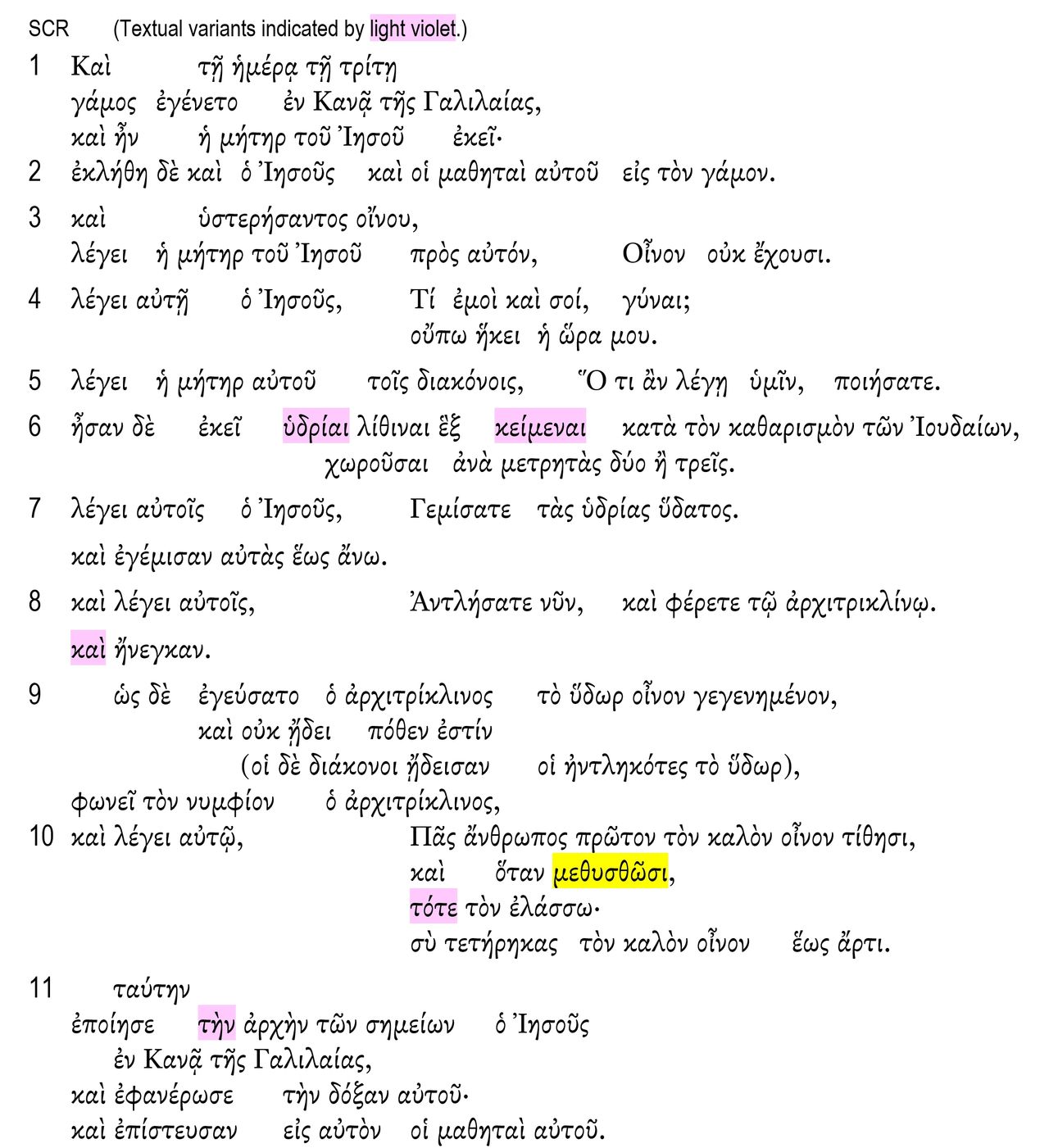
Given below are layouts of the text of John’s record in both English and Greek. These layouts reflect the grammatical structure of the text, with the AV English translation adjusted somewhat to reflect the Greek. The Greek text is the 1894 Textus Receptus edition of Scrivener (SCR), which is essentially the same as the 2005 Majority Text of Robinson and Pierpont (BYZ) and the 2014 Nestle-Aland 28th Critical Text (CT). The CT contains several minor textual variants from SCR; these are indicated in violet and involve conjunctions (3), definite articles (2), and word order (2), and are found in verses 4, 6, 8, 10, and 11. Though these variants are significant, especially with respect to determining changes from the original writing of John, they do not significantly affect the meaning of the text under consideration in this study, nor do they affect the interpretation and meaning of those words.
The Word Meanings in Greek Lexicons Focus Primarily On the State of Drunkenness”
A common interpretation of the Greek verb translated “have well drunk” in verse 10 has created substantial misunderstanding of what actually happened during the wedding at Cana. The form of the verb in the text is the Greek mĕthūsthōsi, an aorist passive subjunctive of the verb mĕthūskō which is, in turn, a causative form of the verb mĕthūō. The primary Greek lexicons give the meanings of mĕthūō as:
Liddell, Scott, Jones, McKenzie: “to be drunken with wine . . . to be drunken or intoxicated with passion, pride, etc. . . . to be drenched, steeped, in any liquid”;
Bauer, Danker, Arndt, Gingrich: “to drink to a point of intoxication, be drunk”;
Thayer: “to be drunken”.
All of these focus on the existence of a person or thing in the state of “drunkenness” resulting, in some measure, after an individual or thing has ingested a substance which, typically, affects the individual or thing by diminishing its mental faculties and abilities, and this substance is usually something containing the ethyl alcohol produced by the fermentation chemical reaction. This explanation of the focus of these lexicon definitions may appear to be “overly complex,” but the ignorance and generalization which characterizes virtually all study of these Greek words, and their actual meaning and significance, has led to inaccurate, superficial, non-specific thinking which precludes and destroys accurate understanding of many references to “drunkenness” in the Scriptures, both the Old and New Testaments . . . including especially the totally erroneous, but almost universally accepted idea, that Noah became “drunk” by drinking fermented, thus alcoholic, grape juice.
The Word Meanings in Some Primary Greek Lexicons Focus More on Causation
Accurate interpretation and understanding of mĕthūō in the Scriptures must, however, also include an accurate understanding of its related causative verb mĕthūskō. The primary Greek lexicons give the meanings of mĕthūskō as:
Liddell, Scott, Jones, McKenzie: “to make drunk, intoxicate . . . give to drink . . . moisten”;
Bauer, Danker, Arndt, Gingrich: “to cause to become intoxicated . . . get drunk, become intoxicated”;
Thayer: “to intoxicate, make drunk”.
All of these include the concept of causation, thus changing the focus from “existing in some measure of a state of drunkenness” to that which causes such a state to come into existence. Certainly, such causation can be considered from the perspective that someone caused or influenced someone else to ingest an affecting substance or that someone caused or influenced himself to ingest an affecting substance.
The Word Meanings in Greek Lexicons Do Not Address Levels and Degrees of “Drunkenness”
Importantly, however, none of these “trusted lexicon definitions” for either mĕthūō or mĕthūskō include any kind of distinction in the level or degree of the state of “drunkenness” or “intoxication.” They incorporate all levels and degrees, even the kinds, of “drunkenness” into their simplified “definitions,” but these simplistic definitions tend to be even more simplified and overgeneralized in the minds of the humans who rely upon these lexicons. The extensive LSJM lexicon appears to be the only primary Greek lexicon which includes a definition, though very brief, on the word methū, “wine,” the very word which is the root upon which the others are built. Though this brief article (given below) does not in itself change the meanings which the lexicons relate to “drunkenness,” it does include referential comparisons to the Sanskrit word mádhu, “sweet, sweet drink, honey,” and the Old English medu, “mead,” and the Slavic med, “honey, etc.”, thus indicating that methū, “wine,” must not be considered alcoholic in all its references.
LSJM 36702 μέθυ±, τό, wine, Hom., only in nom. and acc., πολλὸν. .μέθυ πίνετο Il.9.469; σῖτον καὶ μέθυ ἡδύ Od.4.7.46; ἐκ κριθῶν μ. A. Supp. 953, etc.: gen. μέθυος first in Pl.Epigr.22, Nic.Th.582, Marc.Sid.50; dat. μέθυϊ An.Ox.3.255. (Cf. Skt. mádhu ‘sweet, sweet drink, honey’, OE. medu ‘mead’, Slav. med ( ‘honey’, etc.).
The Word Meanings in Greek Lexicons Do Not Address Reactions Other Than Fermentation
Indeed, because the sugars in fermented substances are usually nonexistent, depending upon the progress of the fermentation chemical reaction, the fermented substances no longer possess the sweetness associated with sugar, and thus, the associations of methū with the words in these other languages indicate that when the Greek word is applied to some kind of juice, including grape, it actually refers more to an unfermented juice than a fermented one. Grape juice, then, would be the basic state of the juice, and fermentation would be a potential chemical change which could occur under certain conditions, but even that change may itself be changed to produce vinegar, that is, a very similar chemical change which produces acetic acid in the juice instead of ethyl alcohol.
The Character of Jesus Christ Precludes His Changing of Water Into Fermented Grape Juice
Certainly, the primary source of intoxicating drink in the Biblical era was fermented juice, especially juice extracted from grapes, and thus, the drinking of fermented grape juice was, potentially, a primary cause of drunkenness. Many interpreters have combined this “potentiality” with the Greek word translated “have well drunk” in the English text. This word is the Greek mĕthūsthōsi, and many have understood it to be indicating that, when Jesus changed the water into wine, the wedding attenders were already “drunken” from drinking fermented grape juice, and thus, the “good wine” that Jesus made was fermented grape juice as well. Using the common definitions found in Greek lexicons, such a conclusion seems reasonable from a so-called “scholarly” perspective, but it is total error, failing to recognize both the skewed nature of the lexicon “definitions” and the fact that it represents Jesus as having directly contributed to human drunkenness . . . that state of excess wherein humans have become so influenced, affected, by having ingested ethyl alcohol that they have lost full, God-designed control of their senses, a dangerous condition that humans in general are to avoid.
Thus, contrary to this erroneous thinking of many who are supposed to be knowledgeable in Biblical matters, Jesus would neither have promoted nor contributed in any way to this sort of drunkenness, especially in this, His first public “miracle,” His first public “sign” revealing His true person and nature. All other revelation of His person and nature contradicts even the least thought that He would do such a thing, but both ignorant and “nonbelieving” individuals have wrongly represented “Greek exegesis” as supporting that conclusion. The real issue is the need of these “false teachers” to truly seek an integral understanding of God’s revelation through intensive analytical study . . . study which accurately correlates all parts of God’s record, thus representing the true person and nature of Jesus Christ.
The Greek and Hebrew Words Translated “Wine” Have Broader Meaning
The Greek word used most commonly to describe grape juice, whether it was fermented or not, was the word ŏinŏs. The word itself was basically a sort of “transliteration” of the OT Hebrew word yăyin, the same word from which the English word “wine” is derived. The Hebrew word, like the Greek, could refer to either fermented or unfermented juice, usually that of the grape. Grape juice, however, is not the only source of juice for the fermentation process. Many fruit and vegetable juices are candidates for fermentation, and thus, grape juice, ŏinŏs, is not the only potential source of intoxicating beverage or “strong drink.”
Accordingly, an ancient Hebrew or Greek might drink yăyin/ŏinŏs and not become “drunken” to any degree as most modern readers conceive “drunkenness,” that is, a drinker of yăyin/ŏinŏs might ingest substantial amounts of this drink without ever losing control of his senses, his mental faculties, in the way typically associated with being “drunken” or “intoxicated.” In the ancient era, as in the modern, “intoxication,” “drunkenness,” could result from the intake of other substances and even from the effects of “non-substance” things as well. As indicated by the less-prominent definitions in lexicons, an individual could be “drunken” with his own “pride,” his “passions,” his “emotions,” etc., and this sort of “drunkenness” could vary in degree, depending upon the nature of the “passion” and the degree to which the individual allowed it to influence him, but this “drunkenness” did not involve in any way the action of having ingested a beverage with alcoholic content or anything that caused physical drunkenness. This broader range of the causes, the degrees, the natures, of “drunkenness” has been well-known from ancient times, but is seldom applied in interpreting this or any other passage where the drinking of grape juice is involved. Clearly, then, those who are satisfied to understand John’s text as indicating “drunkenness,” as modernly conceived, are more “drunken” with their own desires, their own “passions,” their own ignorance, than they are with a search for accuracy and truth.
The Basic Meaning of mĕthūō Is Not Determined by “Specific Usage”
In actuality, the Greek verb mĕthūō found in verse 10 does not, in and of itself, carry the idea of “drunkenness resulting from drinking wine”; nor does it carry even the idea of “drunkenness” from any source. Such narrowed and biased interpretations are the result of having trusted “lexicons” which were not worthy of trust. Even modern linguistic study teaches that the basic, the more general, meaning of a word is not derived from its more specific meanings; the basic, more general meaning is that from which the specific uses are derived, not the reverse order. Thus, even a simple analysis of the lexical “definitions” given above yields a more accurate concept of mĕthūō and its related forms, and yet, rare are those who “preach and teach” the Scripture who ever even consider seeking the more general meaning and the accurate understanding which it brings to light. In reality, any “presumption” that such seeking is unnecessary is, at the very least, a manifestation of chosen ignorance, and thus, an indication of a humanistic disrespect for God’s revealed design and His authority over all human existence.
The Basic Meaning of mĕthūō Is “Saturation, Satiation, Influence,” Not Drunkenness
The more general definition of mĕthūō, just as given in the LSJM lexical article, actually indicates that the word refers to being “drenched, steeped, in any liquid,” and, in its causative form mĕthūskō, to “moistening” something. Obviously, then, these concepts in the physical realm are themselves derived from the still more basic concept called “saturation,” “satiation” in the physiological sense, that is, where some thing is saturated with some type of liquid, but “saturation” also occurs in the nonphysical mental realm, as when mĕthūō occurs in a context of affected emotions. In this mental realm, this basic concept signifies the “saturation,” “satiation,” of human “feelings,” “emotions,” “passions,” by something external which is influencing those “feelings” to exist, and to exist to some degree. Thus, just as the amount of water influences the degree of “saturation” of an object, and the amount of wine, whether fermented or not, influences the degree of “saturation,” “satiation,” of a human’s thirst for that drink, the “amount” and nature of external conditions influence the degree and nature of human emotional responses. All of this, then, dictates that the basic concept of mĕthūō is “influence,” not “drunkenness,” and, because “influence” varies by type and degree, all uses of mĕthūō and its associated terms must take into account as well the varying levels and degrees of “influence” by whatever is affecting the thing in view, whether a person or anything else in the creation. Thus, even true “drunkenness,” “intoxication,” may vary widely from minimal to excessive . . . a variation recognized by modern society in the legal terms used to define degrees of “drunkenness.
The Greek word mĕthūō and its different forms had long been used when John wrote, having been used not only in the NT era, but also in the OT era. Perhaps one of the easiest bridges between the NT Greek and the OT Hebrew is the Septuagint (LXX), the Greek translation of the Hebrew OT. This translation was done between about 250 and 150 BC, and it provides evidence of the relationships between the Greek and Hebrew languages at that time. Many have wrongly trusted the LXX more than the Hebrew Scriptures which they translated, and this translation is even dangerous theologically, but it does provide a connection between the two languages that is nearly impossible otherwise.
The Septuagint translators regularly used mĕthūō and its related forms, and their applications demonstrate that they understood its meaning to be much broader than the lexical articles relating it to some kind of “drunkenness.” In truth, the “drunkenness” aspect is not foundational in the word meaning, but rather, is one application of the foundational meaning. Accordingly, those who represent mĕthūō as necessarily involving “drunkenness” to some degree, in the typical modern concept, are demonstrating, at the best, their humanistic bias or, at the least, their ignorance and lack of understanding of the word’s basic significance and how that significance was transferred to describe “drunkenness” and “intoxication.” In reality, mĕthūō signifies that the person or thing has been “affected, influenced,” perhaps even to the degree of “saturation, satiation” with a substance he is taking into his body, and, if taken in excess, or if it contains ethyl alcohol or similar “intoxicants,” then some degree of “drunkenness,” in the modern concept, is the result.