
by Kenneth F. Sheets
Ancient men and women who “believed,” who “caused firmness to,” Yihyeh, the LORD, the God Who Exists, knew that His revelation was unquestionable fact, totally unaffected in its validity and authority by human acceptance or rejection of its statements. From Adam the first, these Godly individuals knew that the Creator’s expression of Himself and His design was not subject in any way to human recognition or perception of its nature and significance. Yihyeh had brought into existence all that exists, and the entirety of creation existed within His infinite person. Everything, whether it acknowledged its actual relationship to Him or not, was subject to His design criteria and accountable to Him for its conformity to them. Every aspect and criterion of His design, having its origin in His perfect eternal person before He began creating, perfectly defined and described every function and interaction of everything in the creation. This made Him and His design the foundation upon which everything rested.
Faithful ancient men and women knew these things; their every thought and action was completely infused with the perspective that He, Yihyeh, is the foundation upon which every aspect of life and existence rests, and thus, they knew that life must always be evaluated and correlated to the criteria He has revealed of Himself and His design. The truly faithful, then, thought foundationally, that is, they practiced foundational thinking, thinking in which every thought is evaluated in the light of the fact that GOD, the Creator, is the foundation of all that exists. The writers of Scripture were “holy men of God” who received and wrote the Creator’s revelation, and the entirety of their writings, both the OT and NT Scriptures, are established on this foundational perspective and its application. This fact makes foundational thinking essential for accurate understanding of both the OT and NT Scriptures, and interpreters of Scripture who do not properly apply foundational thinking in their analyses will always be somewhat mistaken in their representation of the content.
The words of David in the first verses of Psalm 138 provide an excellent example of this thinking and its application.
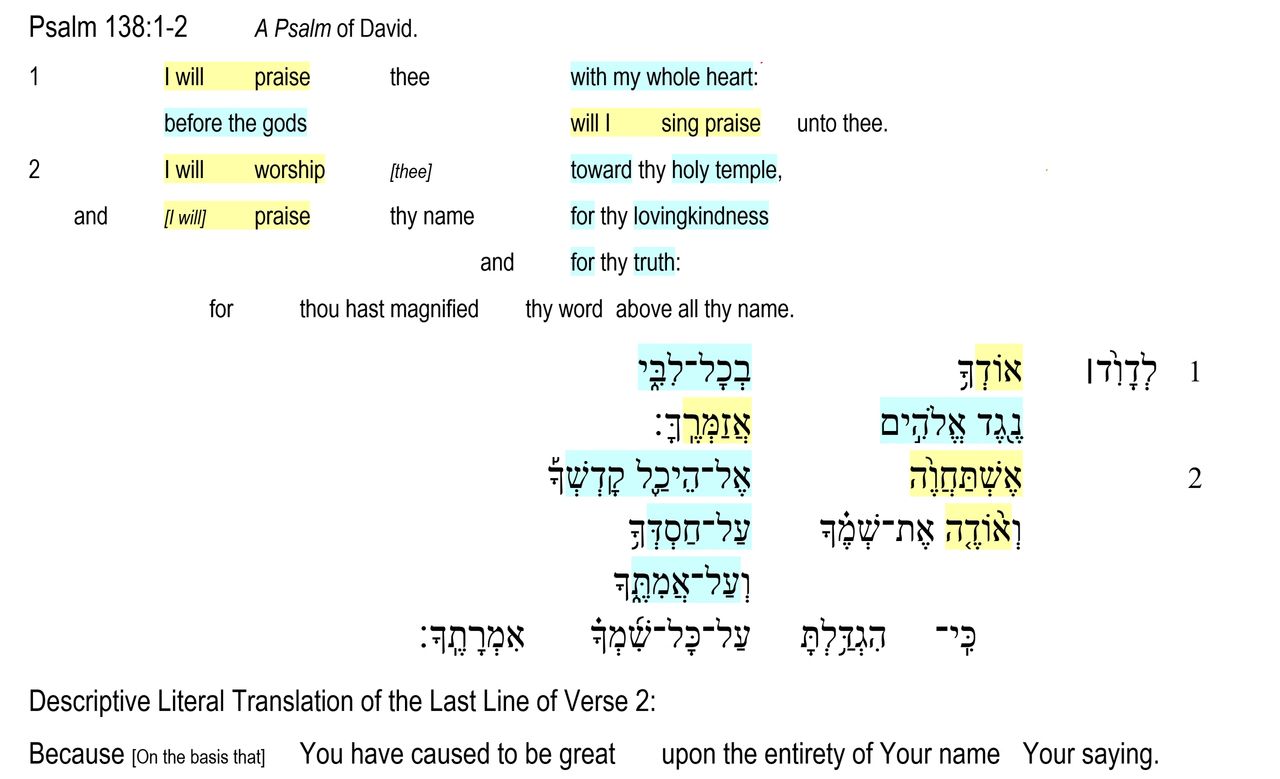
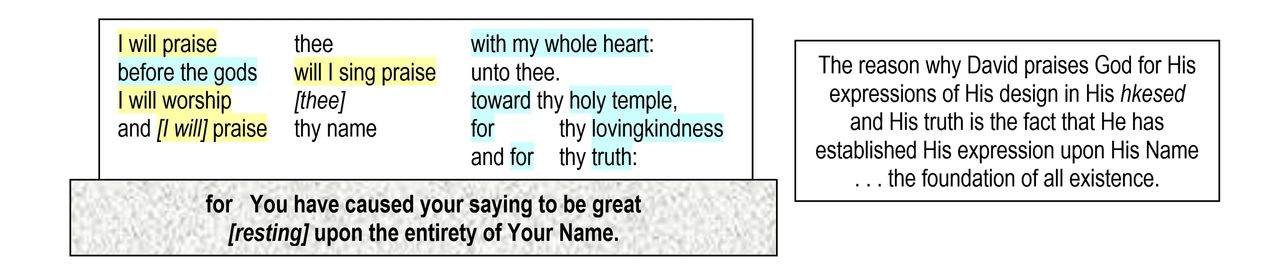
An accurate understanding of the final clause of verse 2 is essential to proper interpretation of this passage and God’s intended understanding of the relationship between His Name and His revelation. In the AV translation, this clause begins with the conjunction “for,” a conjunction translated from the Hebrew conjunction kiy. This word is a subordinating conjunction and normally functions to introduce a statement giving the “ground or reason,” the “cause,” the “basis,” for the action or state of the main verb to which it is subordinate. Though this may seem to be a complex and confusing explanation of “for,” it is extremely important, because it describes what David intended to communicate regarding the relationship between his praise, as recorded in his first four lines, and his statement regarding the LORD’s “magnification of His word.” David’s praise was “based upon” the relationship which the LORD had established between His name and His revelation of Himself.
Unlike most modern individuals, David knew the difference between a descriptive title, that is, a noun used to refer to a person or thing, and an actual name. Descriptive titles refer primarily to a certain characteristic of a person or thing, just as the words human, man, husband, father, son, citizen, employee, member, driver, etc., can all be applied to a single individual, but no one of them, and no group them, encompasses the entirety of the being of the individual. Only that person’s name encompasses all the descriptive titles which may be applied. David knew this, recognizing that the descriptive titles God, Lord, Almighty, Creator, Savior, Healer, etc., do not encompass His Being. Only His Name, the very name He applied to Himself, encompassed the entirety of His person, including within it every aspect of every descriptive title which accurately refers to Him.
David knew that the Name Yihyeh encompassed the entirety of the person and nature of God, and he also knew that the entirety of creation rested upon the entirety of its Creator. David knew that Yihyeh was the Creator of all that existed, the one who was not only the Owner and Absolute Authority over everything that existed, but also the Designer who had established every function and interaction of everything that existed, and the Definer of all true meaning and significance of everything that existed, and the Sustainer who maintained it all in existence. Indeed, Yihyeh was the origin and sustainer of everything; He was the God of the creation, and nothing nor all of creation could exceed His Being, His power, His authority, because the entirety of creation was “living and moving and existing within Him.
David understood what so many in the modern era fail to acknowledge: the God whose name is Yihyeh, LORD, is the foundation upon which all of creation rests and from which all of creation derives its incomprehensible value. For David, the identity relationship between who God is and what God says and does was of great importance, and he made this clear by equating God’s “holy temple” to His “loving kindness” (His hkesed) and His “truth.” Knowing that God’s “loving kindness” and His “truth” are not two different things, David used his ancient Hebrew synonymous parallelism to present “loving kindness” and “truth” as two different ways of looking at one and the same thing, God’s expressions of Himself and His design. David knew that the God Who Exists cannot be contained in any physical dwelling of any kind or size; He, the Creator of all that exists, dwells within every aspect of every thing that He says and does. Thus, this Godly man had called upon the LORD, and the LORD had answered, and the surety and validity of that answer was determined by the foundation upon which the answer rested, and that foundation was the entirety of the very person and nature of the LORD God Himself. David understood this and made it the foundation of his life.
David’s understanding of the identity relationship between the Name of God and His person also established within him a life-governing recognition of the identity relationship between the person of God and His every expression, not the least of which were His words. The man expressed this recognition in the second verse of his psalm. Though many have misinterpreted the wording of the English translation, erroneously thinking the words to say that God had made His word more important, more exalted, than His name, a literal translation makes the truth unquestionably clear. David expressed the “foundation” upon which his praise rested, literally: “because You have caused to be great upon the entirety of Your name Your saying,” or stated more understandably in English, “because you have caused your saying to be great upon the entirety of your name.”
David was actually applying the “foundational thinking” which governed the thinking of all faithful ancient Hebrews, that is, that everything rests upon some foundation. They saw everything as based upon, as founded upon, as resting upon, a foundation of some sort. In their eyes, nothing simply hangs “in space,” “in thin air,” even the creation! Only man in the limitations of his human mind can conceive of things in this manner, but when he looks through the eyes of God, with the mind of Christ, seeing as he was designed to see, then the foundation, that upon which everything rests, is clear and distinct. This faithful man, sees God’s revelation of Himself and His design for all that exists as the ultimate foundation upon which everything rests, and he sees as well that God’s revelation, His expression of Himself, rests upon the entirety of His Being, an entirety encompassed only in one word and that word is His Name, Yihyeh, the LORD.
In the mind of the faithful ancient Hebrew, anything not resting upon this foundation of God and His design was actually resting on nothing, that is, it possessed no real foundation, no “substance,” whether in the physical realm or in the moral or spiritual realm. The NT writer of the book Hebrews used this same mode of expression when he wrote of faith as the foundation of the believer’s hope, that is, as that which “stands under” his expectation. Jesus Himself also used this same mode of expression when He contrasted the two possible foundations of life as rock or sand. Though the “houses” of life seemed to have been built identically, they stood or fell based upon the validity, the true trustworthiness, of their foundations. Occurring throughout Scripture, this same “foundational thinking” is obvious in the concept that the Lord Jesus Christ is the only foundation, the chief cornerstone, of all valid belief, and His assembly of all who have believed in Him rests upon the foundation of those who were sent by God and proclaimed His message in all ages.
Without question, the faithful ancient Hebrew saw everything as resting upon that which determined its validity. If the foundation was firm and trustworthy, if the foundation was sure, then that which rested upon it was firm and trustworthy as well, but if the foundation was not firm and worthy of trust, then that which rested upon it was in like manner unfirm and unworthy of trust. In similar fashion, the ancient Hebrew determined the credibility of a human witness based upon the character of that witness, a practice continuing around the world in the present day. David knew this and, under the influence of the Spirit of God, he “rested” the LORD’s word, literally, His “saying,” upon the entirety of His name. David knew that the entire Being of the LORD, signified by His Name, was the absolute firmness upon which all that He says is established, and, because no difference in nature and quality can exist between the Person of God and any expression of God, His every expression, whether as Father, Son, or Holy Spirit, whether in word or in action, is inexorably, inescapably, completely, firm and unchangeable. David knew that the word of God is the Word of GOD!