
by Kenneth Sheets
The Crucial Nature of Beginning at the Beginning of God’s Revelation
Anyone who seeks to represent God in any way to other people, but who himself does not know God as He has actually revealed Himself, whether that person is a man or a woman or old or young, then that person, in whatever aspect he lacks accurate knowledge, will be wrong in his representation of the Creator and His design.
This is not to say that no one is to seek to teach or proclaim or represent God until he knows everything that God has revealed about Himself and His design, but it is to say that every person who preaches or teaches or represents God in any way must be actively, continually, completely seeking to learn all that the Creator has revealed about Himself in whatever way He has chosen to express that revelation, a revelation that includes His testimony of Himself not only in His written record but also in His creation and in the heart of every human being.
This means that every person who represents God in any way must first recognize his, or her, own ignorance and, then, commit himself to gaining the proper knowledge for reducing, or eliminating, every aspect of ignorance or misunderstanding of God and His design.
The primary, and perhaps the most misunderstood, but foundational, text of God’s written expression of Himself is the content of Genesis 1:1-5, especially the first two verses wherein He described the origin of all that exists and the condition in which it existed immediately after He brought it, “heaven” and “earth,” into existence. Certainly, many have thought, and taught, the total error that a time gap of indefinite length had occurred between the time of verse 1 and that of verse 2, and many more have been destructively influenced by such thinking and teaching. This error, however, is not the only destructive misunderstanding of these first five verses, but the sad truth is that rare is the individual, regardless of his or her supposed degree of learning in the matter, who understands what God actually communicated in these words, and rarer still is the individual who will actually seek the accurate understanding that is absolutely essential for perceiving the person and nature of the Creator, and His design for all that exists.
The ancient Hebrew text of the Scriptures did not have verse numberings until about 1200 years after Jesus Christ lived, and though these numberings are helpful for locating various texts, the numberings, because they are the product of finite human minds, have also introduced substantial misunderstandings into various texts. This is especially, and very destructively, obvious in the numberings of the verses of Genesis 1:1-5, and more especially in verses 1 and 2.
In the Massoretic Text, vowel pointings in addition to the verse numberings have also been added to ensure preservation of proper vocalization and understanding of the text, and, in this text, the difference is clear between
– the waw-conjunctives (“and”) that coordinate the four clauses of verses 1-2,
– and the waw-consecutives (“then”) that introduce the subsequent content of verses 3ff.
This same clarity, however, has always existed even in the ancient unpointed texts when those texts were evaluated as Adam wrote them. Adam began the entirety of God’s written record not only with a prepositional phrase (“in the beginning”) to manifest that his words were indeed the primordial words of the Creator’s written revelation, he also began with a text that is not introduced by any sort of conjunction. Adam’s first clause (“God created”) thus formed the grammatical basis for all other writing of God’s record, that is, every other text, every other clause, every other word, would be “subsequent” to that first clause: “God created.”
The ancient Hebrews who preserved Adam’s text and the additions of other “holy men of God” recognized that Adam’s grammatical construction of Genesis 1:1-2 expressed distinctly the difference between the “connective” nature of the waw-conjunctives of these verses in contrast to the “sequential” nature of the waw-consecutives in verse 3 and following. One primary means of discerning this difference is the identification of the grammatical subjects of the first five clauses, as follows:

Thus, all three clauses of verse 2 comprise a description of the condition in which “the earth existed” immediately after God brought it into existence with “the dimensionality.”
This conclusion regarding the nature of the waws in verses 1-2 is made absolutely firm by all subsequent use of waws attached to imperfect aspect verbs and following perfect aspect verbs which introduce a section of integrally related content. In this case, Adam was describing a condition which existed prior to the time when God created him on day six, and thus, he introduced this entire chapter of integrally related content
– by using a perfect aspect (completed action) verb in verse 1,
– and following in verse 2 with three additional perfect aspect (completed action) verbs describing the basic matter particles,
– and then continued in verse 3 with an imperfect aspect (incomplete action) verb introduced by a waw-consecutive which changes the aspect to perfect and indicates continuation of the perfect aspect which began in verse 1.
Thus, whether one evaluates the relationship of verse 2 to verse 1 by its original grammatical subjects or by the later indications of waw-conjunctives and waw-consecutives, verse 2 is inseparably bound to verse 1, and not even the least “gap” of time existed between the two.
Genesis 1:1 – The Foundational Verse of the Entirety of God’s Revelation
God, in His perfect knowledge of His human creatures, knew that, misusing the authority He had delegated to them, they would turn from Him and His design, and establish their own ideas regarding the criteria that were to govern them and the world around them. He knew that they would develop their own concepts, their own ideas, regarding not only how they themselves came into existence but also how the entirety of the creation came into existence. He knew that they would seek their own designs for how they were to live and interact with other humans and the world around them. He knew that they would influence one another to perceive Him and His design, if they recognized His existence at all, according to their own desires and limited abilities. He knew all this, but He also knew exactly how He had constructed them and their abilities, and thus, He knew their need of an absolutely perfect and unquestionably authoritative written record of the most important, foundational, aspect of who and what they existed. His human creatures needed to know unquestionably not only that He existed the creator of all that exists but also that He is the absolute authority over all that exists. They needed an unequivocal, foundational statement that represented His relationship to all that existed . . . and He gave that statement in the first words of His written record: “In the beginning God created the heaven and the earth.”
This was the most important point of all revelation, because it not only established Him as owner of all that exists but also the absolute authority of His design and its every individual criterion. This first of all verses of Scripture establishes Him, God, as the transcendent Creator, Owner, Designer, Definer, Determiner, Sustainer, and Absolute Authority of all that exists, and thus, the only acceptable and truly successful course of human life and interaction is that which He has designed and revealed in His written revelation. This record was never intended to be a set of criteria, a set of “laws,” that were to be applied to make a person acceptable to Him; this record was to reveal His perfect person and nature, and the perfection of existence that everything in the creation would experience when it operated His creation according to His perfect design. His written record was designed to be accurately understood from its first verse and throughout its words to reveal Him as He actually exists, thus manifesting His perfect heart and drawing all humans into seeking to walk with Him in every aspect of their existence . . . and it all began with, and is established upon, an accurate concept of Genesis 1:1.
AntiGod created beings and humans, however, have recognized the foundational importance of Genesis 1:1, and thus, they have given themselves and their lives to undermining its truth and significance. Having recognized the indisputable testimony of the creation regarding its perfectly created nature, these “God-haters,” many of whom falsely claim to be “God-lovers,” have devised, and are continuing to develop, a whole range of “interpretations” and “reinterpretations” of the evidences that God has built into His creation, and that prove its perfectly created nature. Many of the individuals promoting these “interpretations” and “reinterpretations” openly manifest their hate of the Creator and any concept related to His personal existence, and these individuals are very dangerous in their influence, but, even more dangerous, are those persons who profess a “true belief’ in the Creator and His revelation of Himself while adhering, at the same time, to erroneous and misleading concepts of Genesis 1:1 and its associated texts of Scripture.
Many of these “believers,” having chosen to be or remain ignorant in the matter, present the created nature of all that exists in a superficial, even nonsensical and often totally erroneous, manner, thus misleading not only themselves but every other human they touch in regard to the true person and nature of the Creator. Though many of these “believers” claim that they are seeking to influence the world around them to see and respond properly to God and His design, their ignorance of Genesis 1:1 and its associated verses actually influences others to develop a wrong view of the Creator and His creation. This misleading testimony of God, error that is rooted in a wrong “understanding” of the first verses of the Scriptures, cannot accurately represent Him . . . and the antiGod world has won the battle for the minds of most “believers,” and they resist learning what God actually intended them to know and understand when He began His written revelation with the words: “In the beginning God created the heaven and the earth.” Those who truly “believe God” must then turn from their ignorance and seek the actual meaning and significance of God’s own words in His first verse of Scripture.
Accurate Understanding of Genesis Requires Accurate Definitions of Its Words
Communications take many different forms. They may be composed using words, symbols, gestures, sounds, or any means of expression wherein the senses are able to distinguish variation in the medium, or combination of mediums, used to form a particular communication. The expressions may be intentional, where the originator purposes to express something to a receiver, or they may be unintentional, where the originator does not purpose to express anything in particular to the receiver. Whether intentional or not, whenever distinguishable information arrives at the senses of a receiver, some sort of communication occurs. In this way, the content of the communication becomes knowledge to the mind of the receiver, and the mind immediately stores, evaluates, and correlates it with respect to all other knowledge it has previously received. The mind performs this activity regardless of the form or manner by which the information comes to it.
In this manner, the mind reaches conclusions regarding the information coming to it and determines an appropriate response. This happens whether the receiver is a plant responding to sunlight, an insect responding to perceived threat, an animal responding to the smell of food, or a human responding to a written message, and though plants and insects and animals were not created with the same “mind” as that in humans, all respond to the system of stimuli for which they were created. They read the conditions around them, interpret those conditions, and respond accordingly. Humans take this one step further; they perform the same “mental” actions, but they do so to a degree and from a perspective corresponding to the nature and sense of the authority built into them by the Creator.
Humans apply their intellect and their inherent sense of authority to evaluate not only the “surface information” of a communication but also the “quality” of that information and the “desirability” of what it infers to them personally. This evaluation process is, therefore, biased by the presuppositions existing in the mind of the individual with the result that new information or information which does not conform to the person’s presuppositions may be totally rejected regardless of its objective validity. Truth may be interpreted as “untruth,” and rejected, while “untruth” may be interpreted as truth, and accepted. Having long ago overstepped the bounds of the authority delegated to them by the Creator, humans think that they possess the ability to decide for themselves the nature of truth. They consider themselves to possess the authority to decide the meaning and significance of all the various parts of a communication, so that “the interpretation” fits their own purposes and presuppositions. God, however, never delegated this level of ability or authority to humans, but, knowing His created beings, He gave them His own design criteria to provide bounds and direction for their thinking. He did not create humans to do whatever they possessed the opportunity and ability to do; He created them to do what He designed them to do, a design that included using their minds properly, accurately, to interpret communications.
In the interpretation of a communication of any form, the application of wrong definitions and concepts to the expressions which comprise that communication can, and often does, lead to serious misinterpretation of the author’s intended meaning. Though an interpreter may not think himself to comprehend inaccurately, in actuality, the degree of his misunderstanding varies in direct relationship to the difference between his definitions, his perspectives, and those of the author. In the modern era, and in total contrast to common sense, some teach that the receiver or reader of a communication is the one who decides the meaning of the words and the interpretation of the content, but this concept is complete error and borders on total absurdity. Certainly, the author must consider the minds of those who will receive his communication, but he, the author, is the determiner of the intended interpretation. Thus, to minimize the potential for misunderstanding, the interpreter must seek to understand the communication coming to him according to the criteria applied by the author, that is, according to the definitions, the concepts, the connotations, in the mind of the author when he formed the communication. The acceptance and application of “definitions” which do not actually reflect the thinking of the author is to accept as well the likelihood of error in one’s “interpretation,” and when the communication is God’s perfect revelation of Himself and His design for all that He brought into existence, interpretation error can be destructive beyond comprehension.
God foreknew that, through the years of time, His human creatures would need His written revelation to be preserved as He had given it, and, at the same time, they would need that revelation to be translated into many different languages. This was indeed His design, but He never intended any translation to replace His actual words or to become the authority over those words. He foreknew that humans with finite minds and limited understanding would produce translations of His written revelation, and He foreknew as well that human translators would produce translations which varied in quality and accuracy with respect to what He had actually revealed. Some translators would seek to convey the actual words and meanings of His revelation into the receptor language as accurately as possible, but others would seek to word their translations in ways that conveyed their own philosophies, their own concepts, of the Creator’s person and nature, thus using their translations to “make” Him fit their chosen “beliefs.” He also foreknew that humans, whether they used His original language texts or even an excellent translation of those texts, would do just as His first man, Adam, had done; they would misinterpret many of His intended meanings and make their erroneous interpretations to be the authority over what His revelation actually said. Then, through the years of time, the translations, with their erroneous interpretations, would become independent authorities for humans claiming to know Him and to walk accurately with Him.
Some translations, especially those which most accurately represented His original expressions in His chosen Hebrew and Greek languages, would manifest the high degree of their accuracy by giving truly seeking humans sufficient knowledge to convince them to be reconciled to Him through His Son and to conduct their lives in a manner close to His design, but humans would move still farther from His original truth. They needed an absolute expression of all that He had revealed in His written record; they needed His original records in His original languages, and they needed knowledge of those original languages. In His perfect foreknowledge, God provided His human creatures with all that they needed as His absolute, original expressions of Himself through His holy men, and thus, humans would always be able to compare and evaluate their understanding by consulting the actual words of God in His chosen original languages. In this manner, none of His original meaning and significance would be lost over the years of time; humans possessed an absolute authority.
Misinterpretation of Scripture Begins Where God Began His Record in Genesis 1:1
Moses Became a “Preacher of Righteousness” and Preserver of God’s Genesis Record
Misinterpretation of Scripture often begins where God began His written record, that is, in the words of Genesis 1. Adam, God’s first human, began the record of God, and he had passed that record, and the responsibility for preserving and adding to it as God intended, to Seth, and Seth to Enos, and then to all the other “preachers of righteousness” until Noah, the eighth “preacher of righteousness,” carried it through the Flood and through the 350 years which he lived after the Flood before passing it to Shem, and Shem to Eber, from whom the language of the record would be called “Eberite,” Hebrew. After Eber died in 1984 BC, the record passed to another Godly man, perhaps Isaac, and then to others who maintained it during the time the Israelites were in Egypt, eventually coming to Moses in 1446 BC as he prepared the Israelites for leaving Egypt. Thus, when Moses received the record, the oldest parts were already over 2,600 years old, and, likely, its caretakers, the “preachers of righteousness,” with full understanding of the nature and significance of the document they were preserving and to which they were adding, had, with extreme care, reinscribed its content as needed through the more than two millennia since Adam wrote its first words.
Moses Knew That the God Who Spoke from the Bush Was the God of the Genesis Record
Moses, then, as the “preacher of righteousness” for his time, received both the record and the responsibility for preserving and continuing it. Already knowing the Hebrew language of his Israelite brethren, he reinscribed the record for himself in the same Adamite alphabetic writing in which it had originated. Having interacted with his Hebrew people before fleeing from Egypt to Midian, this Godly man had already learned not only the Hebrew language but also that the Hebrews were preserving the Creator’s record of human history as He, the Creator, was directing them. Though unGodly humans promoted their own “humanized” versions of that same history, the nature and content of the Hebrew record demonstrated its own validity and accuracy. This was the record of God, and, during his forty years in Egypt, Moses could not have escaped being exposed to its content, content then consisting of the entire book of Genesis and the first chapter of Exodus. All of this would have influenced him regarding the existence of the God whose name was Ĕhyĕh (“I exist, I am existing”), and thus, when he saw the burning bush which was not consumed by the fire, he immediately recognized that some mighty being was presenting to him this “great sight.” He had learned from Genesis the existence of powerful antiGod created beings, and he knew that these antiGod created beings were the “powers” behind the “gods” of Egypt, but those “gods” did not possess the ability to “burn a bush” without consuming it; only the true God, the God of the Hebrew Scriptures, possessed such ability. Accordingly, when Moses saw the bush, he recognized that it must be a manifestation of the God “I exist,” perceiving as well that the God “I exist” had prepared this sight to draw him into a situation where He, the Creator, could communicate with him.
Moses Accepted the Responsibility for Preserving and Continuing the Record of God
Moses knew that the God who spoke to him from the bush was the God Who Exists, the God who had brought into existence all that existed . . . just as the Hebrew Scriptures revealed Him. Only one course of action could be right in such a circumstance: He, despite his human weaknesses, must give himself to doing that which the God Who Exists was instructing him to do. Thus, after having returned to Egypt and accepting God’s design for him to lead and deliver the Israelites, he had inherited as well the responsibility to preserve and continue God’s record, and no better human way existed for him to become intensively familiar with its content than to reinscribe it for himself. Moses did not need “to learn” the Hebrew language; it was the language of his family, and he had learned it just as he had learned multiple other languages. This was the language of the record which he inherited, and that record indicated that the Creator had built this language into His first two humans. Moses knew that the record he inherited had originated with Adam over 2,600 years before, and he, Moses, was now accountable to ensure that it continued unaffected, unaltered, by any of the beings of creation. This record was not some humanly contrived “history” of humanity; it was the séphĕr, the record, of God, and the Creator would hold accountable any who marred or misrepresented its content in any way.
Moses Knew That the Record of God Had Begun With Adam, God’s First Human
Moses knew that God had never intended His record to be a “history of the world.” It was not a “history”; it was a “revelation,” the Creator’s own revelation of the origin and nature of all that existed, and thus, it was the Creator’s own revelation of His relationship to all that existed and the relationship of all that existed to Him. Many peoples and nations, including the Egyptians, had written their own “histories” and “legends” of the origins of the world and their own people, but, because these peoples and nations had either rejected or were ignorant of God’s actual record from the hand of Adam, their “histories” consisted of nothing more than the inaccurate “stories” passed to them from previous generations. Certainly, they encountered on every side the unmistakable evidences of the măbbūl, that flood which had covered the entire Earth and reshaped the entire surface of the planet, providing inescapable evidences of its world-wide extent and confirming the fact that it had destroyed all but a few humans and animals. However, as humans dispersed upon the face of the Earth, many lacked the written record of Noah, the eighth “proclaimer of righteousness,” or they had rejected that record, and they devised their own “histories,” their own “ideas,” for explaining the evidence all around them. Then, through the years, they made God’s record of the Flood and all prior history to be nothing more than fanciful, unauthoritative “legends of the past,” legends which their “story-tellers” could embellish and enhance to suit their own purposes.
Having been reared as an Egyptian, Moses knew the Egyptian versions of these things, and, in his “educated” mind, he knew their fanciful nature, but Egyptian “culture” was not the limit of his knowledge. He had learned from the Hebrew Scriptures, God’s record, the true origin of all that existed, and he recognized the absolute firmness of that record. The record of God could be trusted absolutely, and he, Moses, would ensure that, while he was personally responsible for preserving and adding to that record, it would remain the absolutely firm foundation for knowing the Creator. Moses, then, began adding to the record of God by documenting his own origin and the experiences that had brought him into becoming God’s choice for leading the Israelites out of Egypt, and, because all of this was revelatory of the person and nature of the Creator, the man continued the record with an account of the journey of the Israelites into their new land.
When Moses led the Israelites out of Egypt in 1446 BC, this Godly man knew that the record he inherited had begun with Adam and had passed through multiple “proclaimers of righteousness” before coming to him, and he would never have represented the record, which had begun some 2700 years before he received it, as having originated with him. The words of Genesis were not his; they were the words of holy men who had lived long before him. The words of Genesis had existed long before he, Moses, had even been born. Holy men had written, and they had all written in the language which, since `Ébĕr, had come to be called “Hebrew,” but Genesis had ended with the Israelites living in Egypt at the pleasure of Pharaoh. The first four chapters of the Genesis part of God’s record had been recorded by Adam himself; they were the words of the Creator’s first human. Adam, that first male human being, that first man to whom the Creator had delegated authority over the creation, was the original author of those first words. He, Adam, the first of only two humans who walked in the garden of God, had recorded not only the Creator’s revelation of the entirety of the creation, but also the Creator’s record of how he and his woman, the first humans, had come into existence on day six.
Adam Was the First Writer of the Record of God
God Designed and Built Into Adam Perfect and Complete Communication Abilities
God created His first two humans complete, that is, He built into the man and the woman every ability they would need to completely fulfill every function of their existence, including the need to prepare written documents for communicating with “family” as that family spread over the earth. The language which God built into Adam was, then, the best and most efficient possible: alphabetic writing. Accordingly, language did not evolve from oral-only expression into the use of pictograms, ideograms, and syllabograms, and, finally, into alphabetic writing. Rather, the alphabetic language built into Adam continued as the sole language of all humans until the Babel rebellion when the Creator constructed some seventy or more nonalphabetic, oral-only languages to force the dispersion of humans upon the earth. God’s formation of these new languages was a singular linguistic event in the history of the world, and it is called “Babel,” because the Hebrew verb from which the word “babel” was derived is the verb bälăl, “to mix, mingle” and which is translated in the text as “confound.” The word “babel,” then, describes the fact that God formed His new nonalphabetic languages by “mixing” the linguistic components of His original alphabetic “Adamite” language. Prior to Babel, no language “evolution” existed; certainly, some minor speech impediments and pronunciation variants may have existed, but these did not form new languages. After Babel, however, the nonalphabetic Babel languages “evolved” as those who spoke them developed their individual written forms and as these speakers interacted with individuals who continued to speak God’s original language . . . an “evolutionary” process still occurring. Adamite, later called Hebrew, has never evolved, and it manifests its original, non-evolved nature in every alphabetic language which currently exists on earth.
Adam Provided God’s Absolutely Accurate Record of the Origins of All That Exists
Adam was the perfectly designed and constructed creation of God, and he possessed full communication abilities, both oral and written, abilities built into him by God to prepare an unquestionable record which would be needed by his descendants through all the years of time. His descendants, especially those influenced by the erroneous perspectives of Cain, had spread from direct contact with him and his true expressions of God’s person and nature, and he, Adam, had been designed to provide them with the true written record of the Creator’s person and His relationship to all that existed. The words, then, of Genesis 1, and of chapters 2 through 4, are Adam’s written record, as he was borne along by the Spirit of God to prepare this record. He, Adam, was providing for all later humans the information which they would need to give them an accurate foundational understanding of how they, and the world in which they lived, had come into existence. Adam provided God’s revelation of:
– the origin of the entirety of the creation and the first humans (Adam’s first chapter),
– the special nature of the origin of humans (Adam’s second chapter),
– the origin of the current violational state of the world (Adam’s third chapter),
– and the destructive effects of violation (Adam’s fourth chapter).
The words of Genesis 1 are, then, the words of Adam, not of Moses, and they bear the meaning and significance which he, Adam, invested in them in those earliest years of human existence. All later human minds would thus be required to know and apply his, Adam’s, definitions and connotations to his words if they were to accurately understand the true nature of these origins as God revealed them in these first four chapters of the Scriptures, but humans, even “believers,” have not conformed their reading of Adam’s words to his definitions and connotations, and thus, the foundational words of Adam, and God, are misunderstood and misrepresented . . . and, as the Creator would say through Hosea some 3,300 years later, the people of God “are destroyed for lack of knowledge,” but few, if any, seem to care.
Human Misunderstanding of Adam’s Words Increased After the Babel Rebellion
The practice of determining the meaning and significance of ancient words by applying a modern perspective is an obvious inconsistency, but many who study the 6,000-year-old words of Genesis 1 do that very thing. Applying their modern concepts to the ancient words, they seek to understand the writings of the first man who ever existed, and when confusion or lack of clarity results, instead of seeing the error of their practice, they find fault with that which was written. The fault, however, is not in the writer, but in those who apply wrong perspectives to the writing; they seek “what it means to them,” “what it says to them,” instead of the actual meaning God invested in those writings when He moved that first man to write them. Adam saw clearly and understood what God revealed to him, and he recorded that revelation using the linguistic abilities directly imparted to him by the Creator. Adam’s words were the first of all time and his linguistic abilities would become the primary means of human communication for some 1800 years, until God “mixed” (bälăl) the components of His original language to form and impart the seventy, or so, other languages at Babel. Until Babel, Adam’s record was perfectly understood and contained no seeming inconsistencies, but afterward, the humans who now spoke other non-alphabetic languages, and persons influenced by those “other language” speakers, began developing “misunderstandings” of Adam’s words, and this human lack of understanding opened the way for humans to misunderstand and misrepresent the record of God, even where it was absolutely clear in the language God had used for recording it.
God Was the Sole Authority and Source of All That Adam Wrote
Adam Possessed a Clarity of Mind Essentially Unaffected by Other Humans
Adam’s mind was uncluttered by the numerous connotations and derived definitions that have arisen through thousands of years of human experience. Neither was he subject to all the various “interpretations” that would be foisted upon his words as understanding diminished and the time interval increased after his writing. At the time when Adam wrote, his mind was clear, but now, the minds of humans are filled with that which other humans have contrived through the years. Then, God was the authority to whom Adam resorted for understanding, but, now, human contemplations about what God did and said are the authorities to which other humans resort. Now, all too often, the writings of humans carry greater authority than the writings of the Creator Himself. Humans exalt humans, and ascribe to one another great authority, especially outside the Biblical realm where secular perspectives rule and much scholarly endeavor focuses upon confirming the validity of a non-Biblical view of life.
Modern Humans Seek Not to God But to Other Humans for Their Knowledge of Him
Even within the realm of Biblical studies, however, humans tend to pursue the same error: they exalt one another, and ascribe to one another great authority, especially when one needs the “authority” of another to validate a chosen theological perspective, or where one appears to be “belief-worthy” by virtue of his education or experience, or where one has received instruction from respected individuals who based their ideas on the expressions of other men without insuring the validity of the material they had received and were conveying to their students. Humans exalt the humans they choose to follow, often without ever actually seeking for themselves the truth as God gave it. Their wicked and deceitful hearts tell them that it is “easier” to read and absorb from other humans than it is to enter into intensive, analytical study of God’s actual expression of Himself, an expression “spoken” both in the written words of Scripture and in those of the physical creation as well.
Humans Tend to Reject God’s Definitions of His Words in Favor of Their Own
Lacking an accurate concept of the nature of God’s revelation, even believers often place more trust, more authority, in the documents of other humans, even when the concepts and ideas contained therein have developed from nonbelieving and antiGod perspectives. Adam possessed the clear understanding which he received from the Creator; his words carried the definitions of God, and God’s wording was the absolute best for communicating His record of the origin of all that exists. Humans, however, would not live with the meanings which God invested in the words. They would modify, redefine, and reinterpret them in ways that elevated their “humanness” to a higher level of authority. They would decide “good and evil” for themselves, a practice which has pervaded all of human existence from Adam to this present day when the perspectives of humans have so influenced the study of the ancient words of Scripture that the truth of God is almost always confused by human ideas of what the text “should” mean. All too often, present “definitions” are the result of multiple steps away from the original meaning and significance, and these “present definitions” have been taught and published to the extent that those who use the words never look beyond the concepts existing in their minds. The resulting applications can, and do, vary from “essentially correct” to “exceedingly erroneous.”
For those who have accurately recognized Scripture as the revelation of God and who seek to know and understand God as He has revealed Himself, only one course of interpretation is acceptable: they must apply themselves to learning and applying the meanings and significances of the ancient words as those words were originally given. These individuals cannot be satisfied with meanings that may cause them to misconstrue what the Creator intended man to know. Though difficult and often time-consuming, they seek to understand the words as the ancients did.
Humans Tend to Apply Their Own Concepts to the Content of God’s Revelation
The Erroneous “Summary-Details” Concept of Genesis 1 Leads to Misinterpretation
Erroneous word meanings are not the only thing that can lead to misinterpretation. Many a student of the Bible has been taught and sought to apply some variation of the teaching that the first two verses of Genesis 1 form a sort of summary of creation and then the balance of the chapter describes the same creation in much more detail. Those having learned this “summary-details” concept of Genesis 1 then seek to apply it to comprehending these earliest words, but they soon find that they must conjecture all sorts of nonsensical meanings to the words and their structure if they are to make the “summary-details” pattern seem to fit. In actuality, such a “fit” has not, and can never be, accomplished, because the originators of the “summary-details” pattern never sought to read and understand the text as the perfectly worded and ordered revelation of God which He gave through His first man. God designed the Scripture to reveal Him clearly and to be understood by His people. Modern interpretation, then, must find the clarity and understanding which God built into Genesis 1 by evaluating Adam’s writing using Adam’s definitions and applying them from Adam’s perspective. Adam’s perspective predates not only all the ideas of other men, but also the existence of death and suffering and even his own experiential knowledge of violation of the Creator’s design. Adam’s words in Genesis 1 reveal that they are not his, but God’s. They represent the concepts of the infinite Creator framed in the words of finite humanity, and they must be interpreted accordingly.
The Words of Genesis 1 Must Be Understood As a “Straight-forward, Flowing” Narrative
The following analysis of Genesis 1:1-8 seeks to fulfill this proper interpretation methodology, beginning from the perspective that the text is a “straight-forward, flowing narrative,” and is not to be partitioned or “paragraphed” or “summary-detailed” in any way by the concepts of any later humans who were not “recorders” of God’s revelation. The text, then, flows as it was written, “unpartitioned” and conjuncted only as Adam intended, unfettered by modern minds. Genesis 1 is one continuous narrative, just as indicated especially by the waw-consecutives used throughout, and no possibility exists for the erroneous and destructive concept of a grammatical break between verses 1 and 2; they are conjoined to one another by the single-letter Hebrew waw-conjunction. The importance of this “unpartitioned” approach becomes obvious when one realizes that the first words of Genesis are the first, the primordial, words of human writing and carry meanings not derived from later usage. They are, thus, the sources from which all later usage derived. Stated differently, the words of the first verses of Genesis do not bear in them the influence of subsequent usage; they bear within them the original concepts that would, however, influence all subsequent usage. Some of these original concepts may be difficult for later minds to conceive, because the 6,000 years of human history and usage have imposed greatly differing concepts in the minds of humans. To many, these original concepts will be discernible only by carefully examining the “meanings” which have derived from them and tracing those meanings back to the ancient, original usage of the earliest writers of Scripture.
The “working definitions” found later in this document represent an attempt to discern Adam’s meanings. Certainly, despite all attempts to preclude their being affected by modern presuppositions, these “definitions” are not perfect, but the fact that they fit both the Genesis 1 context and the great majority of later uses indicates a substantial measure of validity. Though proper application of these “definitions” will enhance a reader’s understanding in almost every occurrence in Scripture, they are designed primarily to facilitate an accurate understanding of the first eight verses of Genesis. If these “definitions” are indeed true in the sight of the Creator, the Spirit of God will commend them by increasing the understanding of “believers” both in the text of Genesis 1 and in all subsequent Scriptures, giving those who understand a foundation which cannot be undermined by the humanistic concepts now so prevalent in “Biblical studies.”
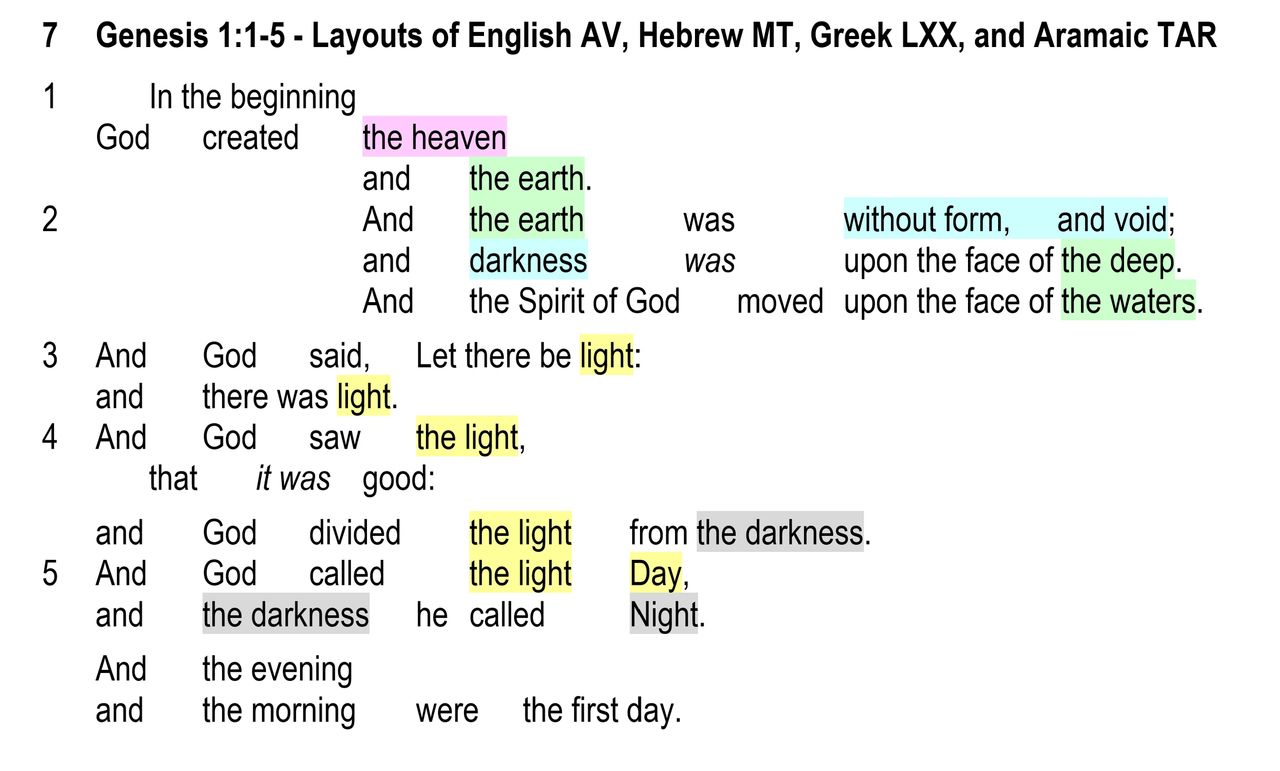
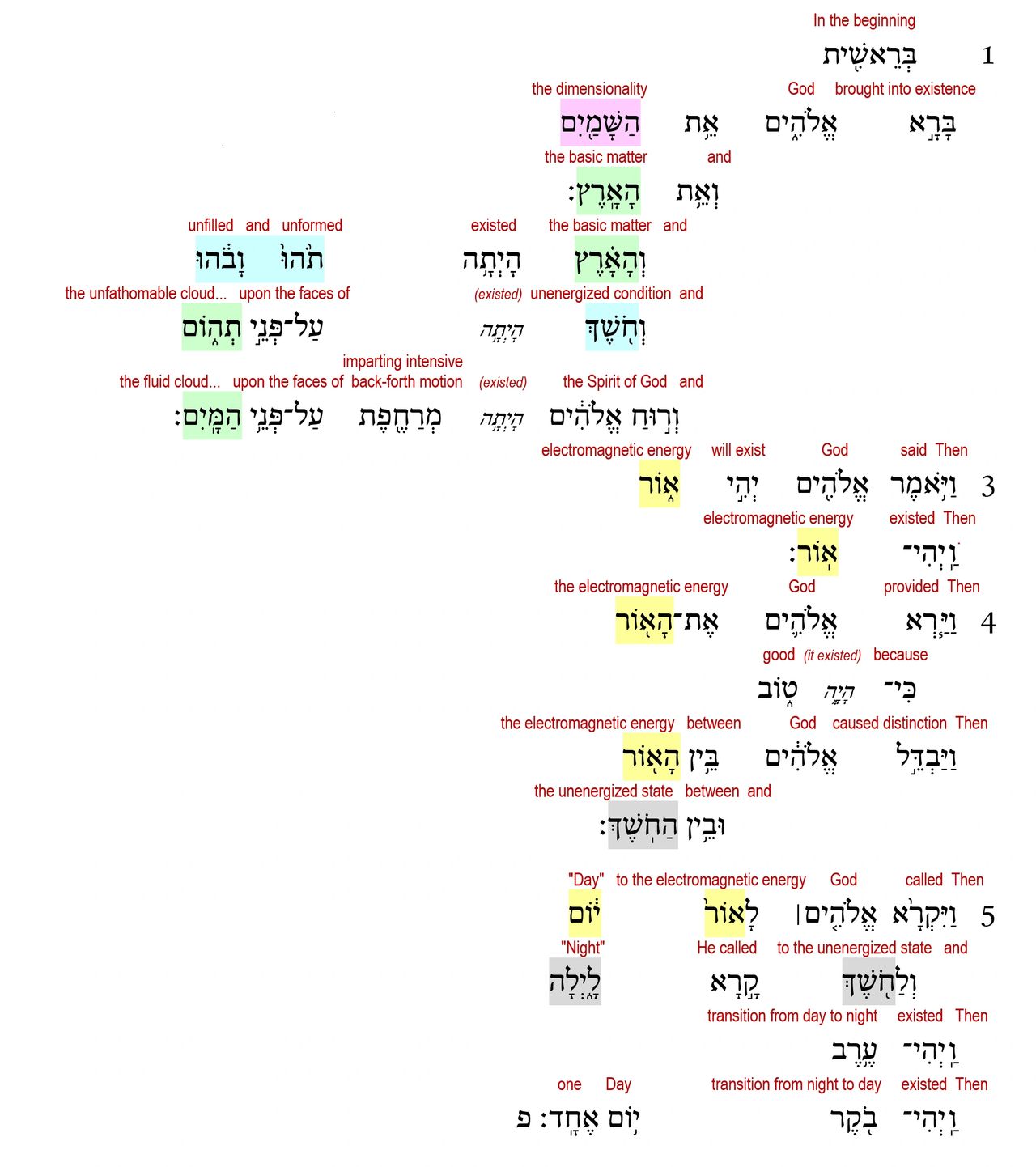
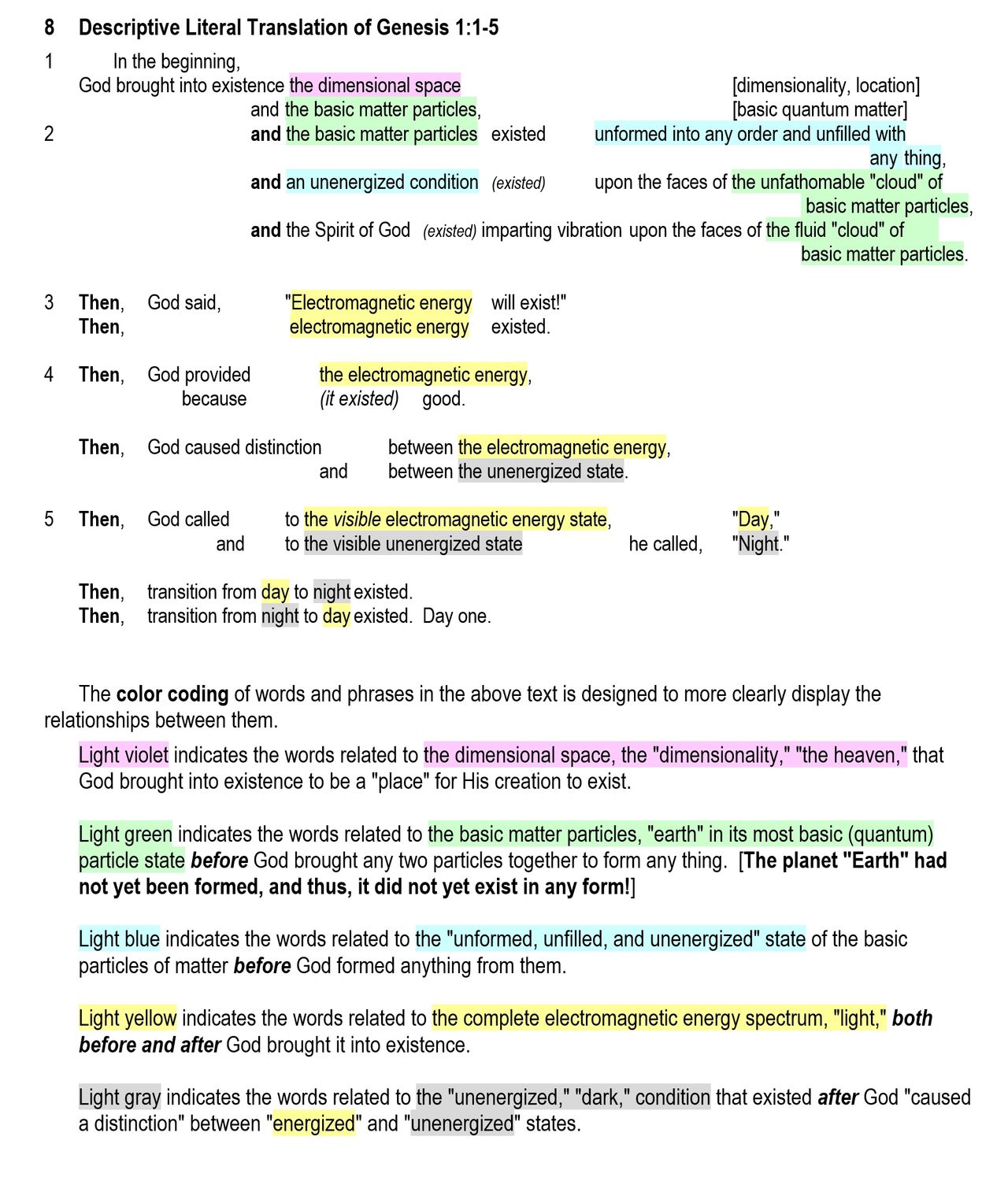
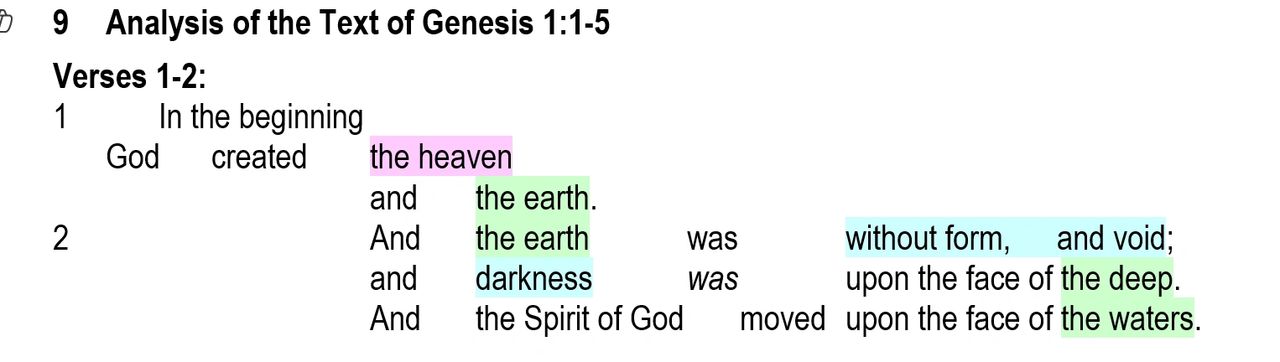
“In the beginning”
Adam’s first word of the record of God is a composite Hebrew word which, in English, is translated “in the beginning.” This Hebrew word actually combines two parts of speech: the prefixed preposition b’, and the noun réshiyth, which is its object. The combination b’réshiyth, is then, a complete prepositional phrase, and it adverbially modifies the verb “created” indicating the time and nature of God’s creative action. It indicates that the creative action which it describes is the “headness,” the “firstness,” the beginning, of God’s creation activity. This is the “head” in the sense that it is the very “top” of everything, the “peak” from which everything flows. Thus, the “headness” of creation is the very beginning of it. The word does not refer to the “beginning” of God or anything outside the creation but to all that the Creator was about to bring into existence.
This word, in this context of creation, establishes God as the supreme being over the entirety of creation, because the entirety of creation exists within His person, having originated from and in Him. As creator and originator, He is also, then, the owner, designer, definer, sustainer, and absolute authority with respect to all that exists. He is transcendent over the creation in its entirety, and, in His perfect knowledge and authority, He, alone, set the perfect design criteria for every function and interaction of every thing and every system of the creation. He pervades the entirety of creation, existing in, over, and throughout all that exists, but He is in no way subject to any aspect of it; the creation, in its entirety, is subject, and accountable, to Him. The creation is also a perfect expression of His person and nature, not as humans perceive Him from their finite perspective from within the results of rebellion to His design, but in the perfect conditions which He intended to result from conformity to His design.
Many, in ignorance and misunderstanding of the person and nature of God, have also misunderstood the relationship between Him and violational behavior, “sin,” by His created beings. In their error, they promote the idea that God intended violation to occur for the purpose of “glorifying” Himself by “saving some” humans despite their violations. This concept, and any of its various similar concepts, is itself a violation, a misrepresentation, of Him and His design. In His creation of His sentient beings, humans and angels, He built into each a measure of delegated authority and autonomy, and, especially in the case of humans, the only beings specifically designed and constructed to represent Him to all else in the creation, they were free to interact with the creation as they deemed best, but always within the bounds of the criteria of His design. God had built the creation as, essentially, a “cause and effect” system wherein:
– operation of the creation according to His design brought blessing,
– and operation of the creation in violation of His design brought destruction,
but even the destructive effects of violation were intended to turn violators back to His way and blessing. This was His perfect original design, and it has never changed. As God, He cannot violate or misrepresent Himself, so the creation with all its criteria for function and interaction clearly and perfectly testifies of the person and nature of the God who brought it all into existence.
“God”
The word “God” here, Ĕlōhiym, is the basic Hebrew descriptive title for the Creator. This word is the masculine plural absolute form of the singular noun Ĕlōăh, which is the longer form of the noun Él. This latter word describes God as what He exists, that is, He exists the “Él,” the God, the supreme power and authority from whom all power and authority derives and has been delegated, and the God who exists in three Persons. The plural form used here by Adam in the perfect language built in to him by the Creator is his expression of God as he, the human, saw and experienced Him. Adam saw God not only as the supreme transcendent being who was the origin of all that existed, he also saw Him from the perspective that He was the transcendent spirit who existed in, above, around, and through all that existed, but these transcendent characteristics were not all that he saw of the God with whom he had walked with no alienation between the two of them. The man also saw God as the transcendent person who interacted personally with every aspect of His creation, not the least of which was His human creations. Thus, Adam, with nothing obstructing his perception of God in his pre-violation walk with the Creator, had come to know Him as He existed: the Transcendent Supreme Being, Spirit, and Person in whom the entirety of creation existed.
In this sense, Adam saw and experienced God in each of these three distinct aspects, almost as though God were three separate persons, and thus, the human described his incomprehensible Creator in a grammatical form which represented to him, and kept him reminded of, the three “persons” he knew to be in the one God. Adam knew that this God was not three independent “Gods”; the Creator was one God who was and expressed Himself in three persons, and thus, the man used singular verbs when he recorded the actions of this “three-person” singular God. The word “God,” then, from the time of Adam, has come to be used as a name for God in any of the various expressions of Himself, but the word “God” is not His name; it is a descriptive title. A descriptive title “names” a particular aspect or characteristic of a person or thing and may function as a “name,” but the true “name” of a person or thing encompasses every aspect, every characteristic, of that person or thing. The name “God” describes what He is and may be used to accurately refer to Him, describing Him as that being who transcends all that exists by virtue of the fact that He is the one who brought into existence all that exists. Thus, His human creatures may accurately use “God” as a name when interacting with Him or when referring to Him in their communications with other humans.
When used properly, then, the name “God” refers to Him perfectly, but, just as He applied personal names to each of His human and angelic beings, He also applied a “personal” name to Himself. In an obvious perception of the need of these beings, especially humans, to perceive not only His person and nature but also the primary aspect of His being, He gave to His first man and woman that all-encompassing name. That name would represent the entirety of His person and nature every time they used it, whether calling upon Him or communicating Him to another being, and no created being was sufficient for devising such a name; He alone possessed both the ability and the authority to form such a name, a name which would form a perfect concept of His person and nature in the minds of Adam, Eve, and all other future humans.
Most certainly, Adam saw God as He existed, and he saw Him as the only God who existed. His human concept of God was perfectly consistent with the Creator’s chosen name, Ĕhyĕh, “I exist,” and Ĕhyĕh would be the very name by which He would identify Himself to Moses some 2700 years later. The Creator had known that, through time, His descriptive title “God” would lose its distinctiveness in human perception, so He applied to Himself a name which, whenever accurately rendered by humans, would always bring to mind His transcendent nature and His relationship to all that exists. The name He chose, Ĕhyĕh, is a Hebrew qal imperfect verb, comprised of both a subject and a verb, which is a complete sentence meaning “I exist, I am existing,” thus expressing His presence, His “existing,” in every place, every situation, every moment of time, in the creation. He was, and has always remained, “God,” that descriptive title indicating His supreme power and transcendence over all that exists, but His human creatures needed to perceive the entirety of His presence in every moment and situation of life; His name Ĕhyĕh, “I exist,” expressed that presence perfectly.
“created”
The Hebrew word here translated “created” is the word bärä, which refers to the action of bringing into existence something which did not exist prior to its creation. This word is verb in the qal perfect 3rd masculine singular form. The Hebrew word bärä’ itself does not mean “to create ex nihilo,” that is, “to create out of nothing”; the word simply means “to create,” “to bring something into existence which had no prior existence.” The “ex nihilo,” “out of nothing,” aspect arises from the context in which the word is used. Genesis 1:1 is a perfect illustration of this. The context here is the very “head” of all that exists, and thus, at the moment when God began to create, nothing existed . . . not space, not matter, not time . . . nothing. At this point, the beginning of everything that exists, He did indeed create “ex nihilo,” “out of nothing,” but this terminology is wrong at its basis, because it expresses this primordial origin from the humanistic perspective, a perspective bounded by the physical creation. Certainly, when God brought into existence “the heavens and the earth,” nothing existed that would comprise them “physically,” but these things existed, not in physical form, in the transcendent mind of the Creator. They had no prior existence before He brought them into existence.
Later, God would “create” humans and many other things, but He did not make them completely “out of nothing.” For humans and much of His subsequent creative activity He would “make,” them, He would “form” them, using previously existing materials, materials He had already created. In each case of creation, however, that which He brought into existence had not previously existed as He would create it. Thus, the verb “create” means “to bring into existence that which did not previously exist.” Like their Creator, humans, too, create, that is, they bring things into existence which had no prior existence, but in each case, they “create” outside their physical being, and they “create” using previously existing materials. With no “outside” to His person, God created completely within Himself, and, possessing as well the ability to bring into existence the basic materials from which He would form His “creations,” He created in the most absolute sense.
“the heaven”
The English word “heaven” has many different meanings depending upon the context in which it is used, and the Hebrew word, shämăyim, from which it is translated has similar variation. In this first verse of the Scriptures, however, the word shämăyim is very specific in its meaning and establishes the basic concept from which all other meanings would be derived. This primordial use by Adam was invested not with human ideas but with the Creator’s chosen meaning, and, though the form of the Hebrew word may incorporate an aspect of Adam’s human perception, the basic significance of the word in Genesis 1:1 was determined only by its use in this first of all contexts.
The basic concept involved in shämăyim is “dimensionality,” that is, some kind of dimensional “space,” something that occupies some kind of “space,” some kind of quantifiable and identifiable “space.” In Genesis 1:1, shämăyim, “heaven,” refers to dimensional, measurable “places” where everything of the creation would exist, whether:
– its dimensional, measurable “physical” location in the physical realm,
– or its dimensional, measurable “time” location in the temporal realm,
– or its dimensional, measurable “thought” location in the mental realm.
Prior to God’s initial act of creation, none of these dimensionalities, or any of their various aspects, existed except in the mind of the Creator, that is, “space” as a physical location or as a location in time or as a realm of perceptual thought, did not exist in any form, except in the mind of God. Thus, this first use of the word cannot be referring to any kind of “location” which already existed. Everything that God was about to create would have “dimensions,” that is, everything would be “dimensional” in some way, typically possessing “length, width, and height” in some way not defined by finite human minds. Thus, the very first thing which the Creator brought into existence was not just “dimensionality”; it was also the very concept of dimensionality, the concept that everything in His creation would have “length, width, height,” and even “time,” in some way.
Though the human mind may find it difficult to conceive the fact that “dimensionality” did not exist before Genesis 1:1, it is no less true, because shämăyim is, purposely, the very first created thing of which God spoke in His record of the creation. He did not simply create a “place,” a “space,” and then fill it; He first brought into existence the very characteristic, the very concept of “dimensionality,” a characteristic which everything in His creation would possess. Everything would be “dimensional,” just as He Himself exists “dimensional,” but not according to the concept of any created being, especially humans. God exists “dimensional” only in that the creation, as He brought it into existence with all its perfectly created dimensionalities, was, and remains, a perfect expression of His person and nature. Thus, the Creator is “dimensional,” but only in the sense that He exists the source of all dimensionality, that is, all dimensionalities of the creation “existed” within His perfect being, His perfect “existence,” before He created them.
All that “exists,” then, is an expression, a manifestation, of His transcending “existence” as He “exists” in and above and over and through the creation in its entirety, thereby demonstrating His transcending “existence” to be His primary characteristic. His first two humans saw Him in this way; in every aspect of their existence, in every place, every circumstance, every moment, He, the Creator, was there, personally, “existing,” and the criteria of His perfect design were transcendent and governing as well. To them, He was the God Who Exists, the God who in every place, every situation, was manifesting Himself as “I exist, I am existing” in that place, that situation. To Adam and Eve, He thus became known, in essence having “named” Himself, as “I am existing,” and this name, this perfect expression of His relationship to the entirety of creation, continued through the centuries as the expression of this primary aspect of His relationship to everything that exists. He was, and had always been, “I am existing,” and this is the very same name which He expressed to Moses over 2700 years after Adam and Eve had come to know Him. Moses needed to know the name of the God who was giving him the authority to lead the Israelites out of Egypt, and God responded, essentially, “I am existing the God whose name ‘I am existing’ has always been known.” He, the God Who Exists, the God “I am existing,” the God within whom and from whom all dimensionalities exist, is Himself the ultimate dimensionality.
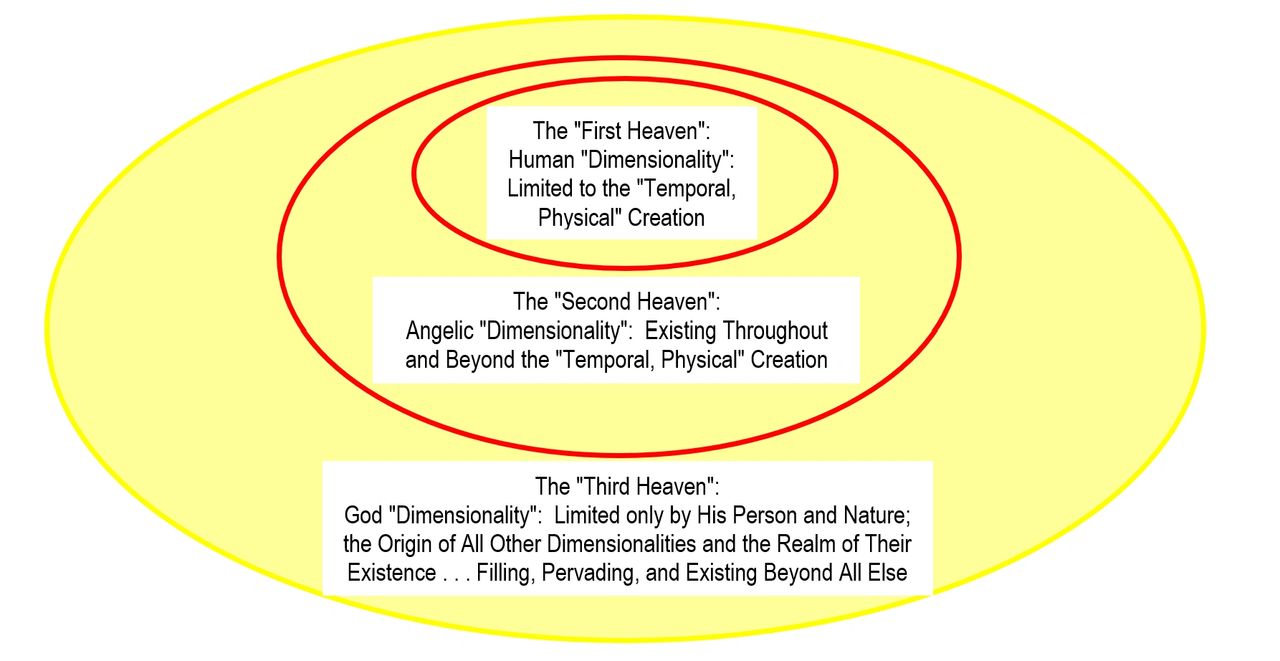
In addition, then, to the fact that shamayim refers to some kind of dimensionality, in its dimensionality, it may also refer to some kind of “substance,” some kind of “matter” or “energy,” which God brought into existence in the creation, but which humans are not able to perceive through any normal means. Though difficult to conceive and foreign, perhaps, to most people, shamayim may refer to something that fills and permeates the entirety of creation in some way as the “medium” in which the entire creation, including humans, exists and which gives to the creation its “dimensionality.” Accordingly, a true “vacuum,” as humans define it, that is, a dimensional location where absolutely nothing exists, cannot exist, because every dimensional “location” would be filled and permeated with shamayim. If this is a valid understanding of shamayim, everything not only exists within shamayim, everything also possesses shamayim in some way as the essential component of its existence. Thus, everything that now exists has “dimensionality”; it occupies “space” and exists within “space,” but not all “space” is of the same nature.
When Adam wrote what is now known as Genesis 1-4, the first four chapters of the Scriptures, he wrote from his human perspective while accurately expressing what God intended him to reveal. His wordings, and his constructions of words, were then expressions of what he actually saw and perceived. Certainly, Adam knew not only that he existed in “space” but also that great volumes of “space” existed above him, and, as he looked about him, he could see the waters that God had created and placed both above and below him, waters that existed, literally:
– “from under to,” that is, beneath, the “räqiyă,” the dimensionality which is Earth’s atmosphere, and
– “from upon to,” that is, above, the “räqiyă,” the dimensionality which is Earth’s atmosphere.
The waters above the atmosphere had been placed there by the Creator in His second day of creation, and they manifested their own particular “dimensionality,” just as did the expanse of “outer space” beyond them. Even Adam’s word for “space” appears to indicate his awareness of the layer of water above the atmosphere. Using the perfect linguistic abilities built into him by the Creator, Adam himself may have constructed the word for “heaven,” shamayim, by combining his word “there,” shäm, with his word “waters,” măyim, a word which is in the Hebrew dual form indicating not plural (three or more) but two “waters.” From his location on the surface of the earth, these “waters,” which enveloped the Earth were everywhere above him, and thus, in his excellent logic, the word he formed to describe the “space,” the “dimensionality,” above him was “there exist waters,” that is, “there waters,” shäm-măyim, which naturally shortens to shämăyim.
The fact that “dimensionality” did not exist prior to God’s act of creation also implies that finite time did not yet exist before God created, because measurable time in the creation is always associated with different points or movement in some dimensional realm. With no dimensions, no difference in dimensional location and no movement could exist, and thus, neither did time exist. Time, then, is another aspect of the creation which God perfectly brought into existence for use by His created beings.
“the earth”
The Hebrew word in Genesis 1:1 which is translated “earth,” (ĕrĕts), is a feminine singular noun and it refers to “matter,” but not “matter” in the particulate forms now associated with the word, and it did not refer to the planet “Earth.” Genesis 1:1 describes the absolute beginning of everything in the creation; nothing had yet been “formed” (verse 2). Adam wrote here of “earth,” “matter,” in its most basic form, that is, the word here refers to the inestimably large number of basic matter particles which comprise everything that exists in the creation. These were quantum particles, that is, they were “the smallest amount of a physical quantity [of matter] that can exist independently,” particles which could not be further subdivided. These, then, were the basic matter particles from which everything in the universe would be “formed.”
Verse 1 stated differently:
God desired to construct a creation, so, with His perfect design in mind He first brought into existence “dimensionality,” “dimensional space,” shämăyim, that is, a “place” wherein everything in His creation would exist. Then, He brought into existence the “matter,” earth, ĕrĕts, the material that would occupy the entirety of His “dimensional space” and would thus be “dimensional” in nature. He would use this “matter,” these “building blocks” of matter, to make everything of substance that would exist in the creation, whether created thing or created being. Because the planet upon which humans live is composed of this matter, they used this same term to refer to that planet as ĕrĕts, “Earth.”
Verse 2:
“the earth”
Verse 2 begins with “earth,” (ĕrĕts), the very same Hebrew word that ends verse 1, and, since the original text of Adam would not have included the verse break indicators found in modern texts, the only divider which Adam placed between these two identical words is the conjunction “and.” This conjunction binds the content of verse 2 to the content of verse 1, totally contrary to the attempts of modern “scholars” and “false teachers” who represent this conjunction as indicating a “time gap” between the conditions described by the two verses, a “time gap” which allows them to justify their antiGod evolutionary concept of the creation; no “gap” or break of any kind has ever existed between the words of verse 1 and verse 2. Indeed, the binding nature of the conjunction is clear and unmistakable in the Hebrew text, where its form is that of a single consonant attached to the word “the earth.” That is to say: in Hebrew, only one letter, the consonant wäw, is between “the earth” of verse 1 and “the earth” of verse 2. This type of construction actually limits the interpretation of “the earth” in verse 2 to refer to the same term, “the earth,” in verse 1. Accordingly, the description of “the earth” in verse 2 is the description of the state of “the earth” immediately after its creation in verse 1. The first verse records the fact that God brought into existence all “dimensionality” and “matter,” and verse 2 describes the condition in which the “matter” existed immediately after God brought it into existence.
“was”
The meaning of this verb, from the Hebrew häyäh, “to exist, to be,” is very similar to that which modern humans call a “being” or “linking” verb, but the meaning and significance of the modern “being” verb are not identical to that of the Hebrew original. This occurrence is Adam’s first written use of the verb, and it carries his original meaning, the meaning from which the later concepts of “being” and “linking” are derived, but his meaning was not derived from those later concepts of “being” and “linking.” Adam’s original concept, and the concept of virtually all of the uses of häyäh in Scripture, is more accurately expressed by the modern concept of “existence.” Even modern usage of the various forms of the “being” verb are more accurately expressed by the “existence” concept. This can be seen in a sentence such as “he is a man,” where the actual significance of this statement is “he exists a man.” Applying this to Genesis 1:2, the first statement of this verse is not saying “and the earth was without form and void,” as if “the earth” had been in one form in verse 1 and then “changed to” or “became” something else or some other condition in verse 2.
The concepts involved in “changing” and “becoming” are not a part of either the Hebrew hayah or the later Greek ĕimi. These “meanings” are wrongly imposed on the words from the presuppositions and limited understandings of readers and interpreters who do not know either Adam as the author of the text or the original meaning of häyäh. Adam himself, using the verb häyäh, constructed the verse to describe the condition in which “the earth” existed immediately after God had brought “earth” into existence. Without question, Adam wrote the words of verse 2 with the intention that all future readers would recognize that these words were describing the condition in which “the earth” existed immediately after it was created.
“without form”
The Hebrew word translated “without form” is tōhū. It is an unusual word and has been defined by the terms “confusion, waste, wilderness, without form,” but Adam’s use of this word in Genesis 1:2 does not carry, in any way or to any degree, any meaning which involves “confusion” or “waste” or “wilderness,” or any sense of “disorderly” or “mixed up” in some way. Instead, the word here describes “confusion” only in the sense that the perfect basic components of every future “thing” existed individually perfect before they were combined by the Creator to “form” the objects of which they would become a part. In this sense, the most basic particles of matter, the basic “building blocks” of every material thing that would ever exist and occupy “dimensionality,” did themselves exist perfect, but, in the immediate moment after their creation, that is, as verse 2 began, they had not yet been brought together into the things, the ordered arrangements, which God would form. Thus, the basic components of matter existed “without form,” “unordered,” that is, no two of the basic particles of matter had been bound together to form any of the particles known to modern physics, whether molecular, atomic, or subatomic in size, because every known particle is perfectly “formed” and is a perfectly ordered arrangement of basic, “quantum,” component parts.
“void”
The Hebrew word translated “void” is bōhū, a word which carries the meaning “unfilled,” “empty of anything,” but not as commonly understood in the modern era. The “unfilledness,” the “emptiness,” associated with this word must be understood within its context of original creation and its occurrence immediately after God’s statement that He brought “dimensionality” and “basic quantum matter” into existence. Like tōhū, the word with which it is paired, it is an unusual word and has been defined by the terms “void, waste, emptiness,” but its use in Genesis 1:2 in no way indicates “waste” or “emptiness” in the modern sense of these words. Those who promote these modern definitions and perspectives of bōhū are demonstrating not only their ignorance of the word’s basic significance but also their possession of a totally wrong and misleading humanistic concept of God as Creator. Their failure to perceive accurately the true nature of this word, especially in this context, has misled them to misrepresent the Creator . . . as though His creative activities could in some way be less than perfect expressions of His perfect person and nature.
This word does not refer to an “emptiness” or “waste” in the sense that it is describing a condition which is not suitable for habitation by any living thing; living things had not yet been brought into existence. Instead, the word here describes “emptiness” in the sense that nothing formed or ordered is present. This word pairs perfectly with “tohu” to describe the overall concept that no “things” existed, no “matter,” no “stuff”. . . only the basic quantum particles of matter from which God would form and make “all things.”
In terms of modern physics, the only things that existed were the “quantum particles” of matter, but with no attractive or repulsive forces between them. They were just “basic particles of matter,” and, possessing no energies of any kind, whether kinetic, potential, gravitational, electromagnetic, or any other, they would have been perfectly fluid, that is, these “particles” would have moved completely freely with respect to one another without attraction, repulsion, friction, or any energy interaction of any sort. This “non-energy” state of the particles did not, however, continue for any measurable time, because the Spirit of God in His creational activity was immediately imparting kinetic vibrational energy into each of these particles (see below).
Even modern physics, having been originally influenced by the actual words of Adam in Genesis 1:1-3 and seeking to explain the nature of gravity, has developed a concept of matter called “string theory,” which, in extremely simplified terms, has calculated the existence of basic, “quantum,” particles of matter which they have characterized as “strings.” The theory says that these “strings” comprise all matter that exists and that these “strings” are “vibrating.” Since the size of these “strings” is millions of times smaller than the smallest visible particle, they cannot be viewed in any way; their unseeable existence is “calculated” only. Modern physics can only consider these particles from the perspective that they have already been “formed,” that is, these basic matter particles have already combined with one another to form “things,” and the physicists are seeking to “isolate” and discern these basic building blocks of all matter that exists. The record of Genesis 1:1, however, God’s record of His original creation, presents these particles from their “unformed, preformation” state before He began energizing or combining them in any way to form any thing.
“and darkness”
The Hebrew word translated “darkness” is the common word hkōshek, and, though “darkness,” or something similar, is its normal meaning, its primordial use in Genesis 1:2 cannot be defined by later, especially modern, human perception. Here, Adam used the word with its most basic meaning, a meaning from which all later usage has derived. The typical modern perspective of “darkness” often considers it to mean the “opposite of light,” but this concept is distinctly humanistic in perspective, that is, the “opposite of light” concept is rooted in the normal human practice of defining words according to what a person sees or conceives in his own finite mind. Indeed, the concept that “darkness” is in some way the opposite of light, or even the “absence” of it, does not fit any valid scientific or theological definition. At this point in God’s record, in only the second verse of His entire written revelation, light had not yet been created, and thus, no comparison to light fits the context. “Darkness,” in verse 2, is not a descriptive or comparative term rooted in human perception; it is an absolute term, just as the words “heaven” and “earth” refer to absolutes in verse 1.
“Darkness” here refers to the fact that none of the electromagnetic energies which are essential components of all currently existing matter, “earth,” did not yet exist. Other energies not normally associated with the electromagnetic spectrum were being imparted by the Creator, but, from the human perspective, the “darkness” described in verse 2 refers to that condition which existed in the creation before God brought into existence the entire electromagnetic energy spectrum, including both visible and invisible electromagnetic energies. Humans developed their “opposite of light” concept to describe their perceptions of light and darkness in the realm of visible electromagnetic energy, but, as in the original concept, darkness is not the opposite of light; it is the absence of “light” in its entirety. At this point in creation, no “light” of any kind existed, and thus, neither did “darkness” exist. God would, indeed, bring light into existence (verse 3), but, then too, immediately after He created it, no distinction between light and darkness existed. It was all just “energies” until He, the Creator, “caused distinction” between “light” and “dark’ (verse 4).
An analysis of the common Hebrew waw-conjunction used to introduce every verse of Genesis 1, except for the first, demonstrates the nature of the differing relationships between verse pairs 1-2 and 2-3. The waw-conjunction connecting verse 2 to verse 1 is a simple waw-conjunctive, connecting the two verses together, but the waw-conjunction connecting verse 3, where the creation of light is recorded, to verse 2, where the word “darkness” is first used, is a waw-consecutive, indicating a sequential relationship between those verses. This conjunction, the waw-consecutive, begins 25 of the 28 remaining verses in the chapter, not counting the slightly different waw-consecutive connecting verse 15 to verse 14. The remaining two verses, 18 and 30, begin with the same type of simple waw-conjunctive found introducing verse 2. Thus, the construction of Genesis is as follows:
– the first verse is the only verse that does not have a conjunction relating it to preceding text;
– simple connective conjunctions bind four pairs of verses: 2 to 1, 15 to 14 (perf cons), 18 to 17, and 30 to 29;
– all other verses begin with waw-consecutives, indicating either temporal or logical sequence. Accordingly, verse 2 is not sequential following verse 1, but rather is directly connected to verse 1, thus confirming the fact that it provides a description of that which God had brought into existence in verse 1.
“the face”
The Hebrew word translated “face” is the word p’néy, literally, “faces of,” the masculine plural construct form of the noun pänĕh, “face.” This word refers to the “faces,” the various “sides,” of the individual particles of basic matter which God had created, and this matter, in its unformed, unfilled, unenergized state, would have had much the same appearance as a cloud of fog or dust or some other minute particles. Without attractive and repulsive forces between the particles, each particle would have been able to move, whether it did so or not, without “friction” or restriction by any other particle. Thus, as a cloud of fog has many constantly changing faces, especially when viewed from different perspectives, the cloud of the basic components of matter would have had many “faces,” indeed, at least one or more “faces” for each quantum particle of matter. The term, then, views the basic matter from a perspective only possible by the person of the Creator Himself.
“the deep” Hebrew noun, t’hom, “the unfathomable cloud of the basic components of matter.”
The Hebrew word translated “the deep” is the word t’hom, literally, the “unfathomable.” Modern humans typically translate this word as “the deep” and understand it to refer to bodies of water, especially the seas and oceans, which are unfathomably “deep” as viewed from their surface. The term thus expresses the idea that when one looks down upon the face of “deep” water, he cannot discern how “deep” it is, that is, he cannot tell how many “fathoms” of water are beneath him. That water is “unfathomable” to him, because from his perspective he is unable to discern its depth; it is “deep,” and that is all he can discern. The same term “deep” is used to describe things other than water, things such as when he enters a fog bank or cloud, or even when he is looking into “space” itself. From man’s finite perspective on Earth, he cannot tell how far “outer space” extends, and thus he uses the term “deep space” to describe it, because it is “unfathomable” to him. Other conditions exist in the experience of man where he describes his limited discernment of something by the word “unfathomable,” or with other words of the same effect.
“the Spirit” Hebrew noun, ruăhk, feminine singular, “the Spirit” of God.
“moved”
The Hebrew word translated in the English text of Genesis 1:2 by the verb “moved,” or “hovered,” has been greatly misrepresented in modern translations of the Scriptures. Most translations, even the LXX and the Aramaic Targum, render the Hebrew word by some form of a verb associated with moving, hovering, sweeping, blowing, etc., but these are all misrepresentations which obscure what the Creator was actually intending to say. The actual word, m’răhkĕh’phĕth, is actually a Hebrew participle in the pi`el stem and in the active feminine singular voice, and, as a participle, it is not a finite verb, but it adverbially modifies a perfectly understood verb of “existence.” In keeping with the finite verb of existence, “existed,” which introduced this verse, the understood verb which the participle modifies is the verb “existed.” The participle then expresses the state in which the Spirit of God “existed,” that is, He “existed” doing the action of the participle m’răhkĕh’phĕth. Thus, a finite verb of existence must be supplied; the Spirit, then, “existed continuously causing (imparting) intensive back-and-forth motion, that is, He “existed continuously causing (imparting) vibrational motion” to the particles of basic matter.
Many have defined this word in the light of their own “modern-day, Western-culture, 21st-century” mindset, the same mindset which had already moved them to adopt erroneous and misleading definitions of the other words in this passage. As a result, the Spirit of God has been presented as “moving about above the great seas of the newly created world” or as “flying around over” or “hovering over” or “brooding over” the creation in some manner that is comprehensible from the human perspective, and, often, the creation is greater or larger than He is. The concepts of God from which these and other related ideas about this word arise are distinctly humanistic and totally absurd and unGodly, because they “make God in man’s image,” that is, they present the transcendent, infinite Creator as related to His creation in some finite manner. A simple intensive analysis of Adam’s “Hebrew” text removes any potential for misunderstanding what God was conveying by the word which humans have misrepresented as “moved,” “hovered,” or something similar, but rare are the individuals who will even consider such an analysis. Thus, the ignorance of God and His Hebrew text among humans, even among those who are supposed to be learned in such matters, forces almost all translators to reject this much-needed analysis, and their ignorance leaves them no choice but to misrepresent the Creator’s actual wording.
The Hebrew word is a piel participle of the verb rähkăph, a root which occurs in the Scriptures only here and in Deuteronomy 32:11 and Jeremiah 23:9. In the Deuteronomy text, Moses used the Hebrew piel stem to describe the intensive “back-and-forth motion” of a bird’s wings as it flies above its nest. In the Jeremiah text, the prophet used the Hebrew qal stem to describe the “back-and-forth” shaking of his bones as he was moved by very intensive emotions. In the Genesis 1:2 text, Adam, the human author, used the piel stem to indicate that the Spirit was not only “causing” the “back-and-forth” motion, He was also moving the particles of matter “back-and-forth” with great intensity. Both concepts, causation and intensification, are essential elements of the Hebrew piel verb stem, and Adam applied both perfectly. In these earliest words of the Scriptures, Adam did not use a finite verb form to describe this action by God’s Spirit. Instead, he used a participle, a nonfinite verb form, to signify that the Spirit’s intensive back-and-forth motion was also durative, that is, it was not something confined in some way to a point or period of time; it was enduring, continuing undiminished in its force, through time.
Though many supposed “Hebrew scholars” have represented and translated Hebrew participles as “present tense” verbs, such a concept is rooted in an ignorance and lack of understanding of this language which the Creator built into His first two humans. In virtually all occurrences of the Hebrew participle where it appears to function only as a present-tense verb, it is preceded by an understood finite verb of existence, a finite form of the “being” verb, and is, thus, functioning as an adverbial modifier to that verb of existence. This fits perfectly with the structure of the first two lines of Genesis 1:2, wherein Adam expressed the finite verb of existence in line one and then expressed the same finite verb, though not in writing, in line two by the parallelism in which he constructed the words. Accordingly, he did the same in line three, expressing the finite verb of existence, though not in writing, and then adding the participle to express the condition, the intensive back-and-forth motion, inherent in that moment of the creation’s existence.
The various aspects of God’s chosen verb and verbal construction perfectly correlate to one another to represent the Spirit of God as “duratively causing intensive back-and-forth motion” upon the “faces of the waters.” Then, too, though modern man regards the “face” of something as an external “side” of an object or person, the Spirit of God sees the “face” of every particle of matter, even the most basic, and thus, He began imparting vibrational motion upon every quantum particle of the creation. Men now call such motion “vibration,” and modern physics has confirmed the presence of “intensive back-and-forth motion” in essentially all matter.
“the face” “the faces,” literally. (See “the face” above.)
“the waters” Hebrew noun, mă’yim, “the fluid,” “the free-flowing cloud of the basic particles of matter.”
Many commentators have seen in these words a reference to the water that is the most widely occurring liquid on earth, the ordinary molecule H2O. Such a reference, however, cannot be valid in this context. In the first place, the water molecule is comprised of H, hydrogen, and O, oxygen, both of which are elements of matter, and both of which are perfectly formed even in their basic atomic state. Indeed, if these atoms were to be divided into their subatomic components: protons, neutrons, and electrons, or even into their subsubatomic components, whatever they may be called, each of these components is completely and perfectly formed to fulfill a specific function within that atom. This means that each of these component particles is “formed” to some degree, and thus, a cloud of formed particles of liquid water could never be called, “empty” or “unfilled,” because “formed particles” exist within it.
The term, “the waters,” cannot then refer to anything molecular or atomic in nature, but if one recognizes that the Genesis 1:2 usage of the term is its first occurrence in the entire revelation of God, its meaning becomes clear. In the present day, “water” has become the standard with respect to which many liquids or fluid materials are compared and evaluated. Man has adopted it as a standard, largely because it is so widespread and well known. Man’s experience with this universal fluid made it perfect for describing various characteristics of other substances. Man, however, did not exist at the time of Genesis 1:2, and man’s experience-derived definition of water did not exist then either!
Man’s definition derives from God’s definition and not God’s definition from man’s, that is, when the first man encountered “water,” he called it by a name that well-described its characteristics, a name that God had given to him. The word “water,” then, could just as well be translated “fluid,” because “fluid” describes the characteristic nature of a substance to flow, as water does, from one place to another.
The word “fluid,” however, is not limited to describing “liquids”; it describes the tendency for flow in solids and gases as well. Solids are “fluid” in that they “flow,” but at a very slow rate. Gases are “fluid’ in that they “flow,” and indeed, more freely than liquids, and though they may not appear to be so, gases are comprised of matter. It is just that their molecules or atoms are more disperse than those in liquids, and thus, the molecules or atoms move more freely with respect to one another. Gases, then, are better “fluids” than the liquids, even liquid “water.” The “cloud of the basic components of matter” would have been a perfect fluid, with each particle unattached to and unattracted by any other particle. In effect, the “cloud of matter” would have been the most freely flowing fluid, the most “water-like” material, to ever exist, until the time when the Spirit of God imparted vibrational motion, mechanical energy, into and through it.
Verse 3:
As described above, the connection of verse 3 to verse 2 is not that of a simple coordinating conjunction, though it appears so in English. Verse 3 begins with what is known as a waw-consecutive, a form of the Hebrew conjunction that indicates some degree of “sequence” from the condition described in verse 2 to that described in verse 3. The waw-consecutive itself does not say whether the sequential nature of the connection is temporal (involving time) or logical (involving non-time relationships) or both. To discern the actual nature, one must accurately assess the nature of the conditions existing both before and after the waw-consecutive, and then assess how they are “sequential.” In the context of Genesis 1:2-3, “light” did not exist at the end of verse 2, and then it comes into existence in verse 3. Clearly, this waw-consecutive indicates a temporal (time) relationship between the two conditions, though the actual amount of time may have been extremely small.
“light” Hebrew noun, ‘ōr, “the whole spectrum of electromagnetic energy, including visible light; the electromagnetic energy spectrum.”
The “light” here was not the “light” which humans associate with those objects that emit light in human experience. Again, no humans existed at this moment in time, nor did any of the “light-emitters” exist. The sun, stars, moon, etc., would not be formed until day four in the account. Neither was “light” distinguished from darkness. That distinction would not occur until the time of verse 4, another verse beginning with a waw-consecutive, and thus indicating a sequential relationship between verses 3 and 4. Indeed, the Creator-God, who does everything in perfect order, could not “separate light from darkness” until He had brought “light” into existence. The “light” of verse 3 must then refer to energy, that is, the entire electromagnetic spectrum of energy. This fits with the fact that God the Spirit had already imparted mechanical, vibrational, energy into the creation. All that was needed at the close of verse 2 to have all the components in place for forming and organizing everything in the entire universe was electromagnetic energy, and this is exactly what God brought into existence in verse 3.
Summation and Correlation of Genesis 1:1-3
The definitions recorded here are derived from intensive analysis of the Hebrew text of Genesis. Interestingly, however, both they and the creative activity they describe correlate very well with some aspects of modern physics. In an attempt to explain the origin and nature of the gravitational forces that exist between two bodies, one branch of modern physics has developed a model called “string theory.” While the theory is quite complicated, it basically consists of the concept that everything that exists, all matter, is comprised of super-subatomic particles, millions of times smaller than an atom, called “strings.” These strings are the smallest components of all matter, that is, they are the “quantum” particles of matter and, thus, they cannot be further divided to any degree. Though these “strings” cannot be seen by any technology available, their existence has been “calculated.” Their shape may be straight, curved, or even round, but whatever it is, to explain the manner in which they cause gravity, they are said to be “vibrating,” “oscillating.”
This correlates directly with the state of “the earth,” the “basic matter” God had just brought into existence, described in the first two lines of verse 2: it was unformed, unfilled, unenergized, and then, the Spirit of God imparted (and continues to impart) continual, intensive back-and-forth motion to the particles of basic matter, that is, the Spirit of God caused, and continues to cause, the vibrational particle motion evident in matter. The Spirit’s impartation of vibrational, mechanical, dynamic, energy was into a system where no “gravity” or any other “force” existed between particles; they were perfectly “fluid” with respect to one another before they began to “oscillate.” However, the influx of vibrational energy into the cloud of basic components of matter would have had the effect of causing “gravitational attraction” between particles, and thus, agglomeration, that is, the particles began “sticking together.” A key point must be made at this juncture: every aspect of creation, whether origin, form, vibration, agglomeration, or whatever, was perfectly accomplished. Nothing occurred randomly; it was under the direct control and design of the Creator, so that the particles came together to form exactly the objects and shapes that He desired, whether on the super-subatomic scale or on the macro scale of planets and galaxies.
Another interesting theory actually comes from studies using a nuclear collider attempting to prove the “big-bang” theory of the origin of the universe. In their studies with this device, modern physicists reached the conclusion that for one minute fraction of a second after the “big-bang” occurred, all matter existed in a basic form which possessed no attractive or frictional forces whatsoever, thus forming the “perfect fluid.” Sadly, modern physicists seem to be so close to the truth about the universe, but their anti-God bias precludes them from recognizing convincing proofs in the very work to which they give their lives.