
by Kenneth F. Sheets
Psalm 116:15 is indeed a precious verse, giving as it does the perfect view of death for those who are “saints” of Yihyeh, the LORD, the God Who Exists. Many, however, have never learned what a “saint” actually is in the eyes of God, and, for them, death remains a feared prospect, because they do not know the true nature of “death” or the relationship between the Creator and those He calls “saints.” This necessary knowledge and understanding usually eludes most readers of Scripture, because they limit themselves to an “English-only” understanding of the words instead of seeking to know the words as God gave them to the Hebrew psalm writer.
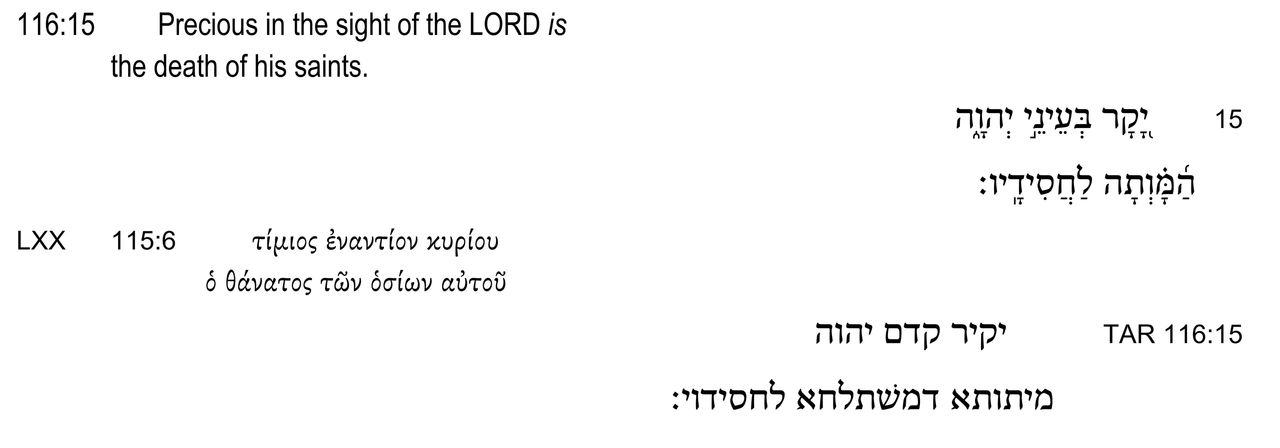
The Hebrew word translated “saint” in this text, hkäsiyd, is an adjective derived from the root, hkäsăd, a verb which is itself derived from the noun hkĕsĕd. Recognition of this inseparable tie between the English word “saint” and the Hebrew word hkesed is essential to accurate perception of the LORD’s view of the death of those who love Him and seek to walk in His way. He is the one who designed and built into the first two humans the language which came to be called “Hebrew” during the life of Eber, the great-great-grandson of Noah. The LORD Himself is the origin of the words of Scripture, and their meanings, and He invested His meaning into the text of this verse. Thus, an understanding of His actual words is essential for developing an accurate view not only of “death” but also of the fact that the God Who Exists cannot in any way be uninvolved in the “death” of “His saints.”
The death of a hkasiyd, then, is not “death” according to the modern perception. Because the hkasiyd is already walking, living, within the criteria of the Creator’s design, death is but another step in that walk. The only change is from walking in the physical life designed by the Creator to walking in the non-physical life designed as well by Him.
Usage of Hkesed:
The widely-used Hebrew noun hkesed has been translated into English almost exclusively using terms which have a positive connotation: “mercy, kindness, goodness, loving kindness, covenant mercy, good deeds, favor, pity, merciful kindness.” Only twice did the translators of the AV use terms which have a negative connotation: “wicked thing, reproach,” but even these occurrences are not truly “negative” when hkesed is accurately defined. The verb form, hkasad, occurs only three times in Scripture, with the translations: “show thyself merciful” (hithpael reflexive) and “put to shame” (piel intensive).
The seemingly wide variation in the translations indicates the difficulty which English translators have encountered as they sought to capture the significance of hkesed in a single word. In reality, the word hkesed cannot be translated by any single English word, but would require a “paragraph” to express the depth and significance which the Creator Himself invested in the word. In actuality, though the various English translations can seem confusing, these renderings can all be correlated to God’s definition, thus helping the English reader who seeks to properly correlate them to one another develop a better sense of each occurrence of this word in all its forms. When the reader applies God’s definition to hkesed, then he will be able to perceive the true nature of the translations “mercy, kindness, goodness, etc.,” and, at the same time, he will realize that hkesed expresses more than any one of these translations encompasses. God set the criteria of hkesed and nothing of man can encompass all that His infinite mind could proclaim in this single Hebrew word.
Meaning of Hkesed:
The Hebrew noun hkesed refers to the criteria designed and established by the Creator for the relationship and interactions between any two entities of the creation, regardless of the nature or number of those creations. Stated differently, hkesed refers to the criteria of God which define the proper interaction between any two persons or things, whether between God and man, man and man, man and animal, or any two things or aspects of the creation. He perfectly designed and constructed every thing and every system of the creation, including the manner in which they were to function and interact with one another. Because the word hkesed refers to the criteria governing these interrelationships, it is also used to describe the condition which exists between two entities when His criteria are being properly applied. Hkesed, then, exists between two persons or things when they are interacting with one another in accord with the Creator’s design.
In the text of Psalm 116:15, the word translated “saints” is the plural form of the Hebrew adjective hkasiyd in which the vowels have been changed from those of hkesed. This change in vowels indicates that this adjective, with its “ä-iy” vowels, is a passive form, thus signifying that the action of hkesed has been done to that person or thing. This indicates that the person or thing is an object which has received hkesed from some other person or thing, and the hkesed given or received by a truly Godly individual is in accord with God’s design for the relationship. If it were not in accord, then the relationship could not be considered as one of hkesed. Certainly, however, when God Himself is the one doing or imparting the hkesed, then that hkesed is in absolute, full accord with the criteria of His perfect design. Then, too, when the individual who is receiving the hkesed of God is a righteous person, that is, one who is seeking to walk with God, that person is a hkasiyd, a “saint,” a “godly” person, a truly “good” person, who is seeking to actively and accurately represent the God Who Exists. This is the nature of a “saint” in God’s eyes: a “saint” is one who has willingly received the hkesed of God in full accord with God’s design for the relationship between him and the Creator. A saint is a person who makes himself or herself walk in the integrity of who he or she is in God’s sight. . . and his or her children, and all who interact properly with him or her, will be blessed. This is an absolute from the absolute Creator of all that exists.
Association of Hkesed with “Mercy”:
The common association of mercy with the idea that some guilty party does not “get what he deserves” is not a part of the basic meaning of hkesed. In actuality, the application of this “not getting what he deserves” meaning to the word hkesed results in an erroneous view of God, and of His salvation. Humans, whether saved or lost, “get exactly what they deserve.” The “saved” human “gets” completeness with God and eternal blessedness, because he has accepted God’s provision for reconciliation. This human has accepted God’s terms, and upon doing so, he passed from deserving the lake of fire to deserving the blessedness of an eternity with God in a totally unalienated condition, not from any merit of his own, but because he accepted God and His condition: believing Him in regard to His giving of the life of His Son to pay that individual’s debt of violation.
On the contrary, the “unsaved” man “gets” the alienation of enmity with God and eternal destruction, because he has rejected God’s provision for reconciliation. This human remains deserving of the lake of fire, until the moment he changes his mind, believes God, and receives God’s provision. At that moment, he no longer “deserves” the lake of fire, but the blessedness of eternity with God in a totally unalienated condition. Truly, God never gives to any human anything which that human does not deserve, or stated alternately, God always gives what is exactly right. He alone knows all things, and the motivations behind them, so He alone knows what is exactly right. Humans presume to know, but in so doing, they are actually demonstrating their desire to be “like God, knowing good and evil,” and this presumption is but another manifestation of their rejection of the Creator and His design.
Even the modern concept of mercy finds its roots in hkesed. When “mitigating circumstances,” or “love,” or “pity,” or any of a number of similar things, are applied when justice is being distributed, and the “guilty party” rightly receives “less than he deserves,” this is simply a proper, hkesed, application of additional factors in the relationship. Though these “mitigating” factors may never be known to others or “discerned” by them, they need only to be known and applied by the one evaluating or rendering judgment. An illustration may clarify this connection.
Application of Hkesed in the Home:
Some parents, even among those claiming to be Christians and “believers,” exhibit little or no hkesed in disciplining their children. Many of these parents seem to have adopted the philosophy that effective correction in some way “violates the child’s rights,” or it “stifles creativity,” or it “perverts the child’s thinking and perspective.” Others seem to have adopted the totally opposite philosophy where no evaluation of circumstances and no mitigation is allowed; discipline is “cut and dried”: “if the child did the crime, then he or she must do the time.” Both of these parenting styles are perversions of God’s design.
Other parents, however, exhibit not only hkesed in their discipline, but also wisdom and understanding, two things which are actually inseparable from hkesed. These parents recognize that in reality no two commissions of a “crime” are exactly alike. In one instance, more rigorous corrective action may be justified and necessary, while in another instance, though the more rigorous correction may seem to be justified, it is totally unnecessary. Thus, especially in the eyes of those outside the situation, the child may not receive what he appears to deserve, and thus, is said to have received “mercy.” In reality, God’s design for the relationship may be that the parent take some personal responsibility for the child’s “crime,” and use that personal responsibility and accountability to correct the child by changing his mind in regard to his unacceptable actions. In this manner, the parent may actually be giving his child exactly what he truly deserves according to God’s design for parenting.