
by Kenneth F. Sheets
Many in the churches of today have been drawn into the belief that Jesus Christ was crucified on what is called “Good Friday,” the Friday before He rose from the grave before the breaking of day on Sunday. Indeed, the belief in a Friday crucifixion has become an established and unquestionable tradition in many circles of Christianity. Apparently, some in time past had studied the Scriptures and concluded that Friday must have been the day when the Lord of all gave Himself to pay the debt for all human violations throughout history. Many would say that the actual day of the crucifixion is not important, and that the only thing which is important is that He died to reconcile a lost humanity to Himself. Certainly, no created being or entity could even begin to pay this debt to God, and Christ’s death, the death of the very Son of God, fully satisfied God’s righteous requirement. So, to many, the day of His death does not matter, but if God revealed that day, then He intended humans to know and represent it accurately. His Spirit confirms all truth, and He does not confirm that which is not true; thus, He confirms this aspect of the crucifixion when it is represented as having occurred on the day which He actually revealed.
Friday might have been the true day of the crucifixion, if it were not for one seemingly “minor point”: a Friday crucifixion does not fit the actual expressions of the Scriptures. At least seventeen verses of Matthew, Mark, Luke, John, Acts, and 1 Corinthians record information regarding that day, and no one of these verses is more authoritative than any other, but when an interpreter uses only a translation, in whatever language, to determine what God intended to communicate in the texts as He gave them, then the potential for error exists. Furthermore, if the Scriptures are interpreted and represented inaccurately, then such error opens the way for valid criticism and for nonbelief. The Scriptures, then, as God gave them in the ancient Greek language of the New Testament era, must be the source, the foundation, for understanding. The ancient Greek expressions of these seventeen verses are as follows:
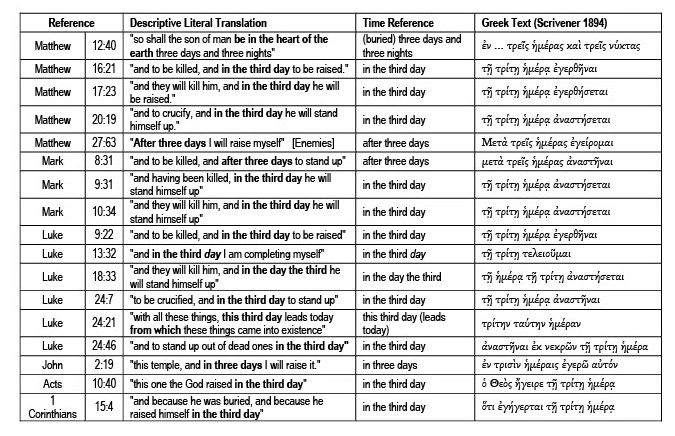
The actual day of Jesus’ crucifixion, the day in which the “three days” began, whether Thursday or Friday, or even Wednesday, has often involved a discussion of sabbaths and sabbath preparation days, including whether or not the day before the normal seventh-day sabbath was itself a sabbath, and this discussion is valid. An unquestionable key to determining the day of the Lord’s crucifixion is the fact that Matthew indicated that “Mary Magdalene and the other Mary” went to the tomb as the sabbath was ending and as the first day of the week was becoming light.[1] A great earthquake came into existence, and an angel of Yihyeh rolled back the stone and sat upon it. Thus, the tomb was open for the women to see that the body of Jesus was no longer there. Certainly, the unGodly “guards” fainted from the sight of this holy being, but they were not the only ones who saw this magnificent messenger from the Creator.
The women saw him as well, and their minds and hearts were stirred by that experience. Matthew’s description[2] indicated their amazement and that the angel’s “Fear not ye . . .” statement was in answer to what he knew those Godly women were experiencing. Matthew’s actual wording of the angel’s address to them is, literally, “having answered, he said to the women, You! Stop fearing.” The fact that he was answering their obvious wondering response is further confirmed by the explanatory words, “For I know that Jesus, the crucified one, you are seeking.” He knew that his explanation of the empty tomb sufficiently relieved the anxiety they were experiencing, because he immediately followed with the instruction to “go quickly, and tell His disciples.”
A key point in Matthew’s text in regard to determining the day of the crucifixion is that Jesus had already risen before the women arrived before the first day of the week began that morning. This, then, definitively determines the end of the “three days,” and thus, the actual day of the crucifixion will be accurately determined from the actual wording which God inspired His holy men to write, and, as stated above, seventeen references exist which describe those “three days.” The most common form of this “three days” reference is “in the third day” (té trité hémera), the exact form occurring in twelve[3] of the seventeen locations, including one where the word “day” is elided and one which would literally be “the day the third.” Two other references,[4] one in Matthew, quoting Jesus’ enemies, and one in Mark, both use the terminology “after three days,” but this is not “after” in the modern sense that three 24-hour periods are completely “past”; it is “after” in the sense that three days are past, in some degree as determined by the speaker or writer.[5]
All of these fourteen references, plus one in John[6] and another in Luke[7]clearly define the number of days to be three, but in one other reference Matthew[8] distinctly defines those three days as “three days and three nights.” This distinction is significant, because it defines the three days to be comprised of three actual days and three actual nights, but then again, these days and nights are not to be defined by the modern concept. They must be defined by the minds of those who wrote the Scriptures, and especially by the mind of the Hebrew individual, Matthew, who recorded this distinction. To the ancient Hebrew, the day began in the evening, essentially at sunset, the “dark” part of the day, and continued through the next morning, essentially at sunrise, into the “light” part of the day, with a new day beginning the next evening. The ancient Romans, though their formal beginning of a day was at midnight, numbered their “natural” daytime hours by starting in the morning at sunrise and ending at sunset. Both the Hebrews and the Romans, just as most modern humans do, considered any part of the “dark” part to be “night” and any part of the “light” part to be “day.” Certainly, they possessed ways of distinguishing earlier and later parts of a “night’ or a “day,” but all parts were still parts of a “dark” or a “light” period. Accordingly, a part of a “night” could be referred to as a night, and a part of a “day” could be referred to as a day, and everyone involved would understand what was meant, because every expression was given in a context which clearly defined its use.
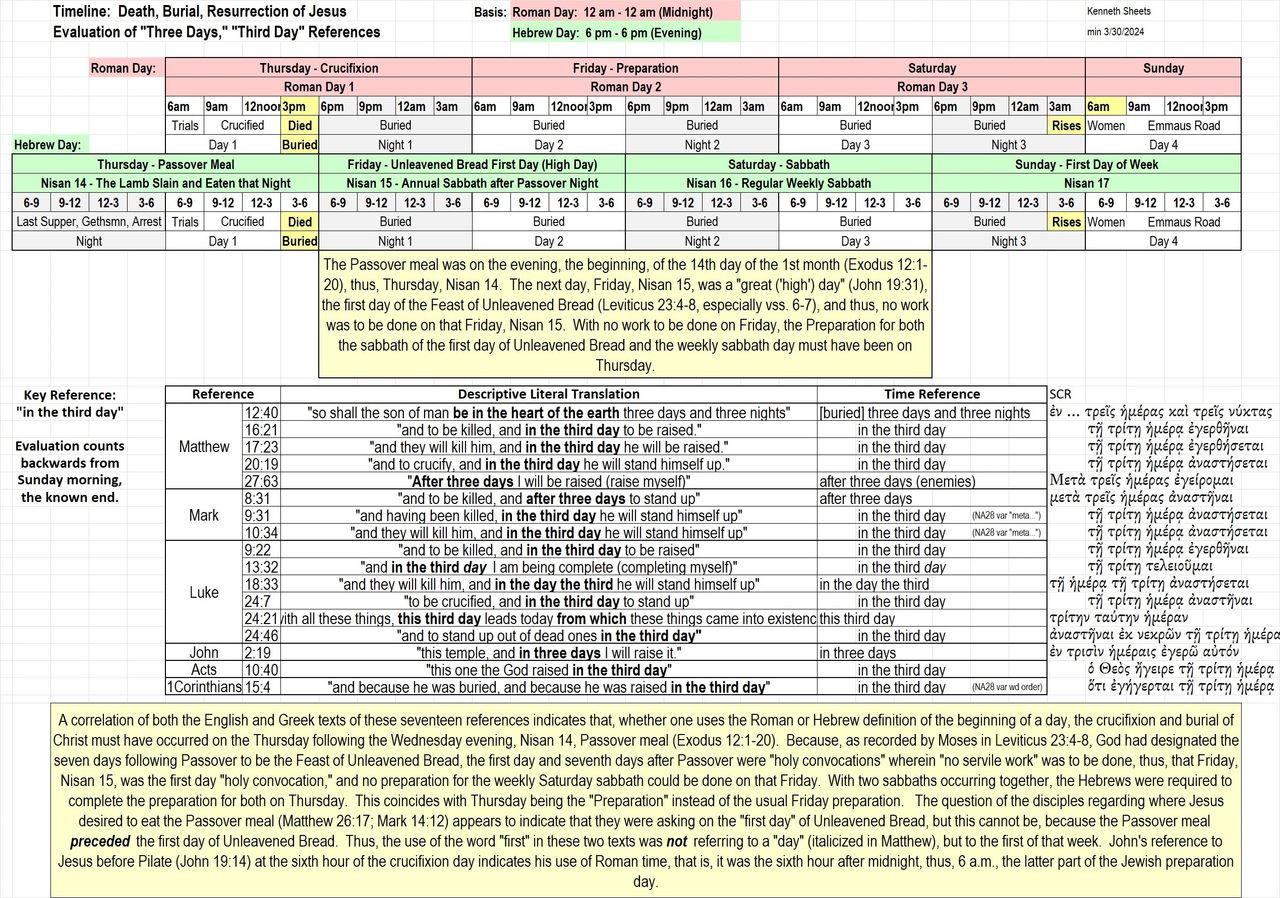
Another key point is found in John’s gospel[9] where he recorded the request of the Jews to Pilate that he break the legs of the crucified ones so they would die and be removed from their crosses before the beginning of their Passover sabbath[10] that evening. This is John’s reason for recording “that sabbath was a great one,” that is, it was not the normal seventh-day sabbath (which followed this particular Passover). The body of Jesus was, therefore, placed in the tomb before the Passover sabbath began, a fact which also indicates that He was already dead on that preparation “day,” thus making the remaining “light” portion of the preparation “day” to be the first day of the “three days.” Then, that evening, the second day began and continued through the next “light” period. Then, following that “light” period, at the next evening, the third day began and continued through the next “light” period.
The Hebrew[11] and Roman times for the beginning of a day varied as indicated below:
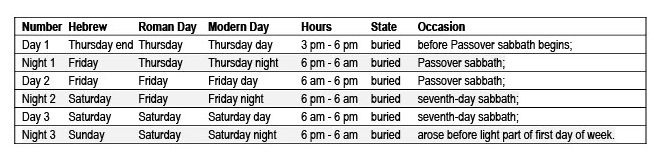
As these various points of evidence demonstrate, a plain reading of the Greek text of the New Testament does not support a Friday crucifixion. The “Good Friday” crucifixion must be reevaluated by counting backwards from the pre-dawn hours of early Sunday morning, the known time of Christ’s resurrection.[12] By either Hebrew or Roman reckoning of the days of the week, Christ arose “in the third day,” and “after three days,” and He was in the grave, “the heart of the earth,” for “three days and three nights.” Any chronology of the death, burial, and resurrection of Jesus Christ must be reconciled to every text which describes the “three days,” including Matthew 12:40[13], and a Thursday crucifixion is the only chronology which fulfills that requirement. The Scriptures indicate that Christ was crucified on the preparation day.[14] Christ was therefore crucified on the day prior to the “sabbath,” and, ordinarily, the “sabbath” would be Saturday, but that “sabbath” was a high day,[15] a reference to the fact that this was not a normal sabbath. Indeed, the Passover observance began the evening after Christ was crucified, and its first day was “a holy convocation” with no work being done.[16] Thus, two sabbath days existed that week, one on Friday and the other on Saturday. The preparation day for both sabbaths was therefore on Thursday, as was the crucifixion.
[1] Matthew 28:1-7.
[2] Matthew 28:5.
[3] Matthew 16:21; 17:23; 20:19; Mark 9:31; 10:34; Luke 9:22; 13:32; 18:33; 24:7, 46; Acts 10:40; 1 Corinthians 15:4.
[4] Matthew 27:63; Mark 8:31.
[5] The meaning and significance of the words in any communication is determined by the author, not the receiver.
[6] John 2:19.
[7] Luke 24:21.
[8] Matthew 12:40.
[9] John 19:31-42.
[10] John 19:14. John specifically states that the preparation was for a Passover sabbath, not the weekly.
[11] Matthew 20:1-16.
[12] Matthew 28:1; Luke 24:1; John 20:1.
[13] “For as Jonas was three days and three nights in the whale’s belly; so shall the Son of man be three days and three nights in the heart of the earth.”
[14] Mark 15:42; Luke 23:54; John 19:31.
[15] John 19:31.
[16] Exodus 12:16.