
A Right View of One’s Relationship to the Creator Makes That Person’s Life Totally Free and Unbound
by Kenneth F. Sheets
The LORD God once said that His people suffered destruction in their lives because they had rejected the knowledge of Him and His design for their existence.[1] Their lack of knowledge left them ignorant not only of the proper way to live and interact with everything around them, but also of the nature and being of the One to whom they owed their very existence. They had denied the evidence He had provided, evidence they encountered in every aspect of their existence, and had become satisfied with the external and superficial aspects of relating to Him. Hosea recorded these words:
4:6 My people are destroyed for lack of knowledge: because thou hast rejected knowledge, I will also reject thee, that thou shalt be no priest to me: seeing thou hast forgotten the law of thy God, I will also forget thy children.
The people of God had rejected the knowledge of God which surrounded them and which He had built into all that exists, thus providing this knowledge, this wisdom, to them in an inescapable manner. His people, however, had not concerned themselves with seeking the criteria of His design, and as a result, they did not possess either the knowledge, or the understanding, they needed to interact properly with Him and the entirety of all that exists.
A proper understanding of “free will” is rooted in understanding that nothing in creation, not anything, is, or ever was, “free” or intended to be free, according to the modern concept of the word. In present day thinking, “being free,” or “having freedom,” is rooted in the idea that an entity, usually a person, is not subject to any form of authority, whether a person, a thing, or a concept, which in some way imposes, or seeks to impose, criteria upon the actions or state of the one who is “free.” The one who is subject to the imposed criteria is, then, no longer truly “free”; he may and does have a “will” in every matter of his existence, and he may appear to be totally “free” to follow his “will” in most aspects of his existence, but, in those aspects wherein he is subject to the criteria of the “will” of an authority external to himself, he does have and cannot exercise a “free will.” He is “accountable” to that authority which he cannot change or affect, and he must answer to that authority for his conformity to or violation of those criteria. Such an entity, such a person, in the modern concept, is not “free,” but “bound.” Indeed, that person is “bound” by and within whatever conditions of existence he is unable to change or bend to his will.
In this sense, every human is truly “bound,” and no human possesses a “free will,” because every human is subject to various conditions of human existence, not the least of which his created nature, which he is unable to change. Though in some instances it may appear that a human has been able to change or influence seemingly “unchangeable conditions,” in reality the human has done nothing more than interact with those conditions according to a set of criteria of which he may or may not be aware. This is obvious in the so-called “scientific realm” where humans seek to discern and apply the governing principles of the creation. Virtually all in the “scientific realm” acknowledge their dependence upon the “criteria” of the physical realm, but, outside the physical realm, humans tend to think that no “governing criteria” exists, that is, they think themselves “free” to do and pursue whatever they perceive to be right for them and their situation. This is the basic philosophy that promotes the concept that “a person can become anything he or she wants to be.” Such a concept makes the mind and will of the individual the only limiting factor in one’s non-physical existence. In light, however, of the “unchangeables” of human existence (history, birth, nature, etc.), the fact that man can to any degree promote such a concept is almost incredible, but the sense of authority built into him combines with his “fallen” mind, and its inherent blindness to reality, to make him think that he is actually self-determining.
On the other hand, everything in creation is “free” to function within the criteria established for its existence. God never designed, allowed, or intended, anything to be “free” as humans so define “freedom.” From the beginning, He designed all things to operate, to interact, to function, in a manner that accurately reflects its true nature . . . that it is the finite creation of the infinite Creator, a fact that makes the Creator, and His design criteria, of singular, irreplaceable, and incontestable importance in the existence of every thing. When a human or any other entity fails to adhere to this truth, that human or entity is in active, willful rebellion to reality. Everything of the creation is accountable to conform to the criteria of the Creator, the God Who Exists, the God who brought the entirety into existence, and nothing can escape this accountability.
Violation of God’s design, “sin” as man calls it, is not just something that is “wrong” from God’s perspective, as though God’s criteria were arbitrary in some way or to some degree; it is “wrong” in the most absolute sense, in that, it represents a violation, a willful rejection, of reality. Such rejections of reality are the manifestations of a rebellion against the real authority structure extant by the fact that the primary, foundational, essential, aspect of everything that exists is that it is created and is accountable to its creator. Certainly, God is at the “top,” but not because He “placed” Himself there. Rather, He has always existed there by virtue of the fact that He is Creator, and that creation does not exist external to Him, but is “internal,” “integral,” to Him; in Him all things “are living and moving and existing.”[2] Thus, the God Who Exists is more than Owner, Designer, and Absolute Authority; He is that within which everything exists, and without whom, nothing of the creation could exist.
Thus, the only accurate concept of “free will” is that concept which the Creator established, and which is in accord with His Person, a Person which was perfectly manifested in what He created and how He designed it to interact. In that perfect creation, He designed a system wherein each entity, each human, was “free”:
– to assimilate information with the sensory abilities built into him,
– to evaluate and correlate that information within the criteria, the perfect set of bounds, the “laws,” established by the One who built the entire system,
– to reach conclusions and make decisions based upon his evaluations and correlations,
– and to act accordingly in complete freedom and with full delegated authority fully within the criteria, the constraints, of the design of the system in which he existed.
Every human, then, possesses a “free will” to function and interact within the design of God, and, in the power of the Spirit of God, every human also possesses the ability to think the thoughts, the “will,” of God and walk within them.
From the moment of his creation, man has never been without knowledge of the criteria of God’s design for his existence. Though, from the human perspective, some criteria may have been “added” over time or “modified” by the Creator according to the specific situation in which man found himself, the basic criteria which form the foundation for all other criteria have remained absolutely unchanged. Included among those unchangeables would be such things as man’s relationship to his Creator, and thus, man’s relationship to every other created thing, because God had established criteria not only for the function but also for the interactions of every individual thing He had brought into existence. These unchangeables form the boundaries within which man is to live. Thus, they are incumbent upon the life of every individual at every moment of time in every place, regardless of the conditions encountered.
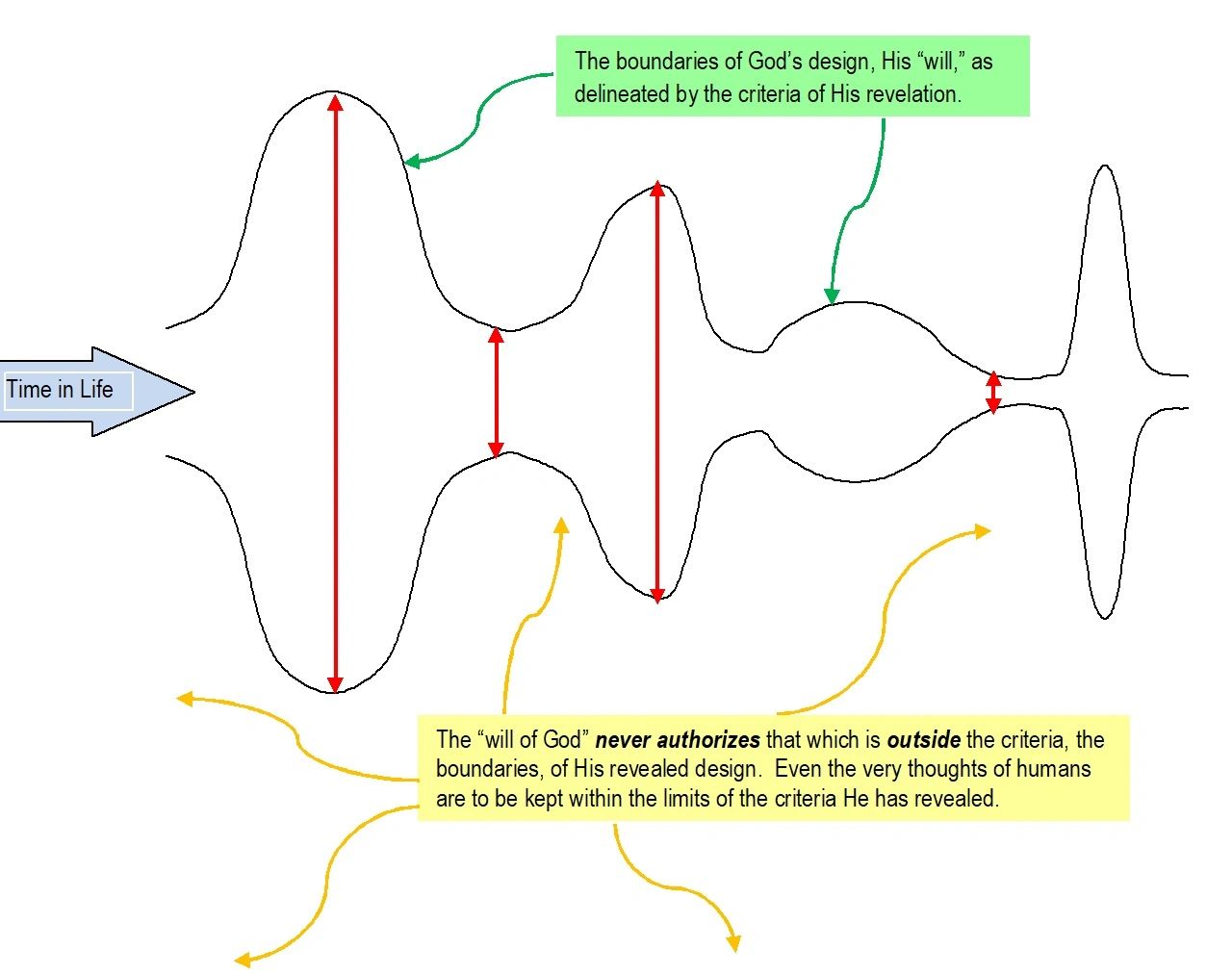
Though God created humans with the ability to think and to act outside these boundaries, they were to exercise personal, individual control and restrain themselves, allowing God’s revelation to form the limits of both their thoughts and their activities. In so doing, humans would conform themselves to reality, the true reality that God is the infinite, transcendent Creator within whom all of creation exists, and that humans are finite, created beings who exist within that creation and whose thinking and abilities exist only as established by and within the Creator.
Accordingly, humans cannot actually think or act outside the Person of the Creator; they can only presume to do so. The true reality is that humans can only think or act just beyond the design criteria, the boundaries, which God imposed to govern their existence, but, regardless of the authorities that appear to confirm all human perspectives to the contrary, humans can in no way exceed the boundary formed by the person of the God in whom they “live and move and exist.”[3] Humans may violate the authority delegated to them and choose to walk within God’s design, and thereby walk with God, or they can walk outside His criteria, misusing their ability and authority, both of which were delegated to them by the Creator, to evaluate information, reach conclusions, and make decisions that are not in conformity to God’s design. Humans cannot, however, escape or change or diminish the authority which God’s design bears over their existence. They can seek with every thought to change or erase the criteria of the Creator’s design, but, because of the Person of their Author, they can never escape either the effects of those criteria or their accountability to them. God is who He is, and this fact cannot be changed by the entirety of the creation, a creation that exists at His will and within His Being.
Within the bounds of God’s criteria, however, a human is completely free. He is free to interact as he desires with every other thing in the creation. He is free to make choices, the range of which is sometimes so wide and varied that he cannot even perceive that boundaries exist. In this condition, he is totally unfettered, unbound, unrestrained, doing whatever he wants to do, walking with the One who brought him into existence and who is always working to make his life a glorious existence.
Certainly, at other times, his choices become fewer in number, and the way of God seems to narrow, but the human who accurately perceives his relationship to God also sees his own smallness in the way of God, and thus, he never seems to recognize the narrowness of his way or the limited nature of his choices. The freedom that remains to him far exceeds the bounds of his own personal desire, and, again, he lives and walks with God totally free of bounds and restraints. Other humans who view his life from outside his smallness perspective or from a lack of understanding of the true design of God may still see him as bound, fettered, controlled, but, for him, the way of God is always broad and open, so great in expanse that the limits and constraints are never in view. He is truly free in Christ.
[1]Hosea 4:6-7.
[2]Acts 17:28.
[3]Acts 17:28.