by Kenneth F. Sheets
The use of the English translations of Biblical words as those words were expressed in the Hebrew and Greek Scriptures is not an unacceptable practice for referring to a “doctrine,” but, like the word “doctrine” itself, a word which simply means “teaching,” when the meanings and connotations associated with the English translation become the definitions of that doctrine, then great potential exists for erroneous understanding and application. In the case of the so-called “doctrine of imputation,” this latter condition of error has led not only to misunderstanding but also to significant misapplication, both of which mislead believers at all levels of supposed knowledge.
The “doctrine of imputation” is rooted in the use of the verb “impute,” and its related forms, in the English Bible, and, despite the many occurrences of “impute” and its related forms in the English Bible, few modern preachers and teachers, if any, give evidence that they have properly correlated this translation to either its Greek or Hebrew origins. Modern preaching and teaching of this doctrine is based almost entirely upon an English-only understanding of the English word and its associated usage. Though some will insist that they trace their concept of “the doctrine of imputation” from the Biblical language texts where the English word occurs, the fact that they use the English terminology to describe the “doctrine” is a clear indication of the foundation of their thinking.
Though claiming to use the Biblical languages, they manifest the common modern error of interpreting the ancient Biblical language words of Scripture according to the definitions and concepts resident in, or associated with, the English words in the modern era. If these were the definitions and concepts resident in the minds of the ancient Scripture writers, the problem might be minimized, but humans tend to use words in ways that cause their meanings to migrate into specialized usages, thereby losing certain aspects of their original meaning. Then, when interpreters attempt to understand these word usages according to the specialized, narrowed, concepts, error results to the degree that the word has changed from its original setting. This is the nature of the foundation upon which the “doctrine of imputation” was built, a foundation which must be demolished to allow the establishment of a true foundation which rests upon a true and accurate representation and interpretation of the texts of Scripture as God intended them to be understood.
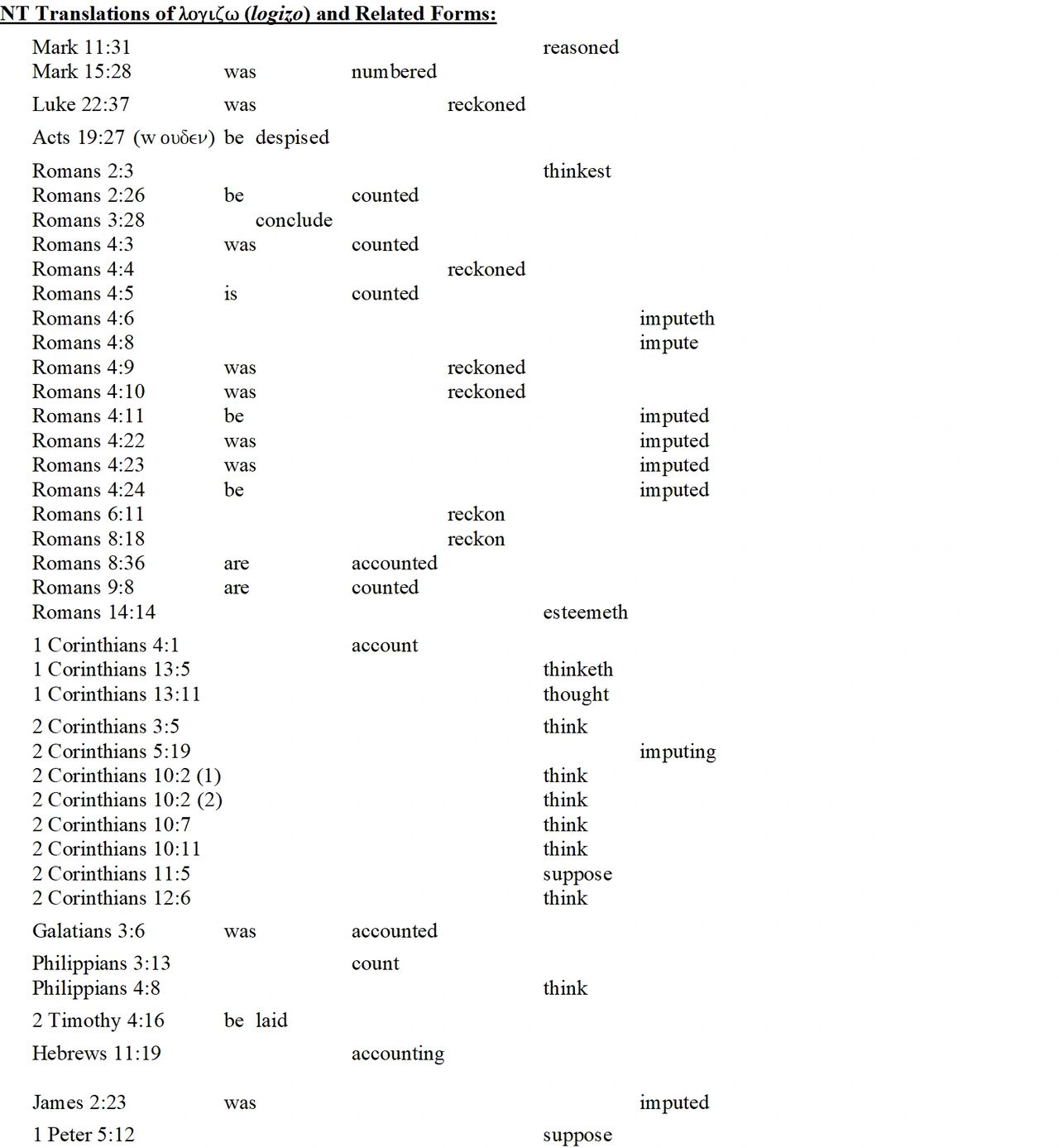
The establishment of this true foundation begins, first, with a determination of the actual meaning of the ancient Greek word which has been translated “impute.” This must be the first step, because those ancient Greek words of the NT are the words chosen by the Spirit of God for revealing His will and His design for His creation. In the NT, “impute” is a translation of one of the various forms of the Greek verb lŏgizō, which is variously translated to “number” (to “count, account”), to “think” (to “reason, esteem, suppose”), to “impute,” or by some similar verbal idea. This Greek verb itself is a two-part composite from:
lŏgŏs: an expression; something which expresses or communicates something,
and
-zō: a verb ending indicating that the action (or state) of the verb is being caused by the subject or doer of the action.
The action of lŏgizō may be expressed in either the active or the passive voice, but it also fits the middle voice perfectly, because when an individual is doing this action, he himself is directly affected by that action, that is, he is affected by his own thinking, his own combining and correlating of all various points of information available in his mind at the time. This action of combination and correlation occurs in his mind whether the individual is consciously performing it or it is occurring only “subconsciously.” He is, thus, “causing expression,” that is, he is thinking, putting together in his mind the various aspects of a condition or situation and causing himself to see that condition or situation in a certain way consistent with the information in and coming to his mind. Each aspect of the condition or situation is “expressing” something to his mind, even if not understood, and the composite of all the information is that which appears to be “actual” to him.
This process is, of course, the design of God, but difficulty arises when man “causes expression” to all the various points of information coming to his mind and reaches an erroneous conclusion. The limitations of man’s “humanness” adversely affects his ability to reach accurate conclusions in the process: his knowledge is limited; his perception is limited; his understanding is limited; and all of this is often skewed and twisted into a parody of right by his own inner man, his heart. However, when God, the creator and origin of this mental process, is the one doing it, He perfectly sees and knows and perceives and understands and correlates every possible point of every possible bit of information, and He is never affected by any “inner desire” that is less than perfect. His conclusion, that which He is actually thinking, is the perfect, exact expression of reality. Thus, the Greek verb lŏgizō, or lŏgizŏmai, its middle voice form, carries the basic meaning “to think,” a significance which clearly manifests itself as the root concept from which each of its translations has been derived.
The Hebrew Scriptures confirm the meaning for lŏgizō in the five (5) occurrences of “impute” in the English OT: Leviticus 7:18; 17:4; 1 Samuel 22:15; 2 Samuel 19:19; and Psalm 32:2. The last reference, Psalm 32:2, occurs in a passage where God constructed the four lines of verses 1 and 2 in a synonymous parallelism relationship which distinctly defines the meaning of “impute.” The parallelism is especially significant both for confirming the meaning of the NT Greek word and for recognizing the Hebrew verb hkäshăb, as well as the inseparable connection between lŏgizō and hkäshăb. In fact, the LXX translators used lŏgizō to render the Hebrew hkäshăb in their translation of the OT into Greek.
This connection between the Hebrew hkäshăb and the Greek lŏgizō indicates that the LXX translators understood the two different words to carry the same basic meaning, though in different languages. The Hebrew hkäshăb, which is the primary word in this evaluation, carries the basic meaning “to think,” and, like its Greek counterpart, can be translated by any of a number of associated ideas. In one-fourth of the 132 OT occurrences of hkäshăb, it is actually translated to “think” or “imagine.”
This is the word translated “counted” in Genesis 15:6, thus giving a more literal translation: “And he [Abraham] believed in Yihyeh, and he [Yihyeh] thought for him righteousness.” Thus, when this OT word or its NT counterpart is translated by terms such as account, count, impute, reason, conclude, etc., etc., these are all derived from its basic aspect to “think,” because all of these actions involve combining and correlating in the mind all the various bits of information coming to that mind. When the LORD is the one combining the information, His thoughts are the exact expression of reality, because He cannot in any way misconstrue or mistake the information coming to Him.
Therefore, when He thought for Abraham, “righteousness,” it was not simply a “judicial” or “imputed” or “declared” righteousness; it was as real and actual as the LORD God Himself. The thoughts of God with respect to Abraham were an expression of absolute reality regardless of what any or all created beings (or modern theologians, even Baptist preachers, who are supposed to be knowledgeable) might conclude to the contrary: Abraham existed righteous in the eyes of the One who is the absolute definer and determiner of righteousness.
In the same manner in the present day, when a person places his trust in the Creator’s revealed design for the means of reconciliation, just as Abraham did, then God thinks “righteousness” for that person, and the righteousness which He thinks is as real and actual as is the Creator Himself. Thus, whenever one speaks of the righteousness of the believer in Christ, he should never qualify it by “judicial” or “imputed” or “declared” or any term which makes, or appears to make, that righteousness appear to be anything less than absolutely actual. Then, when this righteousness is accurately proclaimed with an accompanying emphasis on personal integrity, that is, on conducting one’s life in accord with who he or she is in the sight, the thought, of God, believers will be motivated to commit themselves to learning the criteria of the Creator’s design in order that they might walk more accurately with Him.
Accordingly, the term “doctrine of imputation” should only be used to correct erroneous thinking and the widespread false teaching associated with the term, a false teaching which has too long continued. Essentially, “imputation” as a concept should be eliminated from use by those who seek to walk with God, because its very use tends to imply that the righteousness of the believer is not absolute or complete in some way or to some degree. Though many who teach this “doctrine” will affirm that the righteousness is absolute and complete, they do not realize that their addition of the word “imputed,” or one of its related forms, to refer to “imputed righteousness” is actually making the righteousness something less than absolute and complete. Instead of using this terminology, men and women who desire to teach accurately should represent the righteousness imparted by God as it is: it is the absolute and complete thinking of God toward the believer . . . righteousness! If a preacher or teacher does not recognize the absoluteness and completeness of the thinking of the Creator, that preacher or teacher is not qualified to teach and should be removed from doing so, because he or she does not know God as He has revealed Himself!