
The Godliness Imparted to Esther by Mordechai Affected Everyone around Her
by Kenneth F. Sheets
Esther 2:7 – Mordechai Had “Firmed” Esther’s Character in the Design of God
From the time when she was first taken to the king’s house of women, Esther’s excellent character and demeanor had been obvious in her every action and interaction with those over and around her, and that character was not some kind of facade which she wore at times. This was who she existed, who she was, and it had been instilled into her by her cousin Mordechai, the man who “brought her up” in the absence of her parents. He had taught her to act in a truly Godly manner with respect to everyone around her. She did not act one way with certain individuals to gain their favor and then act another way with others whose favor would have no real effect on her life. Her “upbringing” at the hand of Mordechai had obviously been one focused on Godly instructions regarding the Creator’s design for the conduct and behavior of a young woman seeking to accurately represent her God. Mordechai had sought to make her character one of true “firmness,” and she manifested that she had learned well. The Creator, then, saw fit to record the results of this instruction and the influence which it developed in her life.
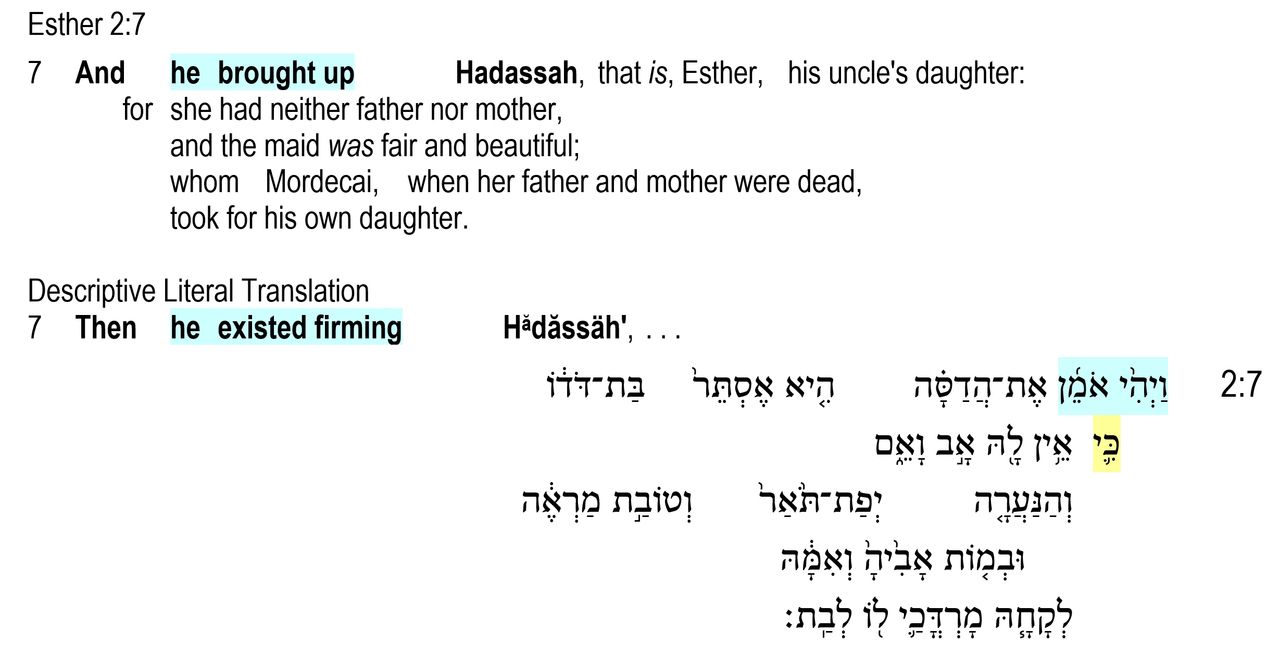
The English translation “and he brought up” would be translated literally “then he existed firming.” The Hebrew construction consists of the verb form “he existed” and the qal active participle of the verb ämén indicates that Mordechai was continually, duratively, “firming” Esther’s character. The Hebrew verb ämén means “to be firm,” that is, “to be firm” according to the design of God for “firmness.” Then, too, that which is “firm” is also “true” in the most absolute sense, and thus, Mordechai was “truing” the character of Hadassah, that is, he was developing in her a character which “truly” represents the design of God. Such true “firmness,” however, is, and cannot be different from, pure Godliness; the “firming” of someone consists of teaching and conforming that person to the Creator’s design for human existence. Any other concept of “firming” is not, and cannot ever be, true “firming.” Stated differently, “firming” in the design of God develops in that person a true concept of conformity to the person and nature of the Creator and the criteria of His perfect design, His perfect hkĕsĕd, a design which encompasses every aspect of every possible interaction between any two things in the creation. “Firming,” then, is “truing,” conforming the entirety of a person to the only absolute means of success and blessing in life. This was the nature and content of Mordechai’s “bringing up” of Esther.
Esther 2:8-9 – Esther Applied the Design of God and Lifted Hkesed in the Mind of Hegai
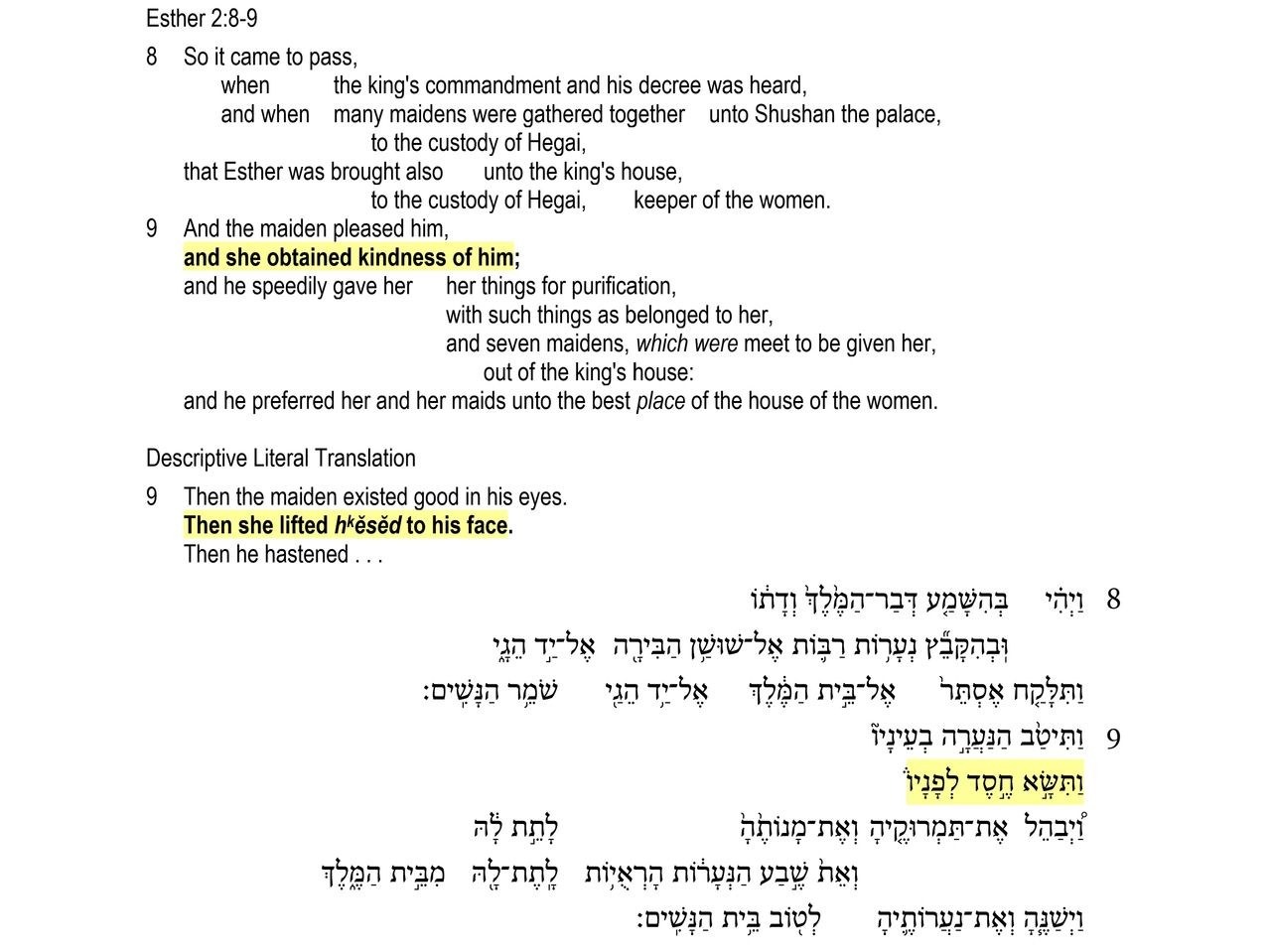
The English wording “and she obtained kindness of him” would be literally translated “then she lifted hkĕsĕd to his face.” In this verse, the word “kindness” is the Hebrew word hkĕsĕd, a word for which no brief definition exists in the English language. This Hebrew word hkĕsĕd describes the perfect criteria which God has established to govern all the interactions and interrelationships of all the entities in the creation, whether those entities are animate or inanimate. Thus, when God moved Mordechai to write that Esther “lifted hkĕsĕd” to the face of Hegai, the Creator was saying that in her interactions with Hegai, she was actively, personally, “lifting up” a recognition in the man’s mind that she was a young woman who knew how to conduct herself properly and respectfully in all her interactions. Hegai also recognized that Esther’s proper and respectful behavior was not a “surface action,” which she manifested only in certain situations. Her proper and respectful interactions came from a foundation deep within her; he could perceive that this young woman had been so well taught that her interactions were simply expressions of her person, her nature, her character; this was who she existed, who she was, in her innermost person.
Esther’s proper and respectful interactions were not superficial; they were not a facade or a “show” of some sort; they were simply the normal expressions of her concept of how she should relate to others. They were, quite simply, external evidences of her internal character, a character which reflected Mordechai’s “firming, his truing,” of her, that is, his “bringing her up” in that which is true and right . . . the design of God. Though Hegai may not have immediately perceived her relationship to the God Who Exists, he could not have missed that someone or something more was working in her life to make her a woman of uncommon grace and wisdom, a woman whose conduct, whose very presence, brought pleasure and peace into the lives of all who interacted with her.
As the individual who was responsible to Ahasuerus for preparing the young women who would be presented to him for his evaluation as a potential queen for him, Hegai was accountable for teaching each girl how she was to interact with the king, how she was to demonstrate proper respect and behavior with respect to the king, whether in his presence or not. The incident with the previous queen, Washti, whose resistance to the king’s will had resulted in her removal, despite her great beauty, now demanded that the next queen be both physically beautiful and “natured” differently. Hegai’s interactions with Esther during the twelve months of her “purifications” certainly confirmed to him that the grace and wisdom he had experienced in his interactions with her would not change when she went in to the king. This young woman would interact with the king just as she had done with him. Indeed, she even trusted him to determine her “appointments” for going to the king. This young woman would interact with and relate to the king with that same grace and wisdom, and he knew that her presence with the king would arouse in the king that same pleasure and peace which others had experienced. Hegai knew the king, and he knew that the combination of Esther’s character with her great physical beauty was a strong indication that she would be chosen to be queen. Certainly, he could do no less than interact with this young woman in an absolutely proper manner, that is, he must interact with her in hkĕsĕd, according to the unquestionably right criteria for a male human to relate to a woman whose Godly presentation of herself indicated that she may become the next queen to his king.
The literal translation “she lifted hkĕsĕd” expresses the actual tense and meaning of the Hebrew words translated, in the English Bible, “she obtained kindness.” Though the translation “she obtained kindness” may appear to be unclear in describing the actual reason why she “obtained kindness” from Hegai, the Hebrew text is clear in indicating that Esther acted specifically in a manner designed to “obtain” the hkĕsĕd, the “kindness,” of Hegai. This hkĕsĕd did not “just naturally arise” out of the goodness of Hegai, and it was not something that God “sovereignly caused to arise” in Hegai apart from Esther’s conscious, purposeful presentation of herself. The actual Hebrew verb translated “lifted” is in a form which indicates that the subject of the verb is actively doing the action, thus signifying that Esther herself was actively doing the action, that is, her actions were those of a young woman who had sought to conform her life to the design of God, and the natural result was that those actions aroused hkĕsĕd in others. Thus, hkĕsĕd arose in the perception of Hegai, but not because God performed a sovereign act or some kind of “miracle” which was not the direct result of the actions of Esther. By the very design of God, Hegai and others could not escape being positively affected by Esther’s manifestations of “ways that please the LORD.” He, Yihyeh, had designed and constructed the system of human interaction so that none could escape being positively affected by their contact with true “firmness,” that is, by their contact with truly Godly interaction; they could reject and resist those effects, but they could not escape them. Esther’s own Godliness positively affected everyone whose life touched hers; this young woman was a Godly young woman who sought to “make herself walk” in the design of the Creator, and the Creator manifested Himself in her life.
Esther 2:15 – Esther Applied the Design of God and Lifted Grace in the Minds of All Who Saw Her
Esther’s grace and wisdom continued to be manifest in all her preparations for going in to the king. She knew that Hegai, a male human being, was far more knowledgeable than she was of those aspects of a woman’s presentation of herself which would please Ahasuerus, another male human being. She would trust him for her “appointments,” and her trust was not misplaced. Everyone who saw her was so thoroughly impressed by the manner in which she bore her great physical beauty clothed in the magnificence of grace (hkén) and wisdom (hkŏkmäh) that they all naturally responded in grace, that is, they gave freely to her the proper expressions and recognition that this young woman was a young woman of incredible excellence in every aspect of her existence, an excellence which was manifested by her unselfish and Godly character. They could all perceive that Esther may indeed become their king’s new queen.
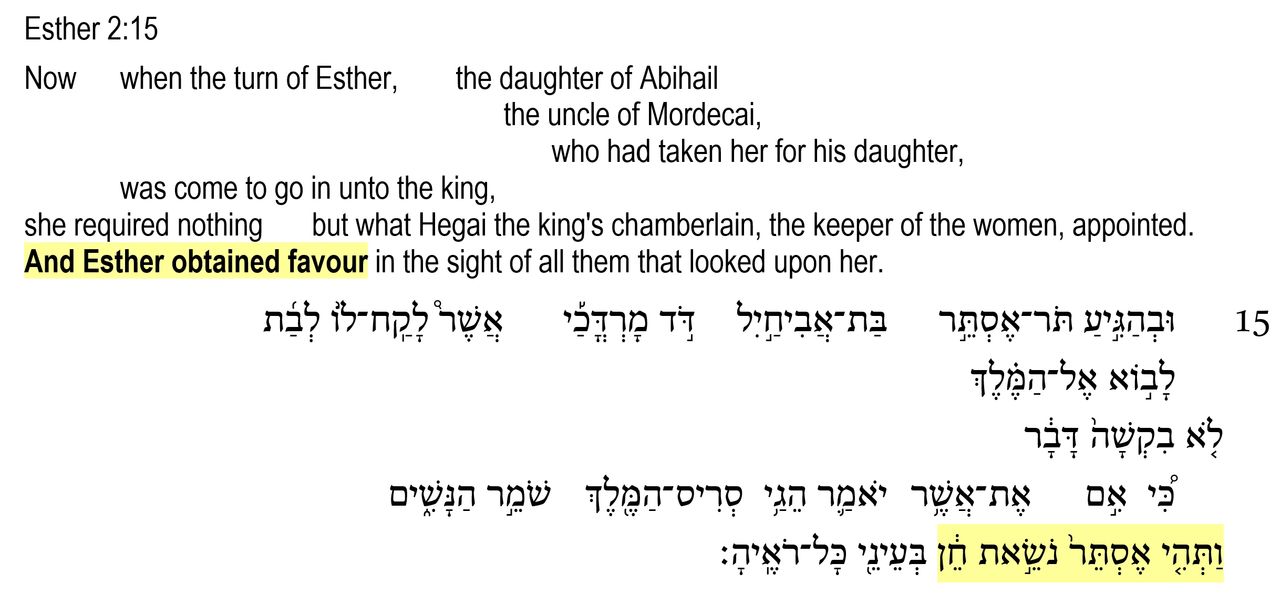
Technically, the English Bible translation “and Esther obtained favor,” in 2:15, would be translated literally “then Esther existed lifting grace.” The Hebrew grammatical construction of this clause is essentially identical to that of verse 7 where the wording “then he existed firming” is the combination of a finite verb, “he existed,” and a participle, “firming.” Though in each of these passages, the Hebrew author could have used a single verb form to communicate the action, he chose instead to combine a finite verb with a participle, thus indicating that he intended readers to perceive that the action in both cases was “durative,” that is, Mordechai’s “firming” of Esther and Esther’s “lifting” grace were not of short duration. Both actions, characteristics of the individuals doing them, were continuing, continuing, continuing, in all aspects and times of their lives. This is the design of God for all who seek to “firm” all others whose lives they touch, and this is the design of God for all those whose lives have been touched by persons seeking to “firm” them.
Esther 2:17 – Esther Applied the Design of God and Lifted Grace and Hkesedin the Mind of the King
When Esther finally went in to the king, the expectation of Hegai in regard to her behavior was realized. The life of this young woman exhibited the grace and wisdom which results from having received proper instruction in Godliness and then having adopted that instruction. She had developed a character that was unswerving in manifesting the criteria and character of a “firm” Godliness, and that character obviously continued to manifest that grace and wisdom in her interactions with Ahasuerus. The King, then, could not keep from being affected, and, very obviously, he was affected.
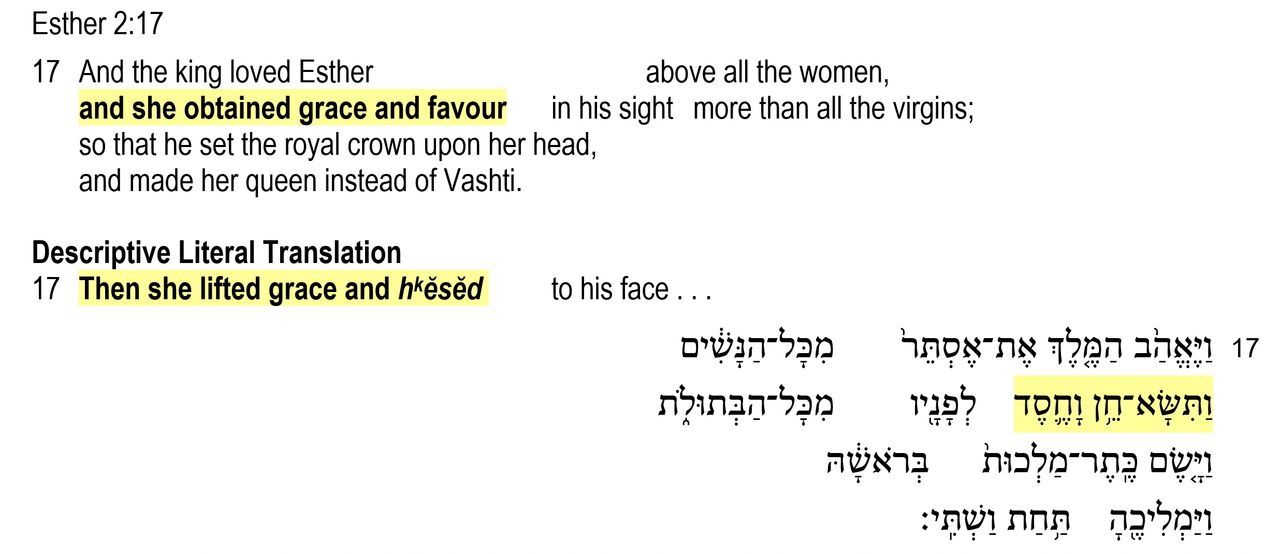
The English Bible translation “and she obtained grace and favor in his sight,” would be translated literally “then she lifted grace and hkĕsĕd to his face.” The Hebrew grammatical construction of this clause is essentially identical to that of verse nine where the wording “then she lifted hkĕsĕd to his face” relates to Hegai. In this instance, however, the words describe the manner in which she presented herself in the king’s presence. As in verse nine, the verb form indicates that she, Esther, was the one doing the action, that is, she was actively lifting both grace and hkĕsĕd to the face of the king. Certainly, she knew the purpose of her going in to Ahasuerus, and she may have even been prepared to experience physical relations at his will, but she also knew that the king possessed the authority to engage in sexual relations with any woman of his harem at any time he desired, and thus, the king was not simply looking for a woman who could give him that physical pleasure; he was seeking something more.
The Scriptures indicate that Esther went in to the king in the 7th year of his reign, in the 10th month (Tebeth), and to the typical reader of Scripture, his “interviews” with the beautiful young virgins may be thought to have been his primary focus at the time. History, however, indicates that his life and reign was filled many demanding situations. Washti had indeed been removed from her queenship in his 3rd year, 483, and four years had intervened, but, even before Washti’s removal, Ahasuerus had begun in 484 to prepare for an invasion of Greece. Then, in 482, his servants had gathered many beautiful young virgins to prepare them for being “interviewed” by the king in his search for a new queen. These young virgins did not come before him immediately upon arrival in Shushan; they were required to undergo twelve months of cleansings and preparations to insure that they were truly ready to be presented to him. Thus, his interviews could not begin until these twelve months had ended in his 5th year, the year 481, and he had already been close to two years without a queen.
Obviously, none of the first young virgins interviewed by him met his criteria for queenship, and then, in 480, his 6th year, he left to invade Greece. Though successful at first, he was defeated at Salamis and, leaving his army in Greece, he returned to Persia. Many matters of state would have demanded his attention, but at some point, his interviews with the young virgins must have resumed. The very next year, in the 6th month of Ahasuerus’ 7th year, his general, Mardonius, was killed in the battle of Plataea (August 27, 479), and, only four months later, Esther was taken to the king for her interview. At this point in time, Ahasuerus had been four years without a queen. Quite obviously, the king had not felt himself pressed to select a new queen, and it cannot even be imagined that he had not engaged in physical sexual relations with any of the women in his harem, and perhaps, some of the “interviewees,” during that four year interval. He was not seeking “sexual gratification”; he was seeking something more, and none of the “interviewees” before Esther had impressed him as having that “something more.”
Ahasuerus was a mighty and wise ruler of his empire, and he desired more than a physical relationship with the woman who was to be his queen. Great beauty and an enjoyable physical relationship were valuable, perhaps even important, but he had those things with Washti, and something in her character had interfered with their relationship. He desired a queen who, from within her own character, would exhibit the proper respect for him whether in his presence or not. Certainly, though Ahasuerus may not have perceived the origin of such character, he desired a queen whom he could trust, a queen who would “do him good and not evil all the days of her life.” From his first interactions with Esther, Ahasuerus could not have failed to perceive that something about her nature, her character, brought him a peace and contentedness, a pleasure, that was rare, if present at all, when he was with other young women. This young woman, this Esther, possessed a demeanor which openly demonstrated an unquestionable respect and care for him, not only as king, but also as a person. She was not seeking all the trappings that might come from pleasing him; this young woman’s beautiful conduct came from a beautiful character deep inside. The Esther he was experiencing was the woman of her innermost person.
The king’s response to Esther’s manifest Godliness, though he apparently did not associate it with her Hebrew ancestry, was the same as that which others had experienced in their interactions with her. Her presence aroused in him not only hkĕsĕd, as Hegai had experienced, but also hkén, “grace,” as so many others had experienced as well. Indeed, he began to sense a “love” for her, that is, her character was such that he sensed in himself a desire to provide whatever he could for her to further develop and manifest that character in a close relationship to him but not based on physical sexual activity. Undoubtedly, Ahasuerus desired her not only for her beautiful body but also for her inestimably beautiful physical presence. This young woman was one with whom he could trust his authority and the respect of his position. This young woman could be the queen who would restore a proper image of the relationship between a man and his chosen woman, both for himself and for all the men of his kingdom, and thus, Ahasuerus chose Esther to be his queen.