
Failure to Perceive and Apply God’s Poetic Parallelism Leads to Error and Misinterpretation
by Kenneth F. Sheets
Through the years, the text of Proverbs 26:4-5 has been used by many to demonstrate the supposed existence of contradictory statements in Scripture. Certainly, the wording of these two verses seems to express two instructions that are obviously contradictory to one another, but those who see only, or primarily, this contradiction are demonstrating their own ignorance of both ancient Hebrew and the parallelistic structure in which the Creator invested His truth here. Then, too, some have been influenced by the division of the text into two seemingly independent verses, each of which stands alone, and thus, again, the two verses seem to be contradictory. God’s original construction, however, was not that of two independent “verses,” but of a single “proverb” comprised of two thoroughly interrelated statements. The later division of the text by humans into “verses” actually obscured the relationship binding the two statements into one perfectly integrated instruction.
Whether one reads either the original Hebrew text or an accurate English translation, only one major difference appears to exist between the two statements: the first is a prohibition, using “not,” and the second is a positive instruction, using no negation. Rare, however, is the individual who perceives the existence and nature of the poetic parallelism which God built into these words. Just as He did in a great portion of His revelation, the Creator not only used specific wording and grammar to present His revelation, He also used specific literary structures to make that revelation clear. Thus, when a human fails to apply God’s criteria for interpreting any of the Scriptures written in poetic parallelism, that person is rejecting the design of God and the leading of His Holy Spirit. Such rejection always results in some loss in the information which the Creator intended to communicate in His “poetic” words, and, when individuals in leadership communicate to those under their influence the acceptability of such improper interpretation practice, then the damage to knowing and understanding God is multiplied.
Misinterpretation of God’s parallelistic structures can be minimized, and often avoided completely, by seeking to see the relationship between lines of poetic text which are obviously similar or related. This seeking, of course, begins by knowing not only the major portions of Scripture written in poetic parallelism but also the most common types of parallelism which God used. Often, seemingly obscure parallelisms can be perceived simply by laying out the lines of text in a way that shows the various terms, phrases, and grammatical constructions in each line, phrase, or sentence. In the case of the two verses of Proverbs 26:4-5, laying out the lines, as shown below, clearly indicates not only the similarity of structure but also the terms which God intended readers to correlate in their interpretation.
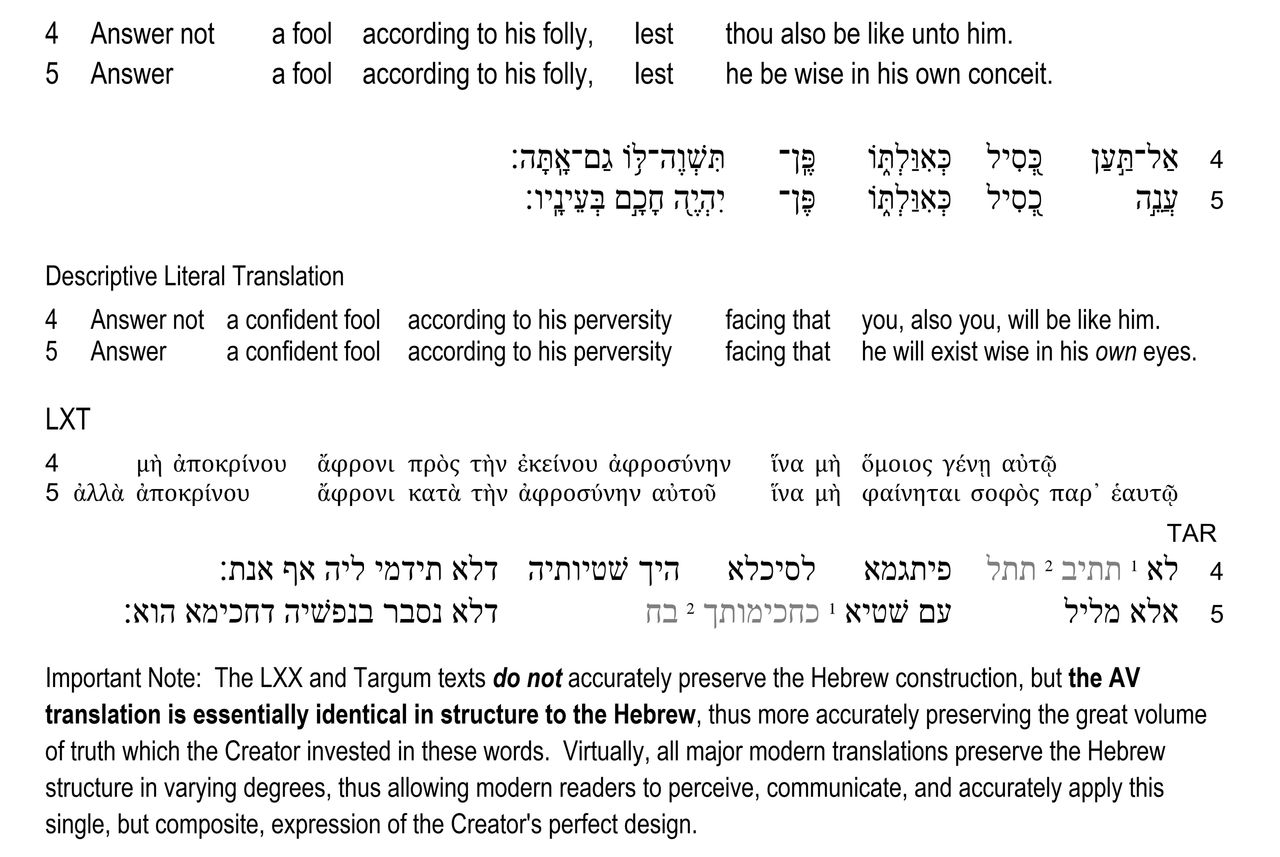
Analysis:
God constructed this one instruction in contrasting, that is, “antithetical,” parallelism. The two qal imperative verbs, “answer,” are made opposite instructions by the addition of “not” to the first. The negation of one imperative certainly seems to make the two parts contradictory to one another, but further intensive analysis corrects this error. The analysis must begin with the recognition that God’s “contrasting” parallelism is actually a variation of His “synonymous” parallelism, that is, when the contrasting words or phrases of “contrasting” parallelism are properly correlated to one another, the two lines, the two instructions in view here, are both giving the same content, just giving it in terms that appear to be opposites or contrasting.
After the imperatives, the great similarity of the wording seems to indicate that no other contrasting elements are involved. The only potential difference appears to be in the expressions “thou also be like unto him” and “he be wise in his own conceit,” but even these two wordings are not opposites. Indeed, if a person is “like unto a fool,” then that same person is contributing to the fool thinking himself to be “wise in his own conceit.” The two expressions, then, are “synonymous” to one another, that is, they are saying the same thing, just using different words, but this seems to leave no other contrasting elements except the imperatives “answer not” and “answer.”
In order for contrasting parallelism to function as a form of synonymous parallelism, two pairs of contrasting terms are required: one pair establishes a contrast, as the imperatives do in this context, and the second pair reverses the contrast, thus eliminating the contrast. This elimination process can be represented mathematically by assigning a value of +1 to each pair of “synonymous” terms and a corresponding value of -1 to each pair of “contrasting” terms. The assigned values of the paired terms are then multiplied by one another, that is, +1 x -1 x -1 x +1 = +1. In a true synonymous parallelism, the product of this multiplication must always be +1, and thus, in a true contrasting parallelism, two sets of contrasting paired terms must be present, that is, -1 x -1 = +1, in order to create a true synonymous parallelism as the two pairs of constrasting elements actually convert the contrast into a similarity.
In these two verses, a second pair of contrasting terms must exist in addition to the imperatives, and indeed, this is exactly the case. Though identical in form, the two terms “according to his folly” are not identical in meaning. In the first line, the words “according to his folly” refer to answering the fool foolishly, that is, in a way that makes the fool more confident in his foolishness because the answerer is indicating that he or she is thinking the same way. This is obviously a violation of the design of God. In His design, every person is always to answer wisely in every matter of life. Accordingly, the first line is actually saying that fools are to be answered wisely. In the second line, the words “according to his folly” refer to answering the fool wisely, giving him an answer that is wise, in accord with the design of God, one which corrects, reproves, one which increases the fool’s knowledge and understanding of the Creator and His design.
Accordingly, a proper understanding and application of God’s design for His poetic parallelisms demonstrates that no contradiction or paradox of any sort to any degree exists between the statements of Proverbs 26:4-5. Herein, God instructs the answering of a fool not “according to his folly,” not “foolishly,” but wisely, and the two verses could be combined into one: “Always answer a confident fool in a wise manner in the design of God, so that he does not think himself to be wise and you do not appear to agree with his foolishness.”