
Understanding Death as God Revealed It to Adam and as Adam Understood It
by Kenneth F. Sheets
Words Are Expressions of Meaning
Words have meaning. They are expressions of information, and information carries a significance to the human brain according to the nature of that brain’s experience with the particular information it is receiving. Humans, however, receive information by all the various sensory abilities they possess, not the least of which is their ability to correlate and evaluate new information according to the information already existing in their minds. Since every human mind differs from every other human mind to some degree, any single block of information content may be perceived differently by each of the individuals receiving it, and the words of a communication, whether written or oral, are no different. Words may have essentially the same meaning to multiple individuals, but, even then, some variation in their significance remains, and the extent of that variation depends upon each individual’s experience with the actual words of the communication he is receiving.
Thus, the difficulty involved in communicating a message clearly and exactly from one human to another arises from the differences in the meaning and significance which a word or series of words carries in the mind of the receiver. If the word meanings and concepts which the author of a communication intends to convey have not yet developed in the mind of the receiver, then the receiver’s comprehension is lacking to the degree that his understanding of the words differs from the author’s intended meanings. The obvious result in the receiver is a lack of knowledge, at best, and total misunderstanding, at worst, and, when the receiver is a group of individuals, the potential for misunderstanding multiplies, and this all happens even when the author of the communication is God Himself. Though His communications are absolutely perfect in their every expression, and though He perfectly designed the information reception systems of His human creations, the finite and limited knowledge and abilities of humans, even those claiming to be “led by the Spirit,” have produced many perspectives of God and His design which are, quite simply, wrong. Humans see the wide variations in human perception of God and His design, but, though they are accountable to Him for accurate perception of His revelation, they rarely question their own perception, and they almost never seek anything more than superficial knowledge to confirm their perception. To them, God is exactly who they think Him to be, regardless of what He actually revealed of His person and nature, and His design for all that exists. Their superficial knowledge results in a superficial, and often erroneous, representation of the Creator in life, and the Creator cannot bless their error and misrepresentation; the effects are inescapably destructive in all they touch. Accurate understanding and interpretation of the words of God’s written revelation is, then, absolutely essential for every human.
Change in Word Meanings May Lead to Serious Misinterpretation
Further complicating the matter is the change in word meanings and word combinations over time. History demonstrates that some words and phrases have changed greatly not only in their definition and connotation but their significance as well. Humans, however, seldom seek any understanding of words beyond the meaning and significance already present in their mind at the moment they receive a communication. If the word meanings have not changed substantially, then a reasonable degree of accurate understanding may result. However, if the words of the communication have indeed changed in their significance, or if they have developed new meanings or applications which did not exist in the mind of the author, then the message will be misinterpreted to the extent that the meanings applied by the interpreter differ from those intended by the author at the time and place in which he composed those words. When those words are the Scriptures, the revelation of God, then the imposing of “modern meanings” upon the ancient words can, and does, lead to serious theological error. Certainly, the words of Scripture vary in frequency of use and in their significance, but some are foundational, essential, for proper understanding, and the application of inaccurate meanings can have great, even disastrous, theological effect. The word death is one of those foundational words which has been erroneously defined, and its subsequent misuse has misled many.
The Meaning of the Word Death Has Greatly Affected Theology
In Christian theology, man’s concept of his relationship to God typically ranges from one extreme where man is free to choose the degree of that relationship to the opposite extreme where God sovereignly controls every detail, and free choice does not exist. While both extremes are based on a series of theological misunderstandings derived from misinterpretation of God’s revelation, the latter, sometimes called a “Calvinistic” or “hyper-sovereignty” view, rests certain of its precepts on a misapprehension of the word death. Though all may not consciously do so, proponents of this theology typically use physical death as an analogy to prove that man cannot receive the spiritual truth necessary for salvation, that is, the gospel and other revelation, until he has first been made alive, “regenerated,” by the grace of God. Their reasoning tends to follow the line that since each human is “dead in trespasses and sins,” he is, therefore, “dead” to the revelation of God as well. Thus, each must be “regenerated,” made alive, by God before he is even capable of belief. This makes belief a matter of the “predestinated” choosing of God. All of this seems to make sense and may have some merit, if man’s spiritual “deadness” is indeed defined and depicted by this analogy to physical death. However, if this analogy is in error, and it is, then any theology that utilizes it is in error from its foundations, and all subsequent and correlative teaching is suspect and requires analysis from a different perspective.
As is so typical of modern man, those who use the “physical death analogy” apply a definition of death that is compatible not only with their own experience but also with that of men from the time when death first came into human experience. In theological circles, this definition is a combination of both revelation and experience. That such a definition is lacking is evident from the attempts of theologians to explain its application in all the various occurrences of the concept in Scripture. Death is a recurrent theme from the very beginning of man to the present day, but to presume that the concept which the word arouses in the mind of man has remained constant for these six millennia is to presume that the changes that affect virtually every word in human experience never happened to the word “death.” Obviously, such a presumption is a misrepresentation of reality.
Adam’s Understanding of the Word Death Is the Key to Its Meaning
Some might argue, however erroneously, that the word was first used in the Scriptures long after humans began to experience death. This error rests upon an assumption that the earliest words of the Word of God were not recorded until long after the creation, a delay of more than 2,600 years between the knowledge of Adam and the writing of Moses. This assumption, in turn, fails to recognize the reality of Adam’s being and experience, experience that began before the experience of death. It also fails to recognize the ability and practice of Adam to inscribe and record whatever he desired. Many, even supposed “Bible-believers,” have been taught or developed in themselves the concept that Adam and his early descendants communicated only orally and did not inscribe their ideas, an erroneous concept that fails to recognize both the abilities of these ancient individuals and their reasons for inscribing their ideas. This concept, whether held overtly or subconsciously, is, however, a submission, to evolutionary thinking. God created His first man and woman complete, able to fulfill every aspect of His design for their existence, an existence which included their being able to communicate in the most effective means. The Creator thus built into His aboriginal humans the perfect ability to express themselves to one another orally and to record those same expressions, and any other they desired, in writing. Obviously, any degree of the modern “caveman” view of the earliest humans totally contradicts any proper analysis of the earliest chapters of Genesis, chapters that came from the hand of the first man himself!
The Creator Imparted to Adam the Meaning of the Word Death
The LORD God Himself was the first to speak the word “death,” and whether or not He spoke it prior to instructing Adam regarding His design for man’s life is inconsequential. The meaning of the word “death” certainly did not change in the mind of God, and since Adam learned perfectly from the Creator, the definition in his human mind, at that point untainted by any violation of the Creator’s design criteria, would have been consistent with the definition of the Creator. God revealed His design criteria to the first man and Adam recorded the pertinent points of that instruction. Though it is possible that Adam wrote, or edited from his own previous writings, the portions of Scripture above his “signature,” (Genesis 5:1) his record cannot be questioned in regard to its accuracy. His interactions with God, both before and after his violation, were of a quality unlike those of any other human being, so when he recorded the events of the first four chapters of Scripture, he gave them exactly as they occurred.
The Meaning of Death Was Associated with Violation of the Creator’s Design
The LORD God’s actual instruction to Adam regarding the result of violating His design came before the man himself had any experience of death whatsoever. Indeed, Adam would not have seen the instruction as a special prohibition; it was simply one criterion among the many criteria of the Creator’s design for his human life. Truly, the instruction came in the form of a prohibition, but other prohibitions existed as well. When the Creator expressed His criteria for Adam’s existence, for “dressing and keeping the garden,” for interacting with Eve and everything else that existed, every positively stated design criterion included within it a prohibition against acting in any way which was not in accord with that criterion. Adam was not subject to only one prohibition; he was prohibited from violating any criterion of his Creator’s design, whether that criterion was expressed positively or negatively.
Adam’s first violation, however, did not involve any of the other “prohibitions,” despite the fact that any decision on his part to do so would have brought the same result. Adam’s first violation of God’s design was to usurp to himself an authority never delegated to him by his Creator, and then, to exercise that authority to decide for himself that which was “good and evil” in his existence. God’s design, and expression of His Person, existed before the foundation of any aspect of the creation, and that design included the fact that Adam was to eat of “all the trees of the garden” while avoiding the “tree of the knowledge of good and evil.” This was the “foreordained” design, the criteria that God had “foreordained” by virtue of His very Person, but Adam chose to violate that design in one particular matter: he would take authority over the authority of the Creator. The tree was not the issue; the issue was man’s decision to reject the Creator’s design and replace it with criteria of his own design.
The Actual Wording of the Prohibition
God warned Adam that, if he ever ate of the fruit of “the tree of the knowledge of good and evil,” he would experience “death.” The actual wording of Adam’s record in Genesis 2:15-17 is as follows:
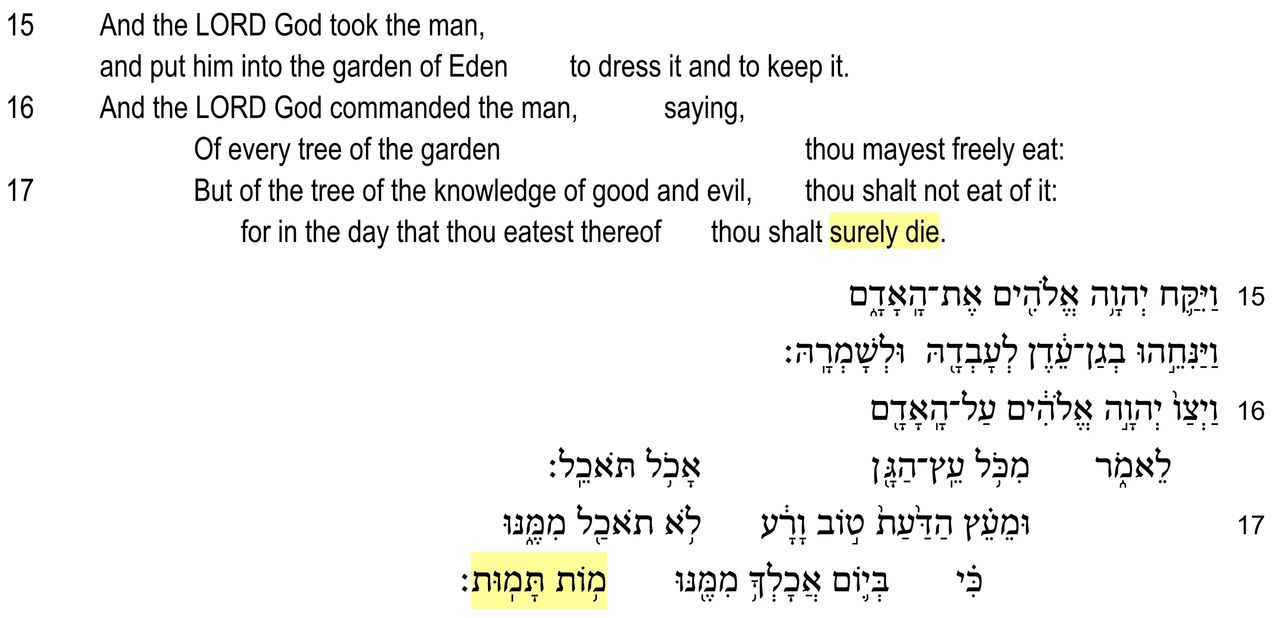
Adam’s Understanding of God’s Wording of the Prohibition
Without question, when God created humans and built into them all that comprised His own “image” and “likeness,” He imparted to them knowledge and abilities which made them able to accurately comprehend the various forms of communication He would use to reveal Himself and His design for human life. Thus, humans understood the Creator’s words when the Creator expressed to them the criteria that were to govern the entirety of their human existence. Adam and Eve accurately understood what God intended to communicate in the words “be fruitful and multiply,” and when He instructed them concerning their food and their interactions with the creation around them. Adam and Eve did not invest God’s words with meanings different from those concepts the Creator had already imparted to them; they understood God’s words according to God’s definitions and design for those words.
The same was true when the Creator, prior even to His creation of the female human, instructed Adam regarding His design for the trees from which humans were to eat. The man accurately understood God’s criterion that he was not to eat from a specific tree, and he understood as well that his eating from that specific tree would bring into existence a new condition, a condition called “death.” Certainly, Adam knew the meanings of all the words and grammatical constructions God used to describe the prohibition and what would result if that criterion of the design were ever violated, but, at that point of his existence, “death” was a concept which as an experience had not yet come into existence. As with the great multitude of conditions and interactions that man and all creation were yet to experience during the time of temporal existence, “death” was conceivable, but it had not yet actually occurred, that is, it had not yet come into existence in time. In the experience of the creation, “death” did not exist; its existence was only potential, possible, conditioned upon the actions of man in relation to God’s design for his existence.
God’s Design for Man’s Accumulation of Knowledge
God had revealed His design to man, and He was continuing to do so, but at every point during the revelation, that which man had received was sufficient for him to walk accurately with the Creator. Though clarifications and details would multiply over time, Adam, like every man of all time, possessed the content of revelation perfect for his time and situation in history, but he did not yet possess every point of revelation that was to be revealed. Indeed, in all the years prior to the completion of His written revelation at the close of the New Testament, God was expanding the volume of that which humans needed to know Him accurately. The Creator had designed man to acquire all the various increments of His revelation in order that he would know Him and His design, and then apply the criteria of that knowledge to every aspect of his existence. Humans, however, developed the ability to “know” God without “knowing” Him, a dichotomy of knowledge in direct contrast to the Creator’s desire for all men. They thought to equate an impersonal, perceptual knowledge with a personal, experiential knowledge, but the two are greatly different. The accumulation of perceptual knowledge is indeed a major part of God’s design, but experiential knowledge adds a dimension of perception not available apart from the experience.
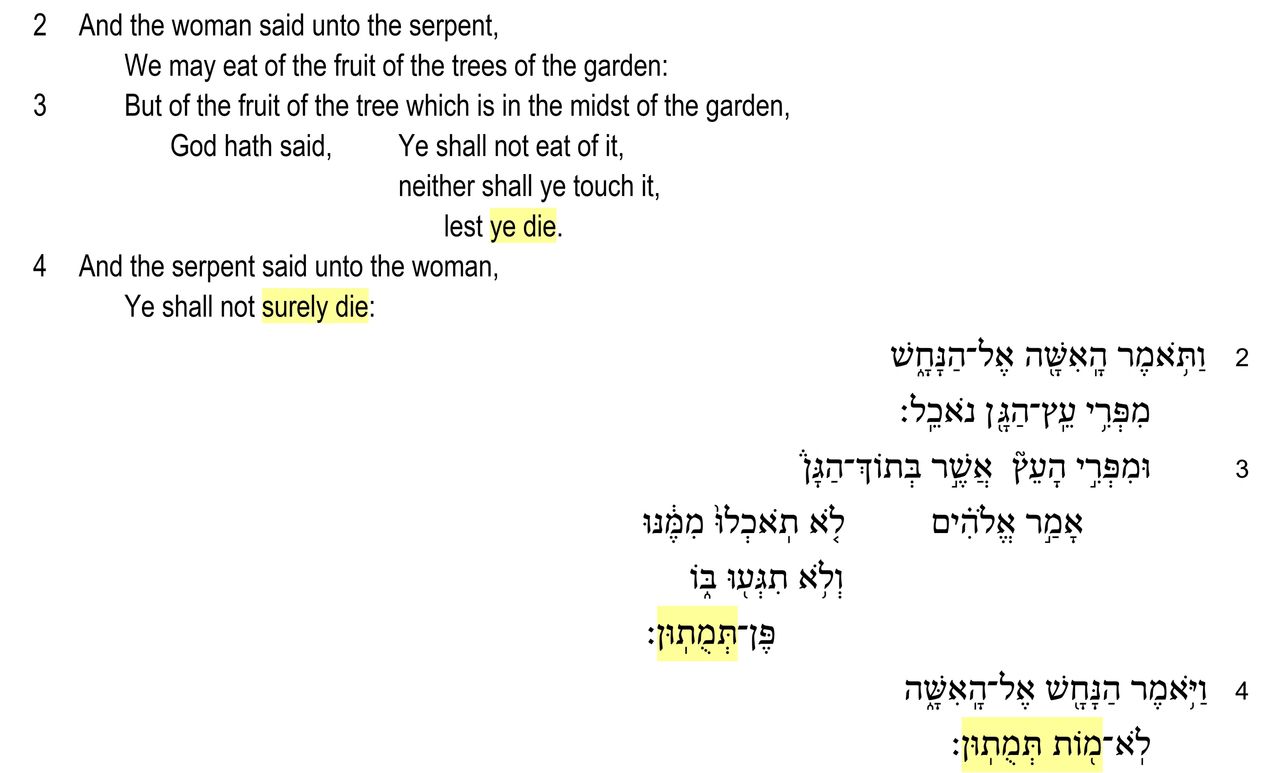
Adam could “perceive,” that is, he could “know perceptually,” in his mind, but he could not “know” death from the experiential perspective. Adam knew experientially only the conditions in which God had placed him, conditions in which death did not yet exist and where, until the activities of Satan, the entirety was in perfect accord with the Creator’s design. Even Satan’s words in his temptation of Eve indicate that man understood perceptually the undesirability of experiencing death. Adam recorded this interaction in Genesis 3:2-4.
Satan Knew and Contradicted the Actual Wording of God’s Prohibition
Both Eve and Satan used the same word which God had used when He gave to Adam the prohibition. The root word was the same in each case; only the form specific to its grammatical use changed. Eve’s response to Satan’s first words indicates that the prohibition, and the reason to obey it, had been communicated to her: they were not to eat “lest they die” (verse 3). Satan responded to Eve with the words “thou shalt not surely die,” though Eve had not used the “surely die” construction. This was the very construction God had spoken to Adam; God had warned that if he ate of the tree, he would “surely die.” Satan’s choice of grammatical constructions indicates that he was not simply interacting with Eve’s words; he also knew the very words God had spoken, and those words, the words of the Creator, were the words he contradicted.
Adam’s Concept of Death Preceded His Violation and Experience
Again, however, each of the above references to death was delivered prior to Adam’s violation and the change in creation that would result from his “sin.” Accordingly, all the references must have carried the same definition and significance in the minds of the users. This makes a proper definition of “death” essential for understanding not only the nature of the prohibition in the eyes of created beings but also the nature of the Creator who gave the prohibition. The lack of a proper definition can lead to misunderstanding the Creator’s purpose and His imposition of “death” and suffering upon His creation, but, because of the foundational nature of the early chapters of Genesis, this lack also carries with it implications for every realm of theology. The definitions, the connotations, the concepts, indeed, all the information found there, form the basis upon which all other revelation rests. This means, in turn, that the terms found in this part of Scripture are the basis of all usage derived from those terms. Those original terms impose their meaning on subsequent usage, and not vice versa; human practice in Scripture interpretation is, typically, in direct contradiction to this right order.
Death to Adam Was an Event Occurring at the Moment of Violation
Made in the image of God and with a delegated authority over all of creation, Adam’s existence was “perfect.” While the Creator may have stated or implied the undesirability of violating any other criterion of His design, His specific words to Adam in regard to the tree had a major effect on the man’s understanding of death. At the very least, Adam’s concept of death was directly associated with violating the expressed design of the Creator for one specific tree. In that situation where no human had yet violated God’s design, Adam must have recognized that, if he violated God’s prohibition, some aspect of his present state of existence would change or cease to exist, and, as a result, he would enter into a new state of existence where he knew experientially what it was like to have violated the Creator’s design and to have become subject to the experience of “dying.” Violation was thereby associated with “death,” and “death” with violation. Adam knew that when he violated, he would “die.” He would not enter into a new state of existence where the condition of “dying” would eventually occur, as was the case with his eventual “physical death”; his “dying” would occur at the moment of his act of violation.
Death to Adam Was an Undesirable Change in His State of Existence
Death, then, to Adam would have meant a cessation of his present state of existence, that is, an irreversible change from his present state of existence to another state of existence he had never known experientially. Even if God had described the process of “physical” death to Adam, this human who interacted with the Creator in an unrestrained and unalienated relationship could certainly perceive that, whatever “death” involved, it would not mean the end of his existence or of his ability to relate to his Creator. The Creator was the one who had brought into existence the ability of humans to both receive and initiate communications with Him. In addition, He, the Creator, was the one who would bring “death” into existence when these same humans violated His design. Thus, better than any later human would ever comprehend, Adam understood that “death” was totally under and within the Creator’s control, just as was everything else that existed. “Death” was not, and would not be, the creation of a created being, or of all created beings; it was not something brought into existence by humans or demonic beings. “Death” was the province of the Creator, and the Creator alone!
Adam’s Understanding of “Death” Would Not Have Caused Him to “Fear” It
19. Adam could not have possessed a “fear of death” like the fear and dread that plagues modern humans after centuries and centuries of experiencing death. In Adam’s concept, though he would “die,” he would remain a created being of his Creator; “death” would not change the fact that he owed both his origin and his continued existence to God. “Death” would bring him into some new unexperienced condition of existence, a condition the undesirability of which had been communicated to him by God, but which he had never experienced. He was not motivated to remain within God’s criteria by an “afraidness,” a “dread,” of the new unexperienced condition called “death.” His Creator would still be Creator, a condition that could never change, and he would still be the first human whom his Creator had brought into existence, another condition that could never change.
Adam knew that nothing could ever change the fact that he was an individual human who had been brought into existence by the perfect, direct activity of his magnificent and perfectly loving Creator. The only change would be that he experienced “dying,” but both he and his Creator would remain who they were, so “afraidness” of “dying” was not an aspect of his motivation to remain within God’s design. For him, it was a simple matter of choice. He would choose whether to “believe,” to “cause to be firm,” what God had said, or he would choose to “believe,” to “cause to be firm,” his own understanding of the prohibition and the nature of the effects that would result.
Knowing the Creator, Adam Could Not Have Comprehended Alienation from Him
Certainly, Adam had no idea of the ultimate ramifications of his action, but, upon eating, he soon learned. His prior state of congenial fellowship with God ceased to exist and a new state of alienation from God came into existence. The Creator gave to His ädäm that which the man had chosen. Adam experienced a dramatic change in his relationship to God, but God did not separate Adam from Himself. Adam, recognizing that to violate the Word of the Creator was to violate the Person of the Creator, experienced an alienation from God that he had chosen in his decision to violate God’s design criteria for his life. Adam’s entrance into his alienated state did not come as a result of God’s pronouncement of judgment; it came the moment he violated, thus indicating that it was an inescapable condition which God had built into His original creation, humans included.
Adam’s alienation, however, did not constitute him “separated from God,” a phraseology common in many modern churches, but rarely explained in any way that accurately represents its meaning. In the mind of virtually all modern humans, especially those who rely on English translations of the Scriptures, the term “separation” tends to involve some measure of “spatial distancing,” that is, some degree of “separation between things which are in different locations.” This concept then brings to the mind of those hearing or reading it a perspective where God is in one place and the “violator” is in another place, and some distance physically separates God from the person. Few who proclaim and teach this concept realize that they are representing God as being in a specific locality, a distinct location in space, but not at the location where the “separated” individual exists, as though the “location” of the “separated” individual is outside the bounds of the person of God.
This is, indeed, a completely inaccurate and destructive representation of God, the transcendent Creator in whom the entirety of creation exists, and it contributes to the failure of “separated” individuals to perceive Him and His desire for each to turn to Him and His blessed design. In the situation existing after Adam had violated, the Creator came seeking the man and continued to interact with him. Later in history, this same scenario would be repeated with Adam’s son, Cain. Even after Cain had clearly violated God’s revealed “good” pattern of sacrifice, substituting his own way just as his father had done in eating, God sought out the rebellious man, and sought to reason with him in regard to his violation and the mindset which led him to violate.
Death Did Not Render the Violator Unable to Receive Revelation from God
Both Adam and Cain were men whose violations would have rendered them “dead in trespasses and sins,” but the condition of “death” in which they existed had not rendered them incapable of communication with the Creator. Both Adam and Cain were able to receive further revelation, further testimony, from the Creator after they had both experienced having “died,” as He sought to turn them back to Himself. Their ability to understand the Creator’s communications and to respond to those communications were not dependent upon Him “making them alive,” “regenerating” them, before they could respond properly. Their ability was not dependent upon the condition of the creatures, but upon the design and ability of the Creator. The “death” man experienced was the death God had spoken, and it did not render him unable to receive and react to God’s revelation. In the same manner, “dead” men of the present day are still able to receive the Creator’s revelation regardless of its form, whether through the words of the creation or the words written by holy men moved by the Holy Spirit.
Death to Adam Was Not Death But An Irreversible Change in His State of Existence
Death, then, cannot be defined as “death” according to the current experiential definition, a definition which does not fit all occurrences of the word, especially those of the time when God was defining death according to His own infinite mind and not that of finite human beings. Death had no effect on the ability of “dead ones” to communicate with the Creator, and indeed, except in the case of physical death, which is a cessation of the present state of physical existence as a “live” body and a change to a different state of physical existence as a “dead” body unable to continue earthly communications, it has no effect on an individual’s relationship to the Creator. Physical death functions to confirm the choices made in physical life, rendering those choices unchangeable, but in and of itself, it has no effect on those choices. “Death” is merely a change from one state of existence to another, and the nature of that change, that is, its quality and desirability, or lack thereof, is determined by the specific nature of the change in existence, and it is an irreversible change to all except the Creator Himself.
Other Human “Believers” Understood As Did Adam
The Writer of “Be Still My Soul” Understood As Did Adam
The writer of the hymn “Be Still My Soul” [assuming accurate translation of the German words into English] understood the true nature of death. In her third verse, Katherina Von Schlegel exhorted her soul to “be still . . . [until the time] when change and tears are past,” a time further clarified in the last words, “all safe and blessed we shall meet at last.” She obviously saw death as the final “change” of physical life, as the final transition, the ultimate cessation, of human existence, a cessation that was irreversible apart from the workings of the Creator Himself to affect that reversal.
Job Understood As Did Adam
Job saw the same thing, and his record is perhaps the source of Von Schlegel’s wording, as indicated by his reference to the time of his death. He viewed it as the time when his “change” would come, that is, the time when death would bring the change that would bring relief from his suffering. Job recognized that death would not end his conscious existence; he would still be able to interact with his Creator even after his temporal life had ended. He recorded his assurance in this matter long before the time of Abraham (Job 14:14):

David Understood As Did Adam
David, too, recognized that physical death was an irreversible condition. When his child through Bathsheba died, he knew that the child could not return to him. From his human perspective, death was a “one-way” proposition to a condition determined and controlled only by the Creator, the One who perfectly designed and created death, and who alone possessed the absolute authority and power to reverse it.
God Has Made Physical Death the Point of Irreversible Choice
God designed and constructed human physical life to be a time when each would decide to accept or reject Him and His design. He delegated to each the ability, the opportunity, and the authority to make this decision based upon the evidence in which He immersed them regarding their need of personal reconciliation to Him. Living in a creation which constantly, perfectly, and inescapably testifies of its Creator, every person sees the need to conform to the Creator’s design before the end of physical life terminates his ability, opportunity, and authority to properly acknowledge the One who made him. Each human knows and perceives that when physical life ends, all the activities and abilities associated with physical life also end. In death, the choices and interactions of physical life cease, and, in a clear demonstration of this cessation, the body itself deteriorates very quickly, returning to the basic matter of which it is composed. Thus, life, and death, testify of physical life as the time when a human must accurately assess his existence as a created being and respond to the Creator accordingly, because, at death, ability, opportunity, and authority in the matter cease to exist. At that point, when the physical life of a person ends, God confirms, establishing and making unchangeable, that individual’s choice to accept or to reject Him and His design. Indeed, the nonphysical life of that person continues, but it continues in the irreversible choice which that person had made at the end of his physical life.
Adam’s Expulsion from the Garden Indicates That Eternal Life Was Still Available
Even the LORD’s forcing of Adam and Eve to leave the garden, so they would not eat of the tree of life and “live for ever,” indicates that eternal physical life was still available to Adam and Eve after the man had violated the Creator’s design. The fruit, and perhaps all parts, of the “tree of life” had been so designed by God that when a human ate from it, the physical existence of that human would in some way be affected to make that person “live to indefinite time.” Expulsion from the garden and access to the tree of life was necessary in the eyes of God to preclude man from living indefinitely in a “fallen” temporal existence. The implication is clearly that the “death” to which God referred in His prohibition was not physical death. It was a change in the nature of man, a change that had existed potentially before violation, but which existed in actuality after violation, a change that would result in physical death, thus necessitating that God restrain him from eating from the tree of life.
Death and the Will of the LORD Jesus Christ
As a human, the Lord Jesus Christ did not desire to experience “death,” but as the very creator of “death,” and knowing that His death would provide the means of reconciliation both for the entirety of an alienated humanity and also for the entirety of the physical creation, He desired to fulfill His own design for the necessity of His death. He, the Creator of all that exists, had perfectly designed “death” to be the inescapable result of violation and a great motivation in the minds of humans for them to seek reconciliation, but He Himself had never personally, physically, humanly, experienced this condition which He had so perfectly designed. In His human nature, He had experienced the joys and blessings of physical human relationships as He had designed them to exist, but He also knew that, by His own design, He would experience the “taste,” the “sting,” the undesirability, of death. He would experience the separation from all the good aspects of physical life, a separation already experienced by so many of His precious creatures. He, the unfalse God who could not violate any aspect of His design, faced the prospect of experiencing that which He had brought into existence for the purpose of turning violating humans from the destructions of violation and back to the blessings of His way. Such a prospect was not welcomed with joy, but He had also perfectly designed the result of His physical death, and that aspect of His design brought a joy that totally overshadowed the undesirability of physical death . . . His creation would be reconciled to Him once again. He would not be “killed”; He would “lay down” His life to bring life to those most in need.