
Understanding “Elohiym” and the “Plural of Majesty” as Adam Understood Them
by Kenneth F. Sheets with Rebecca L. Miller
The Need for Proclaiming and Teaching All of God’s Revelation as He Gave It
Most present-day proclamations and teachings of the Scriptures misrepresent the person and nature of God. Though some clearly reveal the truth that humans are alienated from God and may be reconciled to Him only through “believing,” “causing firmness to,” His revelation regarding His Son, and, indeed, many have been reconciled to Him through this truth, almost all of these “way of salvation proclamations” are very shallow in their representation of the person and nature of the Creator. Certainly, reconciliation is a primary, even necessary, aspect of God’s design, but, “salvation preaching” almost never presents God according to the actual words of His written revelation, and thus, rarely, if ever, do those who “preach” it and those who hear it even approach the full knowledge and understanding of the Creator which He intended. The “preaching of reconciliation” is not the end. The Creator also provided a great volume of instruction regarding His person and nature, and His perfect design, to enable His human creatures to walk accurately in His design, thus experiencing the blessedness of that walk and expressing its blessedness to others. The Creator, then, intended not only that His revelation regarding “salvation” through His Son would be proclaimed and taught, but also that the extensive instruction regarding His person and nature, and His design, would be proclaimed as well.
The Insufficiency of Preaching and Teaching Rooted in “English-Only” Knowledge of God
God intended His human creatures to fully know and understand all aspects of His revelation, but the content of most modern “teaching and preaching” tends to be little more than telling their hearers how to be reconciled to God and what they are to do in their lives in order to please Him. Though such how and what proclaiming should be sufficient, most of these “preachers and teachers” rely either upon their own understanding of an English translation of the Scriptures or upon the understanding of someone else who himself relied upon an English translation . . . and the result is much shallow and erroneous representation of God and His perfect design. Some may even claim that they “have studied Hebrew and Greek,” but, in reality, their learning of these chosen languages of God was never more than superficial, at best giving them little more than the ability to “look up” words in lexicons, but never giving them the understanding which is essential for knowing how to use those words and the grammatical structures in which they were written by the holy men of God who wrote them.
The Origin of Erroneous Understanding of the Word “God” from an “English-Only” Concept
In the matter of knowing and understanding God as He actually revealed Himself and His design for all that exists, all humans, and especially the “preachers and teachers,” need first to know who He has revealed Himself to be, that is, they need to know the meaning of the word “God,” the first of His chosen representations of Himself. This word “God,” however, must not be understood by humans according to the almost universal superficial concepts of other humans. When reading or studying the Scriptures, humans must apply the word “definitions” and concepts which were in the minds of the ancient holy writers of those Scriptures. The readers of English translations find both the word “God” and “god/gods,” and though the translators distinguished between the two forms by capitalizing or not capitalizing, much error and misunderstanding regarding the person of “God” and His relationship to “god/gods” has resulted, because most readers, “preachers and teachers” included, never learned either the true meaning of the Hebrew word ĕlōhiym from which both “God” and “god/gods” are translated or the true person and nature of the Creator and His relationship to all that exists.
The Destructive Error of a Wrong, “English-Only” Concept of God
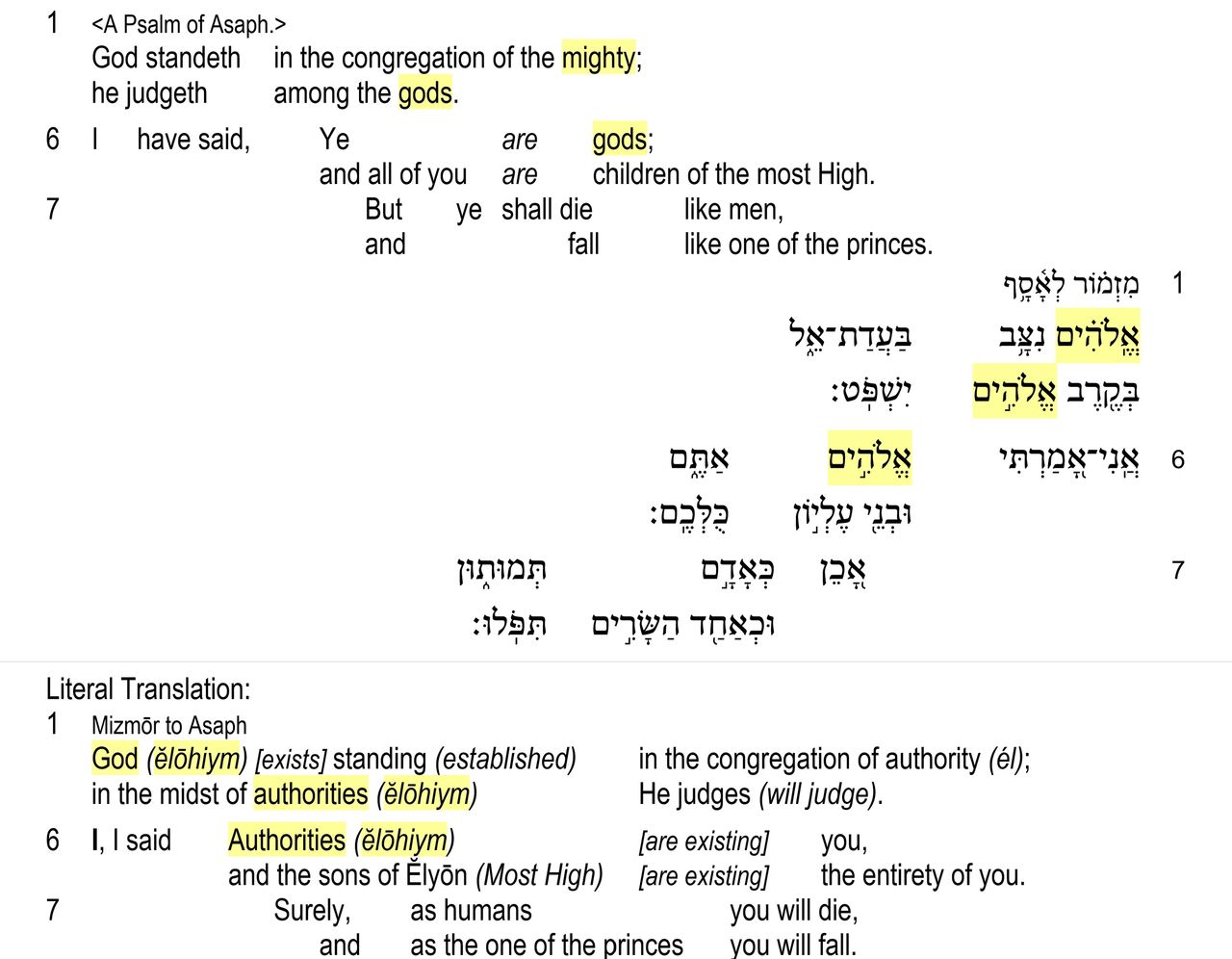
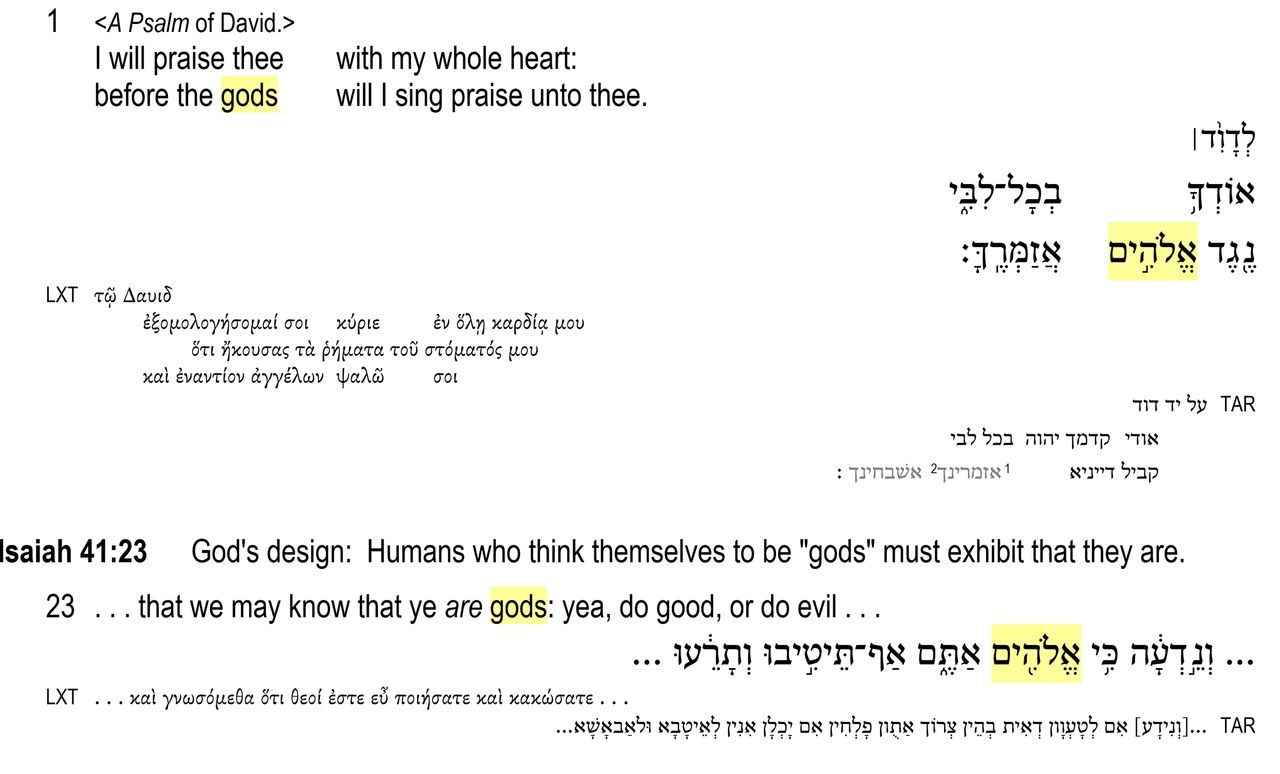
This lack of knowledge led, in turn, to wrong “definitions” of these words, and the wrong “definitions” led to wrong concepts of God. Stated differently, those who needed to know, but who had never learned what the word “God” actually means according to God Himself, never learned accurately the nature and extent of the creation. Thus, when they read many of the passages where the words “god/gods” occur, not the least of which is Psalm 82:1, 6-7 (below), and they attempt to correlate them to the words of Jesus in John 10:33-36, they greatly misunderstand what the Creator intended those passages to communicate. Both David and Isaiah also used the word “god/gods” in Psalm 138:1 and Isaiah 41:23 respectively (both below) where neither text refers to the Creator. Many readers of Scripture through the years have thought that these uses of the word “god/gods” referred to beings who possess power and authority just as the God Who Exists possesses these things.
Psalm 82:1, 6-7 In John 10:34-35, John recorded an incident where the Jews sought to stone Jesus, because He had said that He and the Father existed one, thus, as they said, “making Himself God.” In response, Jesus quoted Psalm 82:6 where Asaph had recorded God’s words regarding humans “You are gods [ĕlōhiym] . . . children of the Most High.” The Jews obviously understood the validity of His use of ĕlōhiym in reference to humans and not to only the Creator. Though He did not explain His use of ĕlōhiym [the Greek thĕŏs] in this manner, the accuracy of His use was clear even in the minds of the Jews. Humans had received a measure of delegated authority from God to enable them to represent Him to all else in the creation . . . and thus, the Hebrew word ĕlōhiym referred to beings who had received “authority” from Him.
Psalm 138:1 David’s use of the word ĕlōhiym, “gods,” to refer to beings other than the Creator indicates that he, too, understood that the word could accurately refer to all “beings” that possess any degree of power and authority, because He, God, the ultimate power and authority, had delegated it all.
Analysis of Four Forms Which May Be Translated “God” or “god/gods”
The Hebrew word Ĕlōhiym is the word most commonly translated “God” or “god/gods” in the Scriptures, but this form is only one of four forms which may be thus translated in the English Bible. These four forms are:
1. Él (pronounced āle) is the basic Hebrew noun upon which the other three forms of this name for God, including the non-Hebrew name Allah, were built. The use of this noun as a name for “God” or “god/gods” derives from its basic meaning which refers to the existence of “authority with inherent ability,” that is, the Hebrew noun él refers to that condition wherein some thing possesses a measure of authority with an inherent measure of power for imposing that authority. This word, then, when referring to God is actually a descriptive title which focuses upon His person and nature, describing what He exists, His Being, that is, the name Él focuses upon the fact that He is “God,” the one being who exists the ultimate power and authority and the one from whom all other power and authority has derived.
God is Él in the most absolute sense, that is, both His power and His authority are absolute, both transcending every existing power and authority of every kind. Indeed, they are the source from which every existing power and authority of every kind is derived. Accordingly, every power and authority, and every manifestation of power and authority, is absolutely accountable to Him for its conformity to the criteria He has established. This name of God, Él, indicates that, in His supreme power and authority, He, and He alone, possesses the absolute right to establish, to design, in entirety, the criteria that govern every function and interaction of every thing that exists. Every thing, then, that exists is absolutely accountable to Him and His design in every moment and aspect of its existence.
The name Él, then, also signifies that, as the absolute authority and power that exists, God is the origin and creator of all that exists, having brought the entirety of creation into existence within Himself. He is, therefore, transcendent in every way over all that exists, and everything that exists “is living, and moving, and existing” in Him. In this perfect transcendence, His every action is an exact expression, a perfect representation of His perfect person and nature, and thus, neither He nor any aspect of His design can ever change or be false or misrepresent or violate His person in any way or to any degree.
Understanding, however, the true basic meaning of the Hebrew noun Él, the writers of the Scriptures used at times the noun él but not in reference to God. Recognizing these occurrences, English translators often used “god/gods” with no capitalization to convey the original writer’s reference to a created thing which possessed a measure of “authority with inherent ability,” that is, to a thing that possessed “authority with an inherent measure of power to impose that authority.” The noun él could then be applied as a name to refer to any created thing which possesses some measure of authority and power, and thus, it could refer to “mighty ones,” “powers,” “strong ones,” “rulers,” “gods,” or any kind of individual created being, especially any angelic or human being, which manifests a measure of delegated or derived authority and power to impose its will, in some measure, upon other beings. When, however, él is applied as a name for the transcendent Creator, it presents Him as the absolute authority and ultimate power that exists.
2. Éliym is the plural form of the noun Él and is not used in the Scriptures to refer to God Himself. This plural form refers to things, usually angelic or human beings, who possess, or exhibit, some measure of authority and power, whether it has been received from the Creator or not. It is also translated “rams,” because these male flock animals exercise a measure of power and authority over others in the flock. Some significant references include:
Exodus 36:19 The skins of rams are dyed red for the tabernacle.
2 Chronicles 29:22 The blood of the rams was sprinkled on the altar.
Job 41:17 – Even “mighty ones” among humans fear leviathan.
Psalm 29:1 – All “mighty beings” are to ascribe “value and strength” to Yihyeh.
Psalm 89:6 – The sons of “mighty ones” cannot be compared to Yihyeh.
Isaiah 57:5 – “Idols” are representations of “mighty beings.”
Daniel 11:36 – An evil king exalts himself above the God of “gods,” all “mighty beings.”
3. Ĕlōăh is an alternate spelling of Él, where the hé (“h”) has been added (with the vowels needed for pronunciation) to form a different, but very closely related, noun referring to the same thing, a common occurrence in many Hebrew nouns. This alternate form of Él may have been built into Adam at his creation, or it may have been constructed by the man using the perfect linguistic abilities which God had built into him. This form was later adopted into Aramaic as the most common word for God.
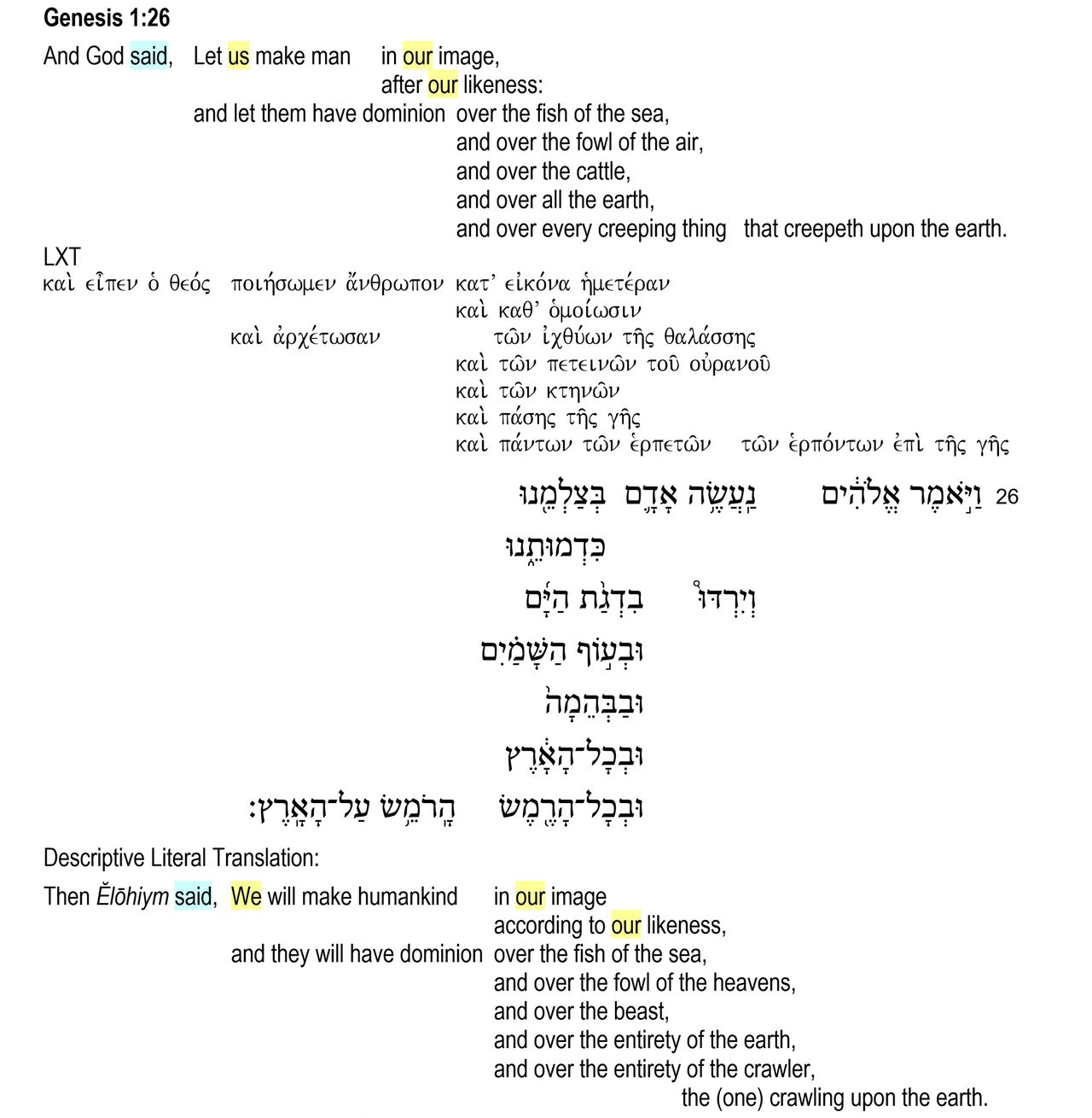
4. Ĕlōhiym is the plural form of Ĕlōăh, and it is the primary form translated “God” or “gods” in the Scriptures, occurring well over 2,000 times. This is the form Adam used to identify the Creator in the very first verse of his record. The iym-ending of this form is plural, indicating a minimum of three persons, in contrast to either the singular or dual forms which would indicate one or two persons respectively. Thus, the word may be translated “god/gods,” as shown in multiple references, but in Adam’s record, almost all pronouns and verbs associated with this plural word are singular, thus indicating that the man saw his Creator as one God who existed in three persons. Thus, the word Ĕlōhiym might be called a “uni-plural” noun, signifying that “God is one, yet more than one,” as seen in Adam’s words in Genesis 1:26 (below) where he used the singular verb “said,” and then quoted God using plural pronouns referring to Him.
Adam Knew God as God Existed
The primary word, Él, is the descriptive name of God apparently given directly by the Creator to Adam. Ĕlōah is an alternate form which the Creator may have built into Adam at creation or which Adam himself may have constructed using the perfect linguistic abilities built into him by the Creator. Regardless, however, of the manner by which these two basic descriptive names of God came to exist, Adam knew God as God existed, that is, Adam knew God directly and experientially, and was not dependent upon the testimony or instruction of other humans for his concept of God. The man accurately formed, and used, the primordial concept of God by direct knowledge and interaction, and his knowledge of his Creator was uninhibited by any internal tendency or propensity to resist and replace his Creator’s design.
Adam Formed the Perfect “Singular/Plural” Descriptive Title Ĕlōhiym
As God, all three persons of God were active in the creation, all three acting in perfect and complete concert as distinct persons of the one God. As the first created human, Adam knew each person of his Creator just as each manifested Himself, whether as Father, or Son, or Spirit. Thus, though Adam knew the Creator God to be one God, his concept of that one God included a recognition of all three persons of God, and this knowledge, in the perfect language built into him, required him to accurately incorporate a “plural sense” within the single word he would use, thus representing the three persons of the one God. In his unalienated walk with the Creator, the man knew Him as one God with one name, Ĕhyĕh/Yihyĕh (“I exist”/”He exists”), but he would also call His creator by a descriptive title which perfectly described Him. The word Él was sufficient to emphasize God’s oneness, and His absolute power and authority, but this descriptive title needed to manifest as well His existence in three persons in that oneness, and Adam perfectly formed the singular/plural word Ĕlōhiym to combine both aspects.
Adam’s Knowledge of God and the Man’s Aboriginal Concept of Greatness and Majesty
The Creator, then, in the entirety of His transcendent person was the origin of Adam’s concept of greatness and majesty. For some years after the man and his woman began fulfilling God’s design for them to “multiply and fill the earth” with their descendants, their personal relationship to their Creator was the only interpersonal relationship which they had aside from their relationship to one another. Certainly, they had interpersonal relationships with their children as they grew, but no human or angelic being could replace the God Who Existed in these interactions. God was both majesty and greatness in the most absolute sense, and nothing in His creation even approached these aspects of His person and nature. Thus, Adam’s, and Eve’s, concept of majesty and greatness was inextricably bound in the person of God. To Adam, the God he knew, the God who existed Ĕlōhiym, was the very definition, the perfect incomparable example, of majesty and greatness; no created thing nor the entirety of creation could compare. This God was the transcendent being who had brought the entirety of the creation into existence, and He was the being in whom the entirety of creation existed. The existence, the person and nature of this God, was beyond the ability of his perfect, but finite, human mind to comprehend, and this concept of greatness and majesty, never changing through all of his 930 years of life, was that concept which Adam used and conveyed to his descendants, and they, in turn, derived their concepts of majesty and greatness from that which they had received from him. Adam’s direct knowledge and interaction with God, then, not only developed within the man his “singular/plural” concept of God as Ĕlōhiym; it also developed within him the aboriginal and absolute concept which his descendants would later call a “plural of majesty.”
Adam’s Descendants Developed Their “Plural of Majesty” Concept from His Original
Thus, when his descendants, and perhaps Adam himself, sought for terminology to ascribe some degree of greatness or majesty to some person or thing, or even a concept, they encountered in life, the application of “plural sense” to that person or thing or concept would have been a natural way to ascribe the greatness or majesty which they had in mind. Something about the person or thing or concept reminded them of the majesty, the greatness, which God had built into every aspect of the creation. The thing so described was considered to possess “majesty,” “greatness,” in some measure, and when that thing was considered to be supreme among all similar items, then the plural form of the noun was an accepted and understood means of communicating this supremacy.
Adam’s Language Was Perfect and Complete . . . Built into Him by God
Many have never seen, nor will they allow themselves to see, the origin of the “plural of majesty” concept in Adam. They consider the teaching of Adamic origination to be nothing more than creative conjecture which has no potential of validity, but their rejection is not rooted in a proper consideration of the various points of the concept . . . they simply reject it, because it does not conform to their chosen ideas regarding Adam’s abilities or any texts he would have written. Having been taught wrongly in regard to the nature and quality of God’s creation of His first two humans and in regard to the fact that Godly humans, just like their unGodly counterparts, had been writing in the years both before and after the Flood, long before Moses was born in 1526 BC, those who reject Adamic origination have been misled and are misleading others. For those who have recognized that Adam and Eve were both created perfectly and completely for accomplishing every aspect of God’s design for their future existence, no possibility even exists that Adam did not possess full and perfectly functional linguistic abilities in that original perfect alphabetic language which God built into him and his woman. This is the language in which Adam recorded the earliest texts of God’s record, and this is the language which God used to form the multiple languages at Babel. There, He “mixed” (Hebrew bälăl) the linguistic components of the original alphabetic language of Adam to form the multiple nonalphabetic languages that caused the rebellious humans at Babel to disperse “upon the face of all the earth.” The language of Adam, then, became the origin from which all future linguistic concepts derived, not the least of which is the modern “plural of majesty.”
Evolutionary Thinking Has Perverted Western Thinking Regarding Adam’s Language
Evolutionary thinking has so permeated Western life that it has perverted even the minds of “Bible-believing” instructors in Christian colleges and seminaries; even those who might be considered the most “theologically conservative” have been affected. Many of these “affected” individuals do not recognize this influence or the degree to which it affects their interpretation of Scripture, but they have been influenced nonetheless. Typically, they will formally acknowledge the veracity of the Genesis account of creation, but they view humankind as “having developed” in some way or to some extent, whether in his ability to comprehend who and what he is, or in his ability to communicate with others, or in his religion, that is, in his understanding of God. While the view that man developed “religiously” can be a serious determining factor as to whether an individual is “liberal” or “conservative” in his beliefs, the view that man’s language developed over the centuries tends to be a foregone conclusion of all parties concerned. Indeed, human language does change with time and with various conditions, but the changes must be evaluated in accord with the actual chronology revealed in God’s record, and not from any alternate perspective. The ability of humans to communicate linguistically has not “highly developed” from rudimentary beginnings, but has, rather, “derived” from its “highly created” origin, that is, from the perfect and complete alphabetic language which God built into His first two humans, Adam the man and Eve his woman.
Modern “Biblical” Scholarship Has Been Adversely Affected by Evolutionary Thinking
Many modern scholars have followed an evolutionary line of reasoning to conclude that the word Ĕlōhiym, despite its plural form, is actually “nonplural” in nature, that is, the word is nothing more than a “plural of majesty” which humans long after Adam developed. They then apply this “nonplurality” to the writings of Moses in Exodus through Deuteronomy with the result that his every use of Ĕlōhiym is singular in nature. Then, those who follow this line of reasoning are led into the error of believing that the first writings of Scripture, even Genesis and the parts of Exodus describing Moses’ lineage, did not exist until Moses wrote them. They are also led into the error that the language of Adam, the language now called Hebrew, is a derived language which developed from other pictographic, logographic, or syllabographic methods of communication. All of this error is derived from various forms of evolutionary perspectives, and it has led the thinking even of most who claim to “believe the Scriptures” to hold, in some measure, to a “developmental” view of humanity. Though these individuals profess true “belief” of the Scriptures, their lack of learning in regard to the antiGod presumptions and influences of evolution, whether they profess to hold to them or not, carry more weight than the actual statements of Scripture in the languages which God chose for expressing His written record. These antiGod influences at the very foundational level of belief make the teachings of such individuals highly questionable, at best, because the same mindset pervades all of that individual’s thought.
The Evolutionary Mindset Leads to Chronological Errors in Scripture Interpretation
In the study of Scripture, this mindset sometimes takes the form of following the anachronism of evolutionary thought by taking word meanings and connotations which have been derived through centuries of human history and carelessly imposing them on the ancient text of Scripture. It is as though the connotation and concept that comes to mind in the present day is necessarily the same as that which the word, even in another language and culture, brought to the mind of an ancient reader of Scripture. The danger of this approach to Scripture interpretation should be obvious to all, but in reality, it bears great similarity to another widely accepted approach. Here, the words are essentially stripped of their basic meaning, that is, the actual meaning of their component parts, in the name of determining “semantic value,” that is, what the word “actually meant in the mind of the author at the time it was used.”
The “Semantic Value” of a Word in a Specific Setting Is Significant
Certainly, the “semantic value” is a valid concern when seeking to properly interpret words written in the ancient past, especially when those words describe still more ancient events, but the danger arises when an interpreter applies the “ancient semantic value,” as defined by a “modern mind,” to events which are yet more ancient than the words themselves. In some cases, the words used in the “ancient description” of the “more ancient event” may represent the primordial occurrence of those words. To impose any later, derived meaning upon those primordial occurrences is potentially the same reductive practice of using modern “definitions” to define ancient words. When “less educated” preachers and teachers of the Word practice anachronism of this sort, then those who “know better” are quick to belittle and to publicize the error, never recognizing that because they follow an evolutionary, developmental view of man, they commit the same reductive error. Their error, however, is far more dangerous and its ramifications far more pervasive, because as they express their “learned” conclusions, they influence many a future teacher or preacher of the Word to adopt the same “doubting” mind set, thereby destroying confidence in the very Scriptures they claim to believe.
The Evolutionary and Developmental Perspectives of Humanity Are Very Different
The evolutionary perspective sees humanity as having developed from simple, rudimentary beginnings to their current complex and highly developed state. The developmental perspective sees humanity as always having possessed the same level of abilities, but having progressed in certain characteristics and knowledge-related abilities as individuals and groups progressed in their knowledge and their abilities in correlating various realms of knowledge.