
The Nature and Content of the Only Valid Cursing and Blessing
Humans have devised the word “curse” to describe those conditions by which one being intends to bring harm, or some other undesirable experience, upon another being. One person “curses” another person or thing when he has become so dissatisfied with that other person or thing that he expresses, whether in words or actions, his desire for something harmful, something “bad,” to happen to the person or thing which has brought his dissatisfaction. Certainly, “cursing” may take different forms, but the central issue is that “cursing” originates from the “inner man” of the person pronouncing the “curse,” that is, every expression of “cursing” originates in the heart and mind of the individual. It is rooted in his own personal ideas, those ideas already existing in his mind, regarding what is acceptable to him for his life and interactions with everything around him. He “knows” what he likes and dislikes; he “knows” what is desirable and undesirable to him, and, when those standards, his own personal set of ideas regarding what is “good and bad,” are violated, or just appear to be violated, by someone or something else, then his emotional response, however wrong it might be, drives him to express his displeasure with whatever object is “displeasing” him. Thus, whether outwardly or only inwardly, he “pronounces a curse” on that object, and the nature and extent of the curse is whatever he himself thinks is appropriate in the matter at hand.
Accordingly, “cursing” is an action that is intensely personal and individual, that is, it is rooted in the very depths of the inner person and that person’s evaluation of what is right and proper. The difficulty arises, however, from the fact that humans are finite, limited, lacking in knowledge and understanding, unable to see beyond the perspective they have learned and developed up to any specific point in life. For humans, these limitations make their “cursing” in almost every case to be an expression of their own selfishness and self-focus. The “cursings,” then, of humans bear the effects of their humanity. If life has seemed to be good, challenging but bearable, and they have been taught to view others from a loving and unselfish perspective, then they tend to be more free with forgiveness and understanding. On the other hand, if life has seemed to be bad, challenging and unbearable, and they have been taught to view others from a hateful and selfish perspective, then they tend to be more demanding of punishment and accountability.
The issue which arises is that humans, whether they see life as good or bad, tend to view God as relating to life and to other humans very much as they themselves do, that is, they think that God “curses” or “blesses” very much from the same perspectives which they apply to such matters, but God is not human, and the imposing or ascribing of human perspectives on the Creator, though almost universal among humans, is a practice of grave error. In order to be accurate in any evaluation of the seeming opposites, “cursing and blessing,” or “loving and hating,” or “light and dark,” etc., any person seeking to properly understand the design of God must maintain his thinking in and upon the unfalse, unchanging person and nature of God, and thus, to provide an example, if “God exists love,” then His relationship to every thing in every situation at every moment must be considered from that perspective. Humans do not possess the ability or the authority to impose or ascribe to God a characteristic that is inaccurate. To do so is for that human to act as a “false teacher” to others, and thus, because the Creator cannot change or be false in any way, conformity to His design must be primary in the mind of anyone seeking or pronouncing “blessing” or “cursing.”
The Nature of God’s “Cursing”
The consequences which humans experience in their deviations from God’s design have been termed “cursing,” but this term is much misunderstood. The nature of “cursing” lies in its relationship to the hkesed of God, the criteria of His design, and may be defined as the experience of trying to operate life successfully while violating the Creator’s basic design criteria for its operation. Stated differently, “cursing” is the pursuit of a successful, valuable existence by following the criteria of designs which contradict God’s perfect design and order. These “criteria of violation” are many, and they vary constantly, as humans continually seek to devise some set of “criteria for life” which appear to actually bring success in life, all the while releasing them from their accountability to God. Because these “criteria of violation” have originated in the finite minds of humans and are contradictory to the Creator’s design, they can never produce the desired result. Deviation from God’s perfect design can never bring the benefits which the Creator designed life to produce, but those who deviate are destining themselves to a life of always trying to manipulate the design to produce a semblance of success where success can never be achieved, that is, such a person is actually “destroying himself” and precluding himself from ever experiencing the blessedness which God intended for him.
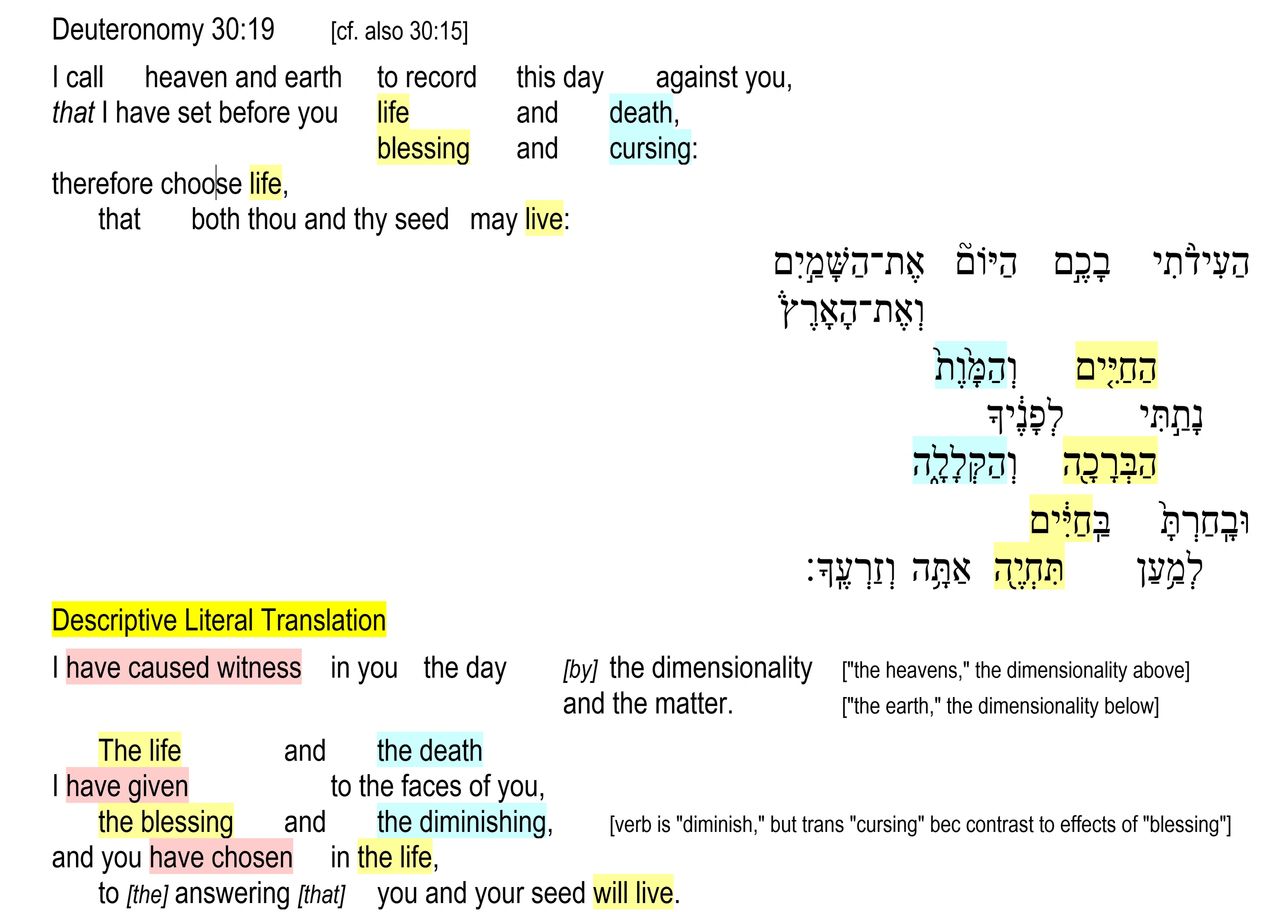
Deviation from God’s design, whether on a momentary basis by a “believer” or on a habitual basis by an “unbeliever,” is actually a denial of God’s person. Though many, claiming to believe God, think that they can believe and accept God in some aspects of life while denying Him in others, the Creator’s person cannot be believed or accepted in part. Indeed, either He is the transcendent Creator, to whom man owes not only his obedience but his very existence, or that man or woman is functioning in this “partial belief mode,” a mode bringing only destruction. In a creation filled with the Creator’s own constantly reiterating testimony of His inexorable value, the failure to acknowledge God as who and what He is in accord with what He has revealed of Himself constitutes a rejection of Him. The individual who deviates and never accepts God’s gracious, “freely given,” revelation of Himself and His design ultimately experiences the Creator’s confirmation of that person’s choice to reject and be consigned to everlasting punishment for that rejection.
The Nature of God’s “Blessing”
The consequence of adhering to God’s design has been termed “blessing,” but this term, too, is much misunderstood. The nature of “blessing” lies, not so much in its results, but in its relationship to the criteria of God’s design, and it may be defined as the experience of operating life in full accord with the Creator’s “very good” design. Stated differently, “blessing” is the pursuit of a successful existence, valuable in the most absolute sense, by following the criteria of the Creator’s perfect design and order, and the experiencing of a personal relationship with the Creator, a relationship that is free of alienation and knows experientially all the “good” that God intended human life to be.
“Blessing” does not exclude being affected by the violations and undesirable experiences associated with living in a fallen world. It does, however, guarantee an existence characterized by the direct personal involvement of the Creator as He interacts with and actively controls every situation of life and its consequences. The one who adheres to His design experiences the result which He has determined, whether or not that individual personally acknowledges Him in that result. Truth and honesty have their rewards even in a fallen world; proper application of physical laws produce a measure of success in the physical realm for anyone. Religion, too, can be of value in helping some to acknowledge God, if that religion does not stray too far from truth. The criteria of God’s design actually work, and they work independently of the man or the situation, regardless of the perception of those involved, because God is personally, actively insuring the result.
Adherence to God’s design means a total acceptance of all aspects of His Person, no part being excepted. He cannot be God, and then suddenly cease to be present, as if He left the room or became preoccupied with some other situation. He, and thus His design, are always present, and the person who walks accordingly acknowledges Him as He is and ultimately receives His righteous sentence to be with Him in eternal blessedness (Proverbs 3:5-6).
Humans may, indeed, “bless” God and other beings in the creation, but the nature and content of that “blessing” is defined, just as is everything else in existence, by the criteria of the Creator’s perfect design for all that exists. Because God never changes any aspect of Himself or His design in the least way, and because He cannot be false in any way or to any degree, for the “blessing” of any human to be “blessing” in the eyes of God, the “content” of that blessing must be in complete conformity to His person and nature as He has actually revealed Himself, including, inseparably, a complete conformity to who and what that human is as a created being in relation to Him. Thus, the design of God is the defining and governing criterion, in all its increments and aspects, in regard to determining whether “blessing” God is true blessing or whether it is just another imposing of mankind’s humanistic thinking on the person of God. Individuals, then, who seek or claim to “bless” God must be careful to maintain their every thought in complete conformity to His perfect person and nature, seeing Him, themselves, and all other things of the creation as He has created them and designed them to function and interact with one another. Thus, “blessing” can never contain any aspect or any degree of selfishness or self-importance; true “blessing” sees all that exists accurately and relates to it all exactly as He, the Creator, relates to it.
One of the earliest texts of God’s record describes His creation of His human creatures, clearly indicating the nature of “blessing” as He defines it, and thus, the inseparable relationship between “blessing” and the criteria of His design. In the Creator’s own description of His creation of humans, immediately after He brought His first two human creations into existence, He “blessed” them, and then He “spoke” to them, expressing in His words the content of His perfect design for their existence. Those words, expressions coming directly from His person, were expressions of His own perfect person and nature, and thus, God Himself inseparably connected His “blessing” to the criteria of His design. Then, too, because God’s expressions of Himself are not limited to verbal speech, but include everything that He does in any way, His “blessing” is inseparably interrelated with everything that He does, however He chooses to do it. This means that His “blessing” and His interactions with everything in creation are inseparably integral to one another, making His every interaction a “blessedness” and every “blessedness” an expression of His interaction. Humans may, then, “bless” God and other beings of the creation, but, if their “blessing,” regardless of what they think in regard to what they are doing, is not in perfect accord with God’s revelation of Himself and His design, then such “blessing” is not blessing at all, but is the exact opposite and includes the exact opposite results.
[See also the author’s paper entitled “The Relationship Between Blessing and Cursing in Job.”]