
by Kenneth F. Sheets
Esther was a Hebrew young woman with a distinctly Godly character, a character which had been “firmed,” “trued,” into her by her cousin Mordechai. He had taken her as his own daughter upon the death of her father and mother, and he had realized that, because of her great physical beauty, she needed special intensive instruction in the Creator’s design for how a beautiful young woman was to conduct herself and interact with everything she touched in life. Esther, Hadassah, had learned well the wisdom of God which Mordechai had taught her. She had received and sought to correlate all the aspects of the Creator’s hkesed, His design for all that existed, to become a young woman whose internal character was truly as “beautiful” as her external physical appearance. She had developed that wise and Godly character which seeks to accurately express God’s design for true love and care to everyone who experienced any degree of interaction with her, and this manifestation of the Creator’s perfect design inescapably and inexorably “lifted up” in the mind of each one a sense that moved them to respond to her with the same grace and hkesed.
As the Scriptures record, even in their first meeting, the king could not keep himself from responding to Esther’s wise and Godly character with the same grace and hkesed. Her Godly character had brought her into her queenship to Xerxes, “Ahasuerus,” and that character did not change when she entered into that new role with all its new responsibilities. She was Xerxes’ queen, but she was also Hadassah, the beautiful young woman who had been “firmed, trued” in the design of God by Mordechai, and that “firming” would continue to be manifest throughout her life. She had become queen in the 10th month of the king’s 7th year, the year 479 BC, and the events considered here occurred in the 1st or 2nd month of his 12th year, the year 474 BC; Esther had been queen for over four years. Mordechai recorded the incident.
For Esther to approach King Ahasuerus without having been called by him was an unthinkable action. This king was not some weak ruler of an insignificant dominion. This was Ahasuerus, Xerxes, the king of Media-Persia, the Achaemenid Empire, one of the most powerful empires of the ancient world, and this man ruled this empire from 486 to 465 BC. During his preparations for going to war against Greece, the king, in the 3rd year of his reign, had made two great feasts, the first for 180 days and the second for 7 days. Though he honored the leadership of Media-Persia, he also honored himself, causing all who attended to see his riches and glory. Xerxes was king, and he was to be honored and respected according to the standard he established for doing so. Every person in the kingdom, regardless of position, was under his authority and accountable to show proper respect; no one would usurp to himself the authority to decide how to honor this great king, the ruler of an empire covering 127 provinces from India to Kush.
Everyone in the kingdom knew the king’s law that anyone who approached him without having been called was to be put to death, unless the king acted specifically to save that person. Though this law may seem harsh in the eyes of modern humans, in the days of Xerxes, such a law could be justified, because any person who would come into his magnificent presence without him having initiated that visit would be doing so presumptuously, at least to some degree. Since the attitude of presumption is an attitude of self-will and self-importance, the entrance of any uncalled visitor signaled the king’s bodyguards that an act of treason and rebellion may be in progress, and they were to act immediately to insure the king’s safety and his throne. Presumptuous individuals were indicating that they were unwilling to submit themselves to the king’s rule; they were indicating that they desired to replace his ways and laws with those of their own choosing. In a sense, their presumption could rightly be interpreted as rejecting his kingship and desiring their own, and such an attitude was a clear manifestation of a treasonous heart.
Though Esther was Ahasuerus’ queen, his law forbidding anyone to come before him uninvited was absolute, and she possessed no more right to violate that law than did anyone else. In actuality, as one who was very close to the king, the one woman whom he had chosen to bear the title of “queen,” and in light of the refusal of Washti, the previous queen, to obey him, Esther was even more accountable to comply with his expressions of his position and authority. If she violated his criteria, her violation would be interpreted as an obvious and overt act of rebellion against his authority, an act which might have the effect of moving many others to conduct themselves in a similar fashion. This was the nature of the violation of Washti, the previous queen, which had moved him to depose her from her position. Washti had not violated a law that carried the death penalty, but she had resisted the king’s will, and thus, she forfeited her position but not her life.
Esther, however, would not be placing simply her position as queen in jeopardy; she would be placing her very life, her very existence, her very continuance as a living person, at the whim of an authority who did not even have to give the order for her destruction. All that was required of him was to do absolutely nothing! For Esther to be destroyed, all Ahasuerus had to do was to not extend the symbol of his authority, and he had not seen fit to call her to himself for a substantial period of time. Esther had been queen for over four years, but she had not been called to the king for “this thirty days,” a period sufficiently long to make the queen wonder just what the king was thinking in regard to her.
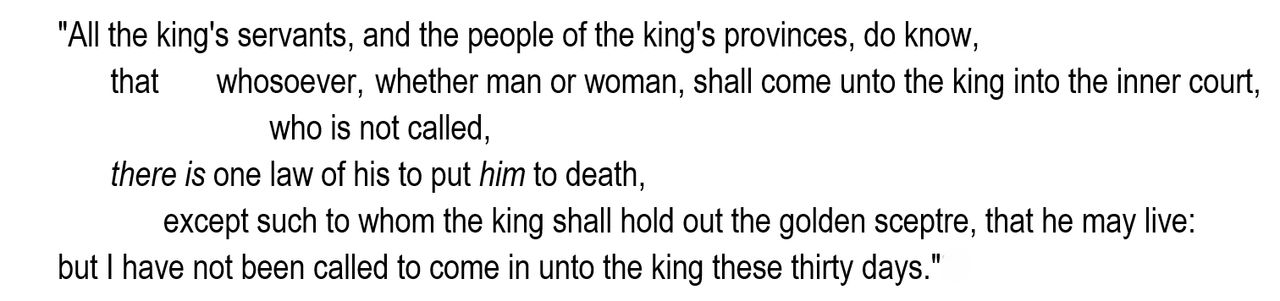
To approach such a man in such conditions, and have any possibility of remaining alive, required an approach that would immediately assure him, and all those entrusted to protect him and his royalty, that no treason and no rebellion of any sort was even remotely intended. The great king, and all those about him, must recognize in the first moment that her entrance, though contrary to his law, was in full submission to his person and to his position. They must recognize that her coming contrary to law was motivated by such great personal need of his assistance, an assistance he alone could give, that she would risk her very life in seeking fulfillment of that need. She knew well the king’s law and related this understanding to Mordechai:
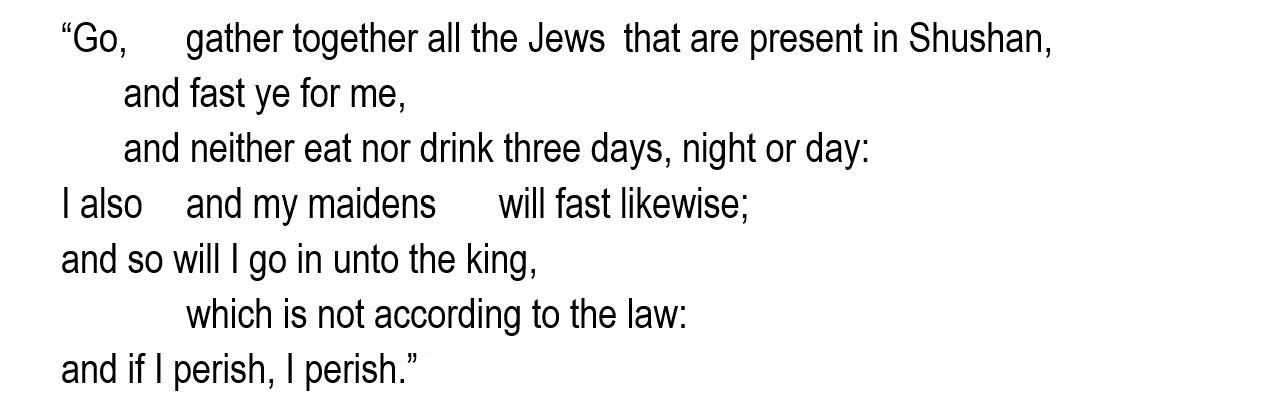
Having decided to commit the forbidden action of presenting herself before Ahasuerus without having been called, and fully anticipating that her approach to the king might result in her destruction, Esther instructed Mordechai to seek help for her from the only power who could provide it. She needed the help of someone who had the power to affect the king’s judgment and his evaluation of her entrance. She needed the help of an authority who could protect and preserve her even in the face of the most powerful ruler of her time. With this in mind, she instructed Mordechai to enlist all those who were supposed to know the God of Abraham, Isaac, and Jacob, and who were in the capitol, to intercede for her in preparation for her entrance to the king:
Esther knew that she would need the wisdom and guidance of her God, the God Who Exists. She knew that He was the only one who could influence every aspect of the situation and who fully knew each heart. Help could arise from no other; she needed to know very clearly and assuredly the Creator’s design for doing an action which was forbidden by man, and which could be wrongly evaluated as rebellious.
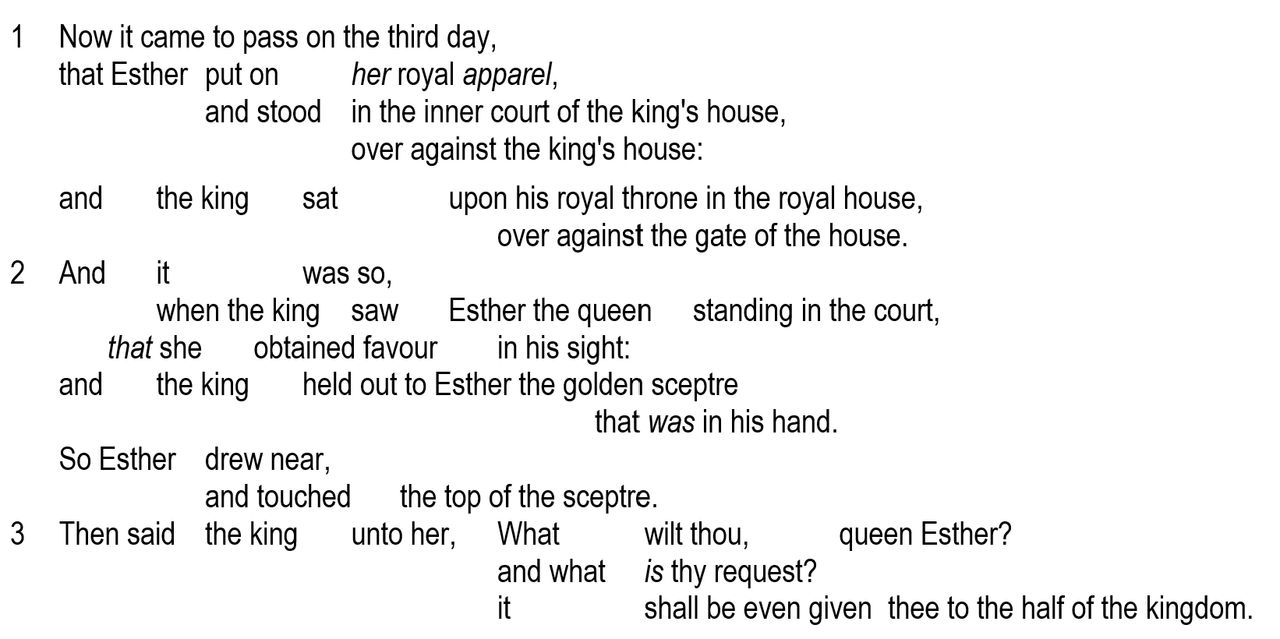
Mordechai carried out Esther’s instructions, and as the words, “now it came to pass on the third day,”[1]indicate, she must have used the time well. She gave the Creator time to work and prepare the hearts of others, especially the king and those around him, for what she would do. She did not act impetuously or rashly. She gave the Creator time to teach her and remind her how to interact with the king wisely, how to violate the king’s law and at the same time actively “lift up grace in his eyes” as soon as she stepped into the place of violation. She was not only about to violate a law which carried the death penalty, but also, if she lived, she would be accusing one of the king’s favored princes. Either action was an extremely dangerous thing to do. Her life was at stake.
Esther formulated an effective plan of action. If the king allowed her to live, rather than focusing on herself, she would request that the king allow her to honor him at a “feast” which she had already prepared and which was specifically designed for him. This was not a feast of excess where she had invited and provided to an extent and in a way that would bring honor and recognition to herself or which would in some way mimic or rival the feast that he, the king, might provide. Indeed, her “feast” must be a clear demonstration of her recognition that its every aspect reflected her knowledge that he owned it all in absolute entirety; she was merely using that which already “belonged” to him, herself included, and which he had delegated to her, to further proclaim his glory and honor. Every aspect of her feast, and even her violation of his law, must definitively proclaim her desire for him to be the great king he was. Her preparations would not be done in secret; they would be open to all, even, likely, being made known to the king by those who served him. This feast would be just another manifestation of her known character as a woman who “lifted up grace and hkesed” in the eyes of all who saw or interacted with her; the preparations would not be done “in secret;” there would be no “surprise” for the king.
Esther well knew what had occurred with Washti; she knew that Washti’s unwise presumption had cost her the queenship, but much more was now at stake, and she must act with wisdom and discernment. As a wise woman, she knew that secrecy could be, and often was, seriously misinterpreted, and thus, her every preparation for her feast must be done openly, visible to all, not the least of whom would have been Ahasuerus himself. The king’s servants and administrators would have known of Esther’s activities, and they would not have withheld from the king any information in this regard. Esther was openly preparing for something within her authority and ability to provide, and that something was not excessive or wasteful of the king’s property. No invitations had been sent, and the provisions seemed to indicate that she was preparing openly for a very private time of interaction with perhaps only one or two others in attendance. This woman, this queen, was preparing something very special for some one, or ones, who were very special in her sight.
Though no one had yet been invited, her preparation in advance of any invitation indicated that the person for whom the “feast” was made was not to be kept in waiting while preparations were finished. She recognized the importance of the individual and the importance of his time, and she would honor him and all that pertained to him. Such preparation with no invitations must have caused some measure of speculation in the minds of all who observed. Indeed, those speculations could have reached the king himself, even giving rise to the conclusion that he alone must be the sole individual for whom the feast was intended. Certainly, he had perceived that Esther was no “ordinary” woman; the wisdom and perception she manifested in all her interactions, and the constant grace with which she wore her great beauty, had long been recognized by all those who saw and interacted with her. Ahasuerus knew all this; this queen was not a woman of rash or disorderly behavior; this queen was a woman who demonstrated to all that his choice of her had been a choice of the utmost wisdom; this was a woman who openly manifested not only her respect for him and his position but also her desire to please him. Certainly, this queen was not resisting or rebelling in any way or to any degree against his authority. She was truly his queen.
In wisdom, Esther had thought all the way through the desired course of events, that is, she did not just do one thing and then determine what to do next. She planned thoroughly and openly, preparing the feast before presenting herself to the king, and thus, allowing time for the king to learn of her activities. The king’s instruction for Haman to “hurry” to Esther’s feast indicates that he understood that her preparations were already completed. This, too, would have demonstrated to Ahasuerus that she had trusted him to perceive that his trust in her was well placed, and obviously, he knew this, because if he had not been assured that she was worthy of trust, then he would have called her before him to explain her activities. If he had experienced any questions before this point in time, he was quickly learning that this was a woman he could trust, a woman, a queen, in whose hands his best interests, his kingdom and all that pertained to him, were safe. Esther was a woman who manifested the design of God just as she had learned it from the Creator’s proverbs. The heart of her husband, the king himself, could trust in her that he would have no loss as a result of her actions. He could safely trust that she would do him good, and not evil, all the days of her life. Esther was truly a woman of “virtue,” hkăyil, a woman who effectively applied the perfect design of God, in her relationship to her husband. Whatever else she may have done imperfectly, Esther knew that only God’s design could meet the need of her people in that hour.
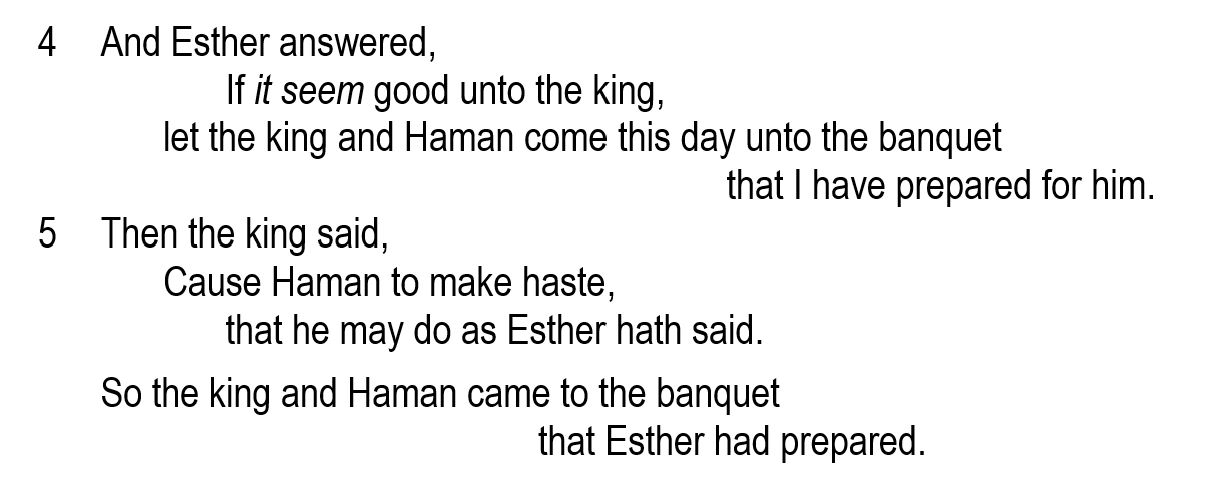
Unlike so many who have designed a set of circumstances for seeking something from an authority, Esther did not presume upon the king in presenting her request. Her first request, the one requiring her violation of his law, had been only that he and Haman come to her ready feast, and, even this request was contingent upon the fact that his doing so was “good upon the king.” Her every action was a demonstration of her care and respect for him and all of his responsibilities as the “king of kings” over a great empire. Then, during that first feast, she had, in the same grace and wisdom, asked only that he allow her to prepare a second feast for him and Haman on the next day, contingent again upon her having “found in the eyes of the king the grace” that she sought. In that feast, she would do as the king had said; she would reveal her request. By waiting until the next day to state her predicament, she was allowing the king both to “read” the situation and, while recognizing her reluctance to appear to be imposing her desire upon him, to bring up the matter at his convenience. This, too, would indicate to him both that she was submitting herself to his authority and that she recognized his ability, inherent in his person and position, to properly correlate all the various conditions of her situation to determine when she should present her petition. By not “pressing” him, she was indicating her trust that he could, and would, satisfactorily resolve her matter. She had freely presented herself before him in a manner that, though contrary to his “law,” had honored him and his decision to make her queen, assuring him of her trust in his will; she could not follow that indication of trust with actions demonstrating anything else.
Esther used the many different kinds of knowledge she possessed. She obviously knew that the king was a “thinker,” and that when presented with a puzzling situation, he would not just dismiss it, and he would not make a rash evaluation. Instead, the situation would gain more and more of his interest until he had resolved it, but he would do so in his own time and in his own way. He would immediately know that her request was of dire importance, because it had motivated her to violate his “law,” but she could not impose her determination of importance upon him. Her every action must demonstrate honor and respect in the eyes of all who witnessed or heard of her interaction with the king. Her actions must arouse his interest and communicate that she needed something that he alone could provide, but, at the same time, she must insure that those actions would not be considered manipulative in any way. Her interactions with the king must allow him to be the great king, the man she knew him to be, making him think, making him wonder, making him know that her request was extremely important to her, but at the same time, clearly demonstrating the honor and respect due his position. She would not express her request as though it were a selfish desire. Instead, the king and his kingdom would be prominent in her interests; she did not only want herself and her people to live, she wanted the king to suffer “no damage.” She would insure that he knew that his rule, his kingship, was safe in her hands. Even the least detail of her existence was submitted to his will, and she had no desire to replace him as the king of her life.
To communicate all these things, Esther wisely prepared herself for appearing before the king. She “put on royalty,” that is, she clothed herself in that which she knew would demonstrate her recognition of the fact that her life, her position, and all that she had, was bestowed upon her by his free giving to her, by his grace. She clothed herself in that which she had received from his hand. She had not merited that which he had given; she possessed it by the grace of her lord, the king. Clothed in the very royalty he had bestowed, she would manifest that she knew he could take it all, even her life, away at any time. This would manifest that she trusted him fully and implicitly. As she stepped into the realm of that which was “forbidden” to her and “stood in the inner court of the king’s house,” in full view of the king, she exhibited no haughtiness, no presumption, no attitude that she “deserved” anything from him. Instead, she exhibited humility, submission, honor, those things that were proper in the presence of a great king. She did not approach his throne until bidden to do so; she simply stepped into the place where her life was totally in his hands to do with as he saw fit. This exhibition of absolute trust in her king was perhaps the greatest honor that she could bestow upon him.
The degree to which Esther’s actions honored the king, and the degree to which he understood that she was accepting his will as her will, is indicated by the fact that he entrusted her with “up to half the kingdom.” Though in the modern era, many have diminished the significance of this offering by Xerxes, it was in no way a trite “saying”; this was the valid offer of the King of Media-Persia; it was not just a way of saying she could have anything she wanted, but within reason. The king’s words carried weight, authority, power, and he well knew how and when to use them. His very wording, literally, “unto the half of the kingdom,” was distinct and measured, designed to provide an opportunity for the person making request to demonstrate his or her submission to the one offering a portion of that over which he possessed authority.
The nature and degree of the request would be an indication of the perspective, the attitude, of the one doing the asking. For anyone to ask for more than half the kingdom was to ask to be regarded as greater than the king himself. To ask for half the kingdom was to ask to be co-ruler with the king. To ask for anything less than half the kingdom, and especially anything substantially less or even inconsequential relative to the magnitude of the offer, was to acknowledge a desire for the king to remain ruler, not only over his kingdom, but also over the individual making the request. Thus, Ahasuerus’ words indicated that he trusted Esther to the extent that she could ask for anything as long as that request indicated her desire for him to remain king over her life. Certainly, she knew that she was not to presume on the king’s grace. She could have asked for much more, “unto the half of the kingdom,” but to have done so would have indicated both a lack of satisfaction with his provision and an attitude of personal self-focus above his interests. Though she may have received her request, she would have forfeited her life for not seeking the welfare of the king and his kingdom.
In all this, God honored Mordechai’s “firming,” his “truing,” of Esther. Her cousin had not taught her the content of the Scriptures as so many of both that time and the present actually do. He had taught to her the Scriptures as the revelation of the person and nature of the God Who Exists, as the revelation of the Creator’s perfect design for every function and interaction of everything that exists, as a design that, in its every criterion, was to be thoroughly and accurately incorporated into every aspect of human existence. Mordechai himself lived this design, and when he and the other Jews in Shushan sought to the Creator and His power to influence the king and resolve the predicament in which they found themselves, they were conforming themselves to His criteria for righteousness, thus “allowing” God to “know their way” and to work in their behalf.
Though, like every human who has ever lived, some of Esther’s and Mordechai’s actions, and their responses to the Medo-Persian government, may be deemed by some to have been “questionable” at best, these two Hebrews did recognize the most important truth of all: God, and God alone, could deliver them. They, like Esther, had “clothed themselves” in the only “clothing” which is acceptable in the sight of the Creator: the “clothing” of a righteousness determined only by Him. They, just like Abraham, their father, had done long before, had chosen to turn from “causing firmness” to any and all aspects of their finite human existence. They chose, instead, to turn to “causing firmness” to the God Who Exists and to Him alone. They manifested that He and the absolute firmness of His design was their only hope, and, just as He had designed all the systems of the creation, He, the transcendent Creator of all that exists, honored their “causing firmness,” and He manifested His honoring of their “firmness” by doing that which they were unable to do.