by Kenneth F. Sheets
The Relationship Between the Criteria of God’s Design and the Happenings of Life
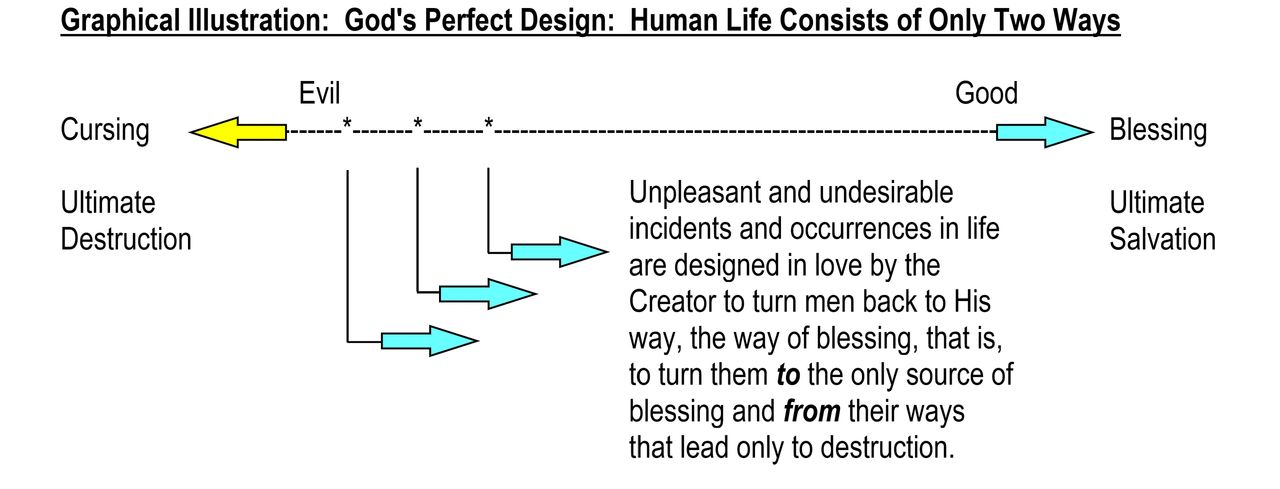
Bad things happen in life, that is, situations and events that are undesirable from the human perspective arise as if “out of nowhere,” as if they “just happen” without being incited or caused by anything. These conditions are not “random happenings”; they are the design of God for His “fallen” creation. Many humans have, in some measure, the erroneous perspective that the Creator is “just watching and waiting” to impose penalties on anyone who does anything “wrong,” but that is not the person and nature of the God Who Exists, the God who brought into existence all that exists. Though He possesses the authority and the ability to do so, and He may do so whenever He chooses, the Creator does not directly and personally cause “bad things” to happen. He built into the creation certain criteria, certain “cause-and-effect” conditions, certain “laws” and “standards” that govern His creation, and, when these are violated, they bring “bad” results.
The “Failures” of God’s Design Are the Failures of Humans to Operate His Design Properly
Humans are constantly devising and constructing systems that are designed to bring “good” when operated in accord with the design criteria imposed by the builder, but when those same “good” criteria are violated, whether purposely or accidentally, the system fails and results in “bad,” and that “bad” may be extremely destructive, even catastrophic, to those involved. The “good” design criteria were established so that failure and “bad” would never occur as long as the system was operated as it was designed to operate. Indeed, as long as the system was operated within the “good” design criteria, that system would bring the “good,” the “blessing,” the “success,” intended by the designer. God, the perfect designer, designed and built the creation with the absolute best design criteria in place, and thus, when humans operate within those criteria, “good” is the result. All too often, however, humans choose to operate God’s system in ways that are contrary to His “good” design, and, when failure and destruction result, they blame Him and His system for not working as they thought things should operate, but He, the designer, is not to blame. The blame is upon the “misusers” of His perfect system, and the “bad” results should influence the “misusers” to turn back to proper use of the system.
God’s Design Criteria Govern Every Aspect of the Entirety of the Creation
God’s design criteria, then, act as controls upon the creation and, when properly applied, they always result in “good,” but when violated, they always result in “bad.” In the physical realm, the existence of this “cause and effect” system is usually obvious, and humans tend to operate much of their world according to these “cause and effect” criteria, seldom recognizing their origin in the Creator’s design. His criteria govern all that exists, not only in the physical world but the moral and spiritual realms as well. Indeed, His criteria exert their inescapable influence in every sphere of interaction associated with all the various aspects of the creation, and, just as humans cannot violate the Creator’s design for the physical world, for example, the “laws of physics” or the “laws of chemistry,” without experiencing “bad things,” neither can they violate God’s design for any other aspect of existence without similar results. Whether humans are ignorant or knowledgeable of the criteria of the systems around them, they are subject to those criteria. Only the unchanging, unfalse Creator possesses the power and authority over the criteria, and He will not change or “override” them in any way or to any degree.
Violation Brought Alienation and a Propensity to Continue Violating
Some consider God’s design to be unnecessarily authoritarian, even cruel, on His part, but, in reality, the very opposite is true. Before the first “bad” result occurred in human history, God had already built into His creation system the criterion that human violation of His design, human “sin,” would cause the violator to be alienated from Him, and this alienation, if not eliminated by becoming reconciled to the Creator, would ultimately lead to death and eternal destruction, separated from the blessed existence which He had designed for every human to experience. When Adam violated, he was the primary created authority in existence and the human from whom all other humans descended. Thus, he experienced not only the designed alienation in his relationship to the Creator, but he also experienced the change in human nature which alienation from God brings and he has passed that “changed nature” to every human who has come into existence.
Adam no longer experienced that closeness of relationship which influenced him to conform to his Creator’s design. With his alienation had come something else: a propensity, a primary tendency, to violate and to continue violating. Alienated from God, he experienced a new sense of dependency upon his own “authority” and his abilities for determining how he would function and interact with everything around him. Certainly, the Creator had a perfect design, but he, Adam, was now just as alienated from that design as he was from the person of the Creator, because that design was a perfect expression of the Creator’s perfect person. Something had changed in his human nature as soon as he had thought himself sufficient in authority to violate any criterion established for his created existence. He had chosen, as an act of his own will, to violate, and as a result, he and each of his descendants, even in their alienated condition, would be required to choose, again as an act of the will of each one, to return to their Creator’s design by conforming to His means of reconciliation.
Apart from this choice to turn back to God and conform to His design for reconciliation, every individual human not only continues in life in this state of violation but is also proceeding inexorably and inescapably toward an end of life when the decision to either conform or reject is permanently confirmed by the Creator. Knowing both the Creator and that He had a perfect design, humans had rejected both; only a return to Him, according to His design for such a return, could alter that course of life, and the first criterion for reconciliation is “believing God,” that is, every human who would be reconciled must first recognize and acknowledge his true relationship to God. He must then also acknowledge his alienated condition and the reason it exists, seeking only to God to restore him to the designed relationship. Despite any and all human evidence which seems to contradict this condition, every human must “cause to be firm” to himself, that is, he must “believe,” what God has established and revealed about the matter.
Believing God: The Active, Personal, Individual Means of Reconciliation
This is the essence of “belief”: a human is faced with a choice between “what God has said” and what all other evidence appears to say, and he chooses God over all else. From the human perspective, the “other evidence” may appear to be the most firm and trustworthy, but the man who “believes God” chooses what God has said, not because of the evidence coming to his senses, but because of the person and nature of the One who said it. The inestimable person of Yihyeh, the Creator, the God Who Exists, makes what He says inestimably and absolutely firm and trustworthy. In this sense, the person who “believes” God makes God to be to himself true, firm, trustworthy, the only foundation upon which to build any aspect of human existence. Nothing of the creation, nor all of it, can actually “cause” God to be either more or less firm, but each individual can “cause God to be firm” to himself. No one can “cause God to be firm” to another person; it is a personal and individual choice on the part of every human. One person can give evidence, reason to believe, to another person, but in the final analysis, each makes his own choice that either what God has said is firm or that something else which commends itself to the human mind is more firm. Every choice of “something else” is not simply a failure “to trust God”; it is an active choice against God.
Man’s Violation Complicated His Ability to Choose to Believe God
Reconciliation, then, has always been a matter of “believing God.” The first man, Adam, chose to not make firm God’s word to him, and became the first human to willfully violate that which his Creator had established. He chose the “good” that he could “see” as opposed to the “good” of his Creator’s design, a good that he could not see for himself. Doubtless, Adam turned from this rebellious and destructive course, but his turn was too late for his descendants. Because Adam, with Eve’s consenting, had chosen on his own volition to violate God’s design for human life, God’s design brought about a change in the nature of His human creature. Man would no longer have the ability to choose whether or not to “believe” Him from a totally neutral perspective. Instead, man would have to choose whether or not to “believe” from a “fallen” perspective, that is, from the God-imposed perspective of mind that “naturally” chooses contrary to what its Creator has said. Believing God would no longer be an easy task; man would have to make an active choice to do so, and that choice would be made in the face of “competing evidence” that such a choice is foolish. In truth, “easy believism” vanished with Adam’s choice to not believe.
Believing God Involves Believing His Design for Reconciliation
In the present day, believing God necessarily involves receiving Jesus Christ as Savior. Because God has now clearly revealed His design for man’s reconciliation, man must “believe,” he must “cause to be firm,” that which God has revealed. From the first violation, the price of reconciliation to God has always been death by the shedding of the blood of one who was not guilty of the violation. The death and blood of animals slain in man’s place could never be sufficient to take away any man’s guilt, because animals were not human; they were not the same essence as man. Though similar to man in many ways, including the possession of intellect, emotion, and will, the three characteristics usually associated with personality, animals were not created with one important element in their being: they were not created “in the image of God.” By the direct expression of the Creator, He instilled His “image” into humankind alone, and that in both genders alike. Thus, the only death sufficient to replace that of the guilty man would be the death of a human who had himself never violated the design of the Creator. The only one who ever met this criterion was Jesus Christ, a truth confirmed by God when He raised Jesus from death. God revealed faith in the sacrificial death of Jesus Christ to be His design for reconciliation; the man who truly “believes God” believes this! The man who does not believe this does not truly believe God, no matter what that man professes!
The Person of God, His Perfect Hkesed, Is the Foundation of His System
Conceivably, God could have left Adam and his descendants in His wonderful garden within reach of the tree of life, but if He had done so, man would surely have eaten and begun an existence of eternal life in his fallen state. The Creator, however, knew the undesirability of such an existence and forced man to leave the garden and access to the tree of life. Whether man could see it or not, God saw that the propensities of man’s fallen heart would lead him into a life of repeated violations of his Creator’s design, violations that by virtue of His person He could not and would not bless, and the potential of eternal human existence in this state would be eternal disaster for man. In love and mercy, in perfect hkesed, the Creator God expelled man the creature from access to the tree of life. Man was then faced with the prospect of death, a cessation of physical life, but a progression to what the Creator had established to follow.
God Designed Physical Life to be Man’s Time of Reconciliation
Man had been created to have a never-ending existence, a condition which never was, and never has been, compromised in any way. This condition was set by God, and when God established man’s accountability for his violations of His design, He designed that accountability to be unaffected by so small a thing as physical death. No man’s guilt for his sin could be taken away by his own death, because his own death was not that of one who was without sin. Death itself, no matter how bloody, did not “atone” for man’s violation, so death only meant the facing of God’s penalty for sin, but without any prospect of reconciliation. Physical life, the time designed for reconciliation, would be past, and the rejection of God’s design would be forever confirmed.
Bad Things in Life Are God’s Perfect Warning System Against Violating His Design
Understanding man’s nature to disregard knowledge of what he might have to face in the future and to postpone seemingly unpleasant decisions, the Creator God once again demonstrated His love and mercy, His perfect hkesed, by building into the creation a system to remind man of what lay ahead. This system would provide “bad experiences” for man whenever he violated the criteria of God’s perfect order. In so doing, each “bad experience” would serve as a reminder to man that it was God who had made him and not man who made himself, and that He the Creator would require an ultimate accounting for the keeping of His design, just as He required a daily, moment-by-moment accounting for the same. All creation would work together to warn man of his need to reconcile with the Creator while the opportunity remained; it would demonstrate to its human inhabitants the inestimable value of following His way in contrast to the inescapable consequences of rejecting it. No man would ever have even the least measure of justification to accuse the One who made him of failing to provide warning of the judgment to come. In truth, God’s warning system is further proof of His original design and His desire that no human suffer ultimate destruction. “Bad things” do happen in life, but if recognized as reminders to walk in God’s perfect design, in reality they are expressions of the heart of the Creator who seeks to turn man to a glorious earthly existence and an eternal life of incomprehensible blessing.
Moses Described God’s Design to Turn Man from the Way of Destruction
Moses recorded a statement of God’s design to use the “destructive” events of life to turn man to the only possible source of blessing. While a proper understanding of Moses’ “Law” presents this design, he also wrote of it in very specific wording in a psalm he authored. In Psalm 90, Moses described how God sought to turn His human creatures to Himself. The creation which He had designed and built would work to “destroy” the confidence of humans in themselves and their ways, and then, finding the destructiveness of their own ways, they would turn back to Him and the blessedness of His way.
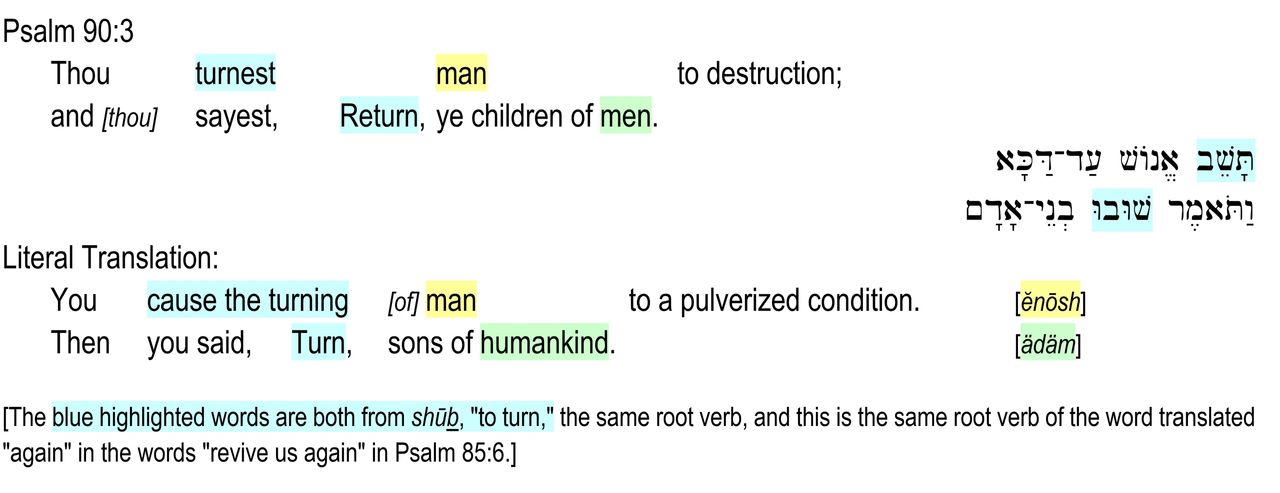
Analysis of Psalm 90:3
Humans have no lack of self-confidence; even those who outwardly appear to be void of confidence are, in actuality, confident that “the way they are” is the right way for them. They are “confident” in the way they have chosen to be. This seeming “lack of confidence” is not the norm for man, however. Individuals choose their way, that is, their thinking and the things they do, based upon that which they believe. This is the inviolable nature of the relationship between belief and action; humans do what they do because they believe what they believe. In reality, the person who claims to believe something, but acts in a manner contradictory to that “belief,” does not, at the moment of the contradictory action, believe what he or she claims.
Choices and actions are the result of beliefs whether the individual is saved or lost, thus the importance of “the renewing of the mind,” of “letting this mind [of Christ] be in you.” Before being “born again,” man thinks with his “natural,” secular, “enemy of God,” mind; he does not see things God’s way, but the way of the world system with which he is so familiar. Even after a person receives Christ, however, most of his thinking is still in keeping with the life he knew before regeneration. The believer does not at the moment of salvation suddenly become complete in his knowledge of God and God’s design. He must learn and grow and develop an understanding of how and when to apply all the criteria of his Creator’s design, but this process takes time, even under the best of conditions.
Regardless of the degree and quality of his knowledge and understanding, man typically acts as though his knowledge and understanding is more than sufficient to justify the action in which he chooses to engage himself. Man thinks that whatever course he chooses to take is right for him, and when this type of thinking begins to connect a series of courses or a life of them, that man’s thinking becomes the justification for an entire way of life. Then, too, because the individual never actually thinks his chosen course, his way of life, to be leading to destruction, the criteria he has adopted or allowed to govern his existence become the criteria of right, the criteria that define “success” in his eyes. In actuality, then, to human individuals, their way always to some degree “seemeth to be right,” and they choose either to ignore or to never see the destruction lying at its end.
In the face of man’s rejection of His way, the Creator has nonetheless demonstrated His great love and the value He has placed upon individual humankind by extending His mercy and grace to man. This He has done by putting in place a system designed to turn man from his self-destructing ways to the ways of blessing and true success. God’s system insures that “bad things,” undesirable conditions, result from violations of His design. The connection is inexorable and inescapable; it cannot be changed or avoided by man. Just as it did with Adam in the beginning, violation results in conditions of life, troubles, problems, struggles, conflicts, that are designed to demonstrate the accountability of human life to God. The conclusion, then, that any human should reach and accept is that fact that the Creator God who established and controls life between birth and death is also transcendent over all existence, having established and controlling that which was before life and which will exist after life is ended.
God Did Not Purpose to Destroy the Ninevites
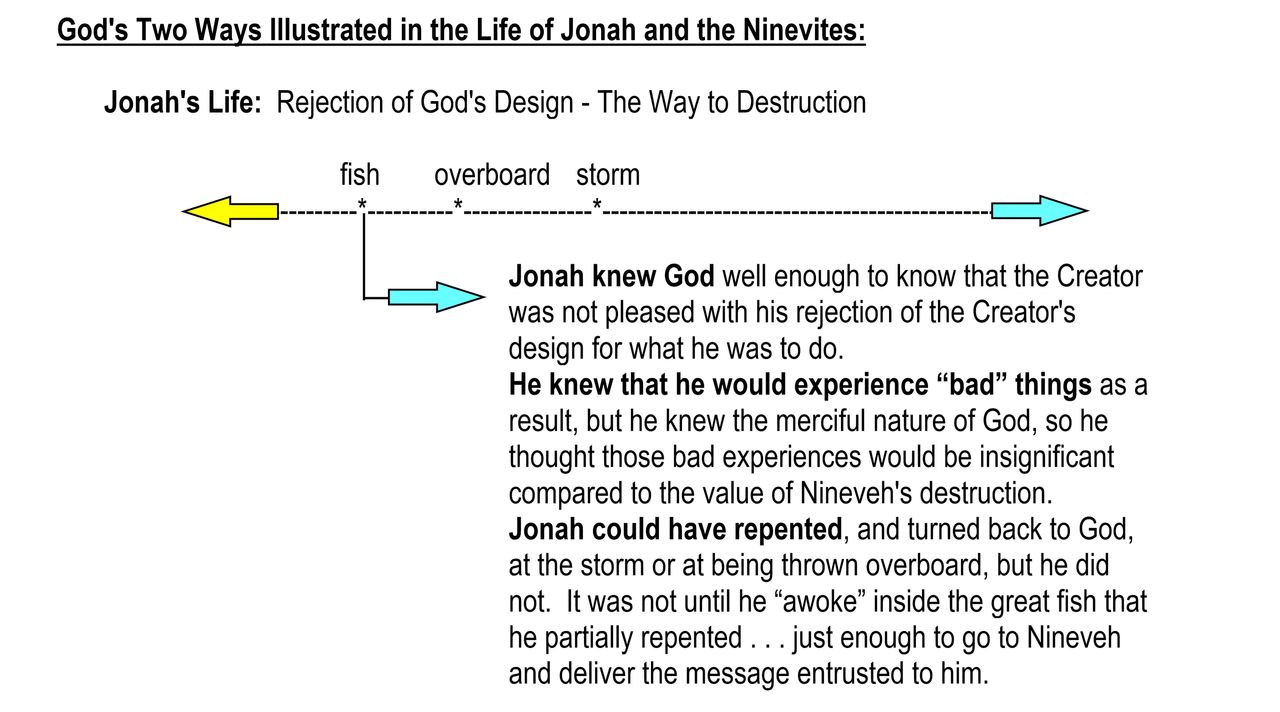
The Scripture record of Jonah illustrates the only two ways of God’s perfect system. He never purposed to destroy the Ninevites. If He had purposed to do so, He did not have to do anything; His “blessing and cursing” system was already at work in their existence. It was inescapable, and their violations of that which is right in His sight were already having their destructive effects. As they became less restrained by good and right and more motivated to do evil and wrong, their “wicked hearts” were confirming their thinking that their “Ninevite way” of cruelty and destruction was the way to live. Thus, to be a good “Ninevite,” each person had to adhere to the “Ninevite way,” regardless of how bad it was, and any violations of that “Ninevite way” would bring undesirable consequences upon the violator.
Somewhere inside each of them, however, was the inescapable testimony of the true Creator God that something was wrong. Their “gods” were indeed powerful, but their “gods” did not control the creation. This meant that another, greater God existed, a God they did not know, but a God who was truly God and manifested His superior authority over all that existed, their “gods” included. Whether or not there was anyone among them, or even some in the nations around them, who told them of the existence of this superior, transcendent, and good Creator God, they knew He was there. Whether they “knew” Him or not, they knew that He possessed absolute authority over them, and would indeed hold them accountable.
Then, when Jonah, despite the dangerous nature of coming into such an unGodly city, came and began proclaiming the true God and His message, they realized that Jonah’s message was the message of the true God. Their ultimate destruction was not only imminent; it was scheduled in time. Only forty days remained, and they would answer to this God whom they did not know and whose way they had so thoroughly spurned and violated. They recognized that they were worthy of being destroyed; He would have been justified in destroying them without any warning, but He had not done so. Instead, He had sent His messenger, Jonah, to forewarn them, and the fact that He had sent this man, this prophet, to speak for Him must mean that He was offering them a genuine opportunity to repent, to turn back to Him and His way. Forgiveness was both possible and available, if they would turn to Him. They “deserved” destruction, but the true God had given them their own special messenger; the only sensible course was to turn.
The Ninevites, like Jonah, understood enough about God to think that repentance was a possible solution to their dilemma. Indeed, if forgiveness through repentance had not been possible, then for God to appear only to “offer” it would have been unjust! The Ninevites, however, “believed God,” including the fact that turning back to Him was an option that might stay His hand of judgment. Their repentance, regardless of Jonah’s desire in the matter, thus fulfilled God’s purpose in sending Jonah.