
by Kenneth F. Sheets
The word “Shiloh” first occurs in Genesis 49:10, in the record of Joseph, wherein he recorded the last words of Jacob, his father. There, in regard to Judah, Jacob had said:
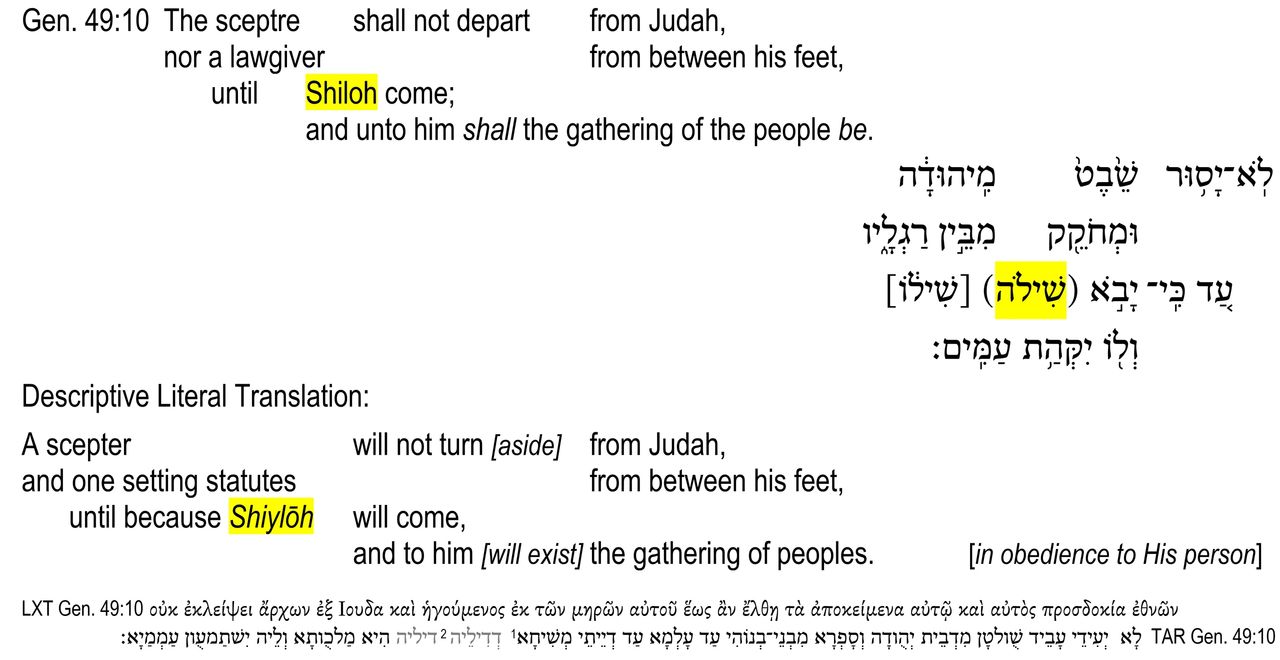
In the Genesis reference, the only occurrence in Genesis through Deuteronomy, the word is spelled “shiylōh” (pronounced shēlōh), and this first occurrence is the primary reference for determining the meaning of the word. Though it occurs more than thirty times in the remaining Hebrew Scriptures, almost all of which spell it “shilōh” or “shilō,” all of these additional occurrences use the word as the name for the place to which the Israelites moved the ark of the covenant, with its tabernacle, after they had conquered the land. When they had crossed the Jordan (Joshua 4:18-19), they had set up the ark and tabernacle in Gilgal, even observing the Passover there (Joshua 5:9). The ark then remained in Gilgal until their conquering of the land was complete, but, recognizing the need for it to be in a somewhat central location for all their tribes in their new land, they chose a place in Ephraim. To there they moved the ark and set up its tabernacle. This new location was named “Shiloh,” apparently because, as the location of the ark, this was the specific place where they would meet with the LORD, the God Who Exists.
The application of the name “Shiloh” to the first designated resting place for the ark in their new land appears to have been derived from Jacob’s use of the word in Genesis 48:10. Certainly, Jacob’s use was not something new or something he had just formed; his use would have carried a clearly established meaning and, since Joseph was recording the word in the record of God, Jacob’s use was clearly understood in the Hebrew grammar of his day. Thus, the word was not at the time a “name” of a person or place, but it was a description of something that would exist in the future. His original spelling, and pronunciation, of the word appears to have been “shĕlō,” which would have been understood as “which exists to him,” but, since the Hebrews indicated possession in this manner, the word would have meant “which belongs to him.” Certainly, Jacob was not referring to something that “belonged” to Judah, as a possession of the man or his descendants; he was referring to some one or some thing which so perfectly manifested some kind of possession that it moved “peoples” to gather themselves to that “one” or that “thing,” and, in their gathering, they would be seeking to be in the presence of that “one” or that “thing,” and they would be seeking to conform themselves to its person or nature.
The Israelites, especially under Joshua’s leadership, knew that the only thing that possessed such importance was the ark and its tabernacle, because the ark, and the place where it rested, was the place where the Creator, the God Who Exists, unmistakably manifested His presence, having placed His name there. Thus, when the Israelites moved the ark from Gilgal, the place to which they moved it then became the place of His manifested presence and the place upon which He had placed His name. This new place was distinctively His; it belonged to Him; this was the place of His “possession,” and it would be named accordingly . . . Shiloh. It was the place of absolute safety and blessedness, the place of absolute “completeness,” “peace,” for all who came seeking Him and His design. Everything about this place was to be in full conformity to the Creator’s person and design, and anything which did not conform was subject to conditions designed to move it into conformity.
Over time, the word “Shiloh” became identified with a place which was so distinctively associated with the presence of the LORD that its original meaning related to a place “which belongs to Him” became secondary to the “perfect peace” and blessedness which individuals experienced in that place. Then, when Jesus Christ, the Son, came, those around Him who were seeking to know Him and walk with Him in His way experienced that same “perfect peace” and blessedness . . . and it continues to exist “the possession” of all who, even in this present day, are seeking that same knowledge and understanding and that same walk in His transcendent magnificent presence. Then, when He comes again, no need of “scepters” and “lawgivers” will exist; He alone will rule in perfect accord with the perfect design which existed in Him before He even began creating. Shiloh remains that place where those who truly love Him meet with Him in that place which “belongs” to Him . . . and that is anywhere in His creation, because He is always existing in every place in His creation.