
by Kenneth F. Sheets
Identification of “the sons of God” in Genesis 6:1-4
Many have debated the identity of “the sons of God” mentioned in Genesis 6:2 and 6:4, and usually, in the conservative realm of Biblical study, the debate centers upon a disagreement regarding whether “the sons of God” were angels or Godly humans. The debate, however, is seldom rooted in intensive analytical study of the Scriptures as God gave them, and most “debaters” seem to be more moved by what they like and dislike regarding the two primary interpretations than what is said by the actual words of God. Though the Creator delegated a measure of authority to His human creatures, humans have an innate propensity to exceed their authority and, in regard to the Scriptures, they tend to insist upon interpreting whatever text they are reading according to the concepts, the ideas, the preferences, the likes and dislikes, already resident in their minds. Their minds form their own understanding of what the words, the word orders, and the grammatical constructions communicate when they read the Scriptures, and that understanding becomes to them the “meaning” which God intended them to receive, whether that understanding is accurate or not.
Certainly, the debate regarding the identity of “the sons of God” is filled with the personalized, “humanized,” concepts of finite human individuals, thus making a firm answer seem to be an impossible goal. However, an intensive analytical study of the words of Scripture as God gave them eliminates the question, giving results that clearly present God’s intended meaning to all but those who insist upon imposing their own human thinking over the actual words of God. In order to know God’s intended meaning, any interpreter must begin with the fact that the actual words of Scripture are the authority over any concept or desired interpretation of man, thus approaching the Scriptures from the perspective, not of later men, even those who lived long before the present day, but from the perspective of the holy men of God who actually inscribed the original words of the Creator’s written revelation.
In the modern era, the prevailing view of the authorship of Genesis has been that the revelation of Genesis through Deuteronomy, and possibly Job, was given directly to Moses by God, and he inscribed these words some time in the late 15th century BC, about 1446-1406 BC, during the wanderings of Israel in the wilderness after leaving Egypt. This original authorship date, however, is more than a thousand years, after the words were originally inscribed by Noăhk and his sons, apparently about 2500 BC, since the words read as an eyewitness account of the Flood and their experiences immediately afterward. Thus, though typically accepted as “the standard,” the concept of a Mosaic origin for these words is both erroneous and dangerous, and forms a major obstruction to accurate interpretation of the words.
The erroneous “Mosaic origin of Genesis” view has held open the door for “humanized conjectures” and “unbounded expressions of origins” regarding the events described in the book. Many, assuming that early humans did not possess the ability to express themselves in writing, have conjectured, theorized, that the knowledge and record of God and His design was transmitted by “oral transmission” prior to the time of Moses, a view held not only by non-believers but also by “Bible believers” who have accepted evolutionary influences. As with any error regarding Scripture, this view is very destructive, undermining the most basic, foundational, records of the origin of all that exists, but few “believers,” if any, perceive this danger, never having learned either a true timeline of history or an accurate explanation of the origin of writing.
Indeed, if only oral records existed of the time from creation to Moses, then it is not unreasonable to expect that those “oral records” were subjected to insertions and deletions, and enhancements and exaggerations, given the nature of humans. In actuality, the “oral records” view is absolute error, and those who have accepted it have ignored, whether purposely or inadvertently, the knowledge that heathen cultures were writing all sorts of things in their pictographic (and derived) languages from the time shortly after the Babel rebellion. Unquestionably, the Godly were writing as well, but, where the heathen cultures sought to leave lasting manifestations of their existence, the Godly knew no need of doing so. They recognized their temporary existence in the physical world was far superseded by their existence as eternal beings in the eyes of the Creator Himself. The Godly were writing but not in the pictographic (and derived) languages of the heathen.
Adam himself had begun the record in the alphabetic language and with the linguistic abilities which God had built into him. He was the first “proclaimer of righteousness,” recording those aspects of history which the Creator desired to have recorded, but many other “proclaimers” followed in his steps. These subsequent “proclaimers” received the records as each of them became the “oldest living believing” individual of his generation, and they added to them as they were led by the Spirit of God. These were not simply “the writings of men”; they were the writings of men who walked with God, men of wisdom and understanding, men who wrote in accord with His design for human existence. Embellishment, lying, and error could have no place in what they wrote. The record was His, and, like Him, it could not be less than perfect in its expressions, and they, the writers, like all who would follow in their footsteps, recognized and accepted their accountability to Him for its accuracy.
These records, then, were God’s record not theirs, and they preserved them accordingly. Noăhk himself became the oldest living believer just prior to the Flood when Methuselah died, and he would have preserved these records through the Flood. No need existed to record the transfer from one generation to the next; all knew the practice and the significance of these records to all generations of the future. Preservation and continuation of the record was a matter of walking in the design of God. They knew the nature of man and the weakness of relying upon an orally transmitted record, and thus, the written record of God was of prime importance, because it would firmly preserve that which later humans would need to know. Therefore, the “oral transmission” view is complete error, resting on the totally untenable concept that the Godly either did not, or could not, write and record the experiences of their lives and the revelation they received from the Creator. Clearly, the error of a non-believing bias underlies any concept of the “oral transmission” perspective.
Though many believers doubt or reject Noahic authorship of Genesis, they do not do so based on the above account. They, like many, many others have been influenced to error by other humans who themselves did not believe the Scriptures to be the revelation of God, and those “others” have themselves been taught by others, too, who had been wrongly taught regarding the true nature of the Scriptures. This error has persisted for generations, having come from men who sought to their own ideas or the ideas of other men instead of resorting to intensive analytical study of the text as God wrote it.
The Flood account itself gives evidence that it was actually written by Noăhk, Shém, Hkäm, and Yĕphĕth, the man and his sons who were eyewitnesses of what they wrote. They were the builders of the ark and experienced the rising and receding of the waters, recording their observations in details which would be knowable and transmittable only by those who saw firsthand the actual occurrence of these things. Certainly, the Flood account must be read and interpreted accordingly, as having been authored by Noah and his sons. Thus, instead of reading into the words the later mistaken impressions and ideas of both good and bad men, the words must be read from the perspective of Noah. He was a man who “made himself walk” with God and who “sought” the grace and interaction of God to be bestowed upon his life. He was a man whose heart had been grieved by what he had seen in his 600 years of life in the unGodly, pre-Flood, “only evil,” culture. He was a man who received not only the commission to construct the ark, but also the commission to proclaim the righteousness of God’s design to a rejecting society. He was a man who received the unalterable, inescapable word of God that only 120 years remained for humankind before the Creator would cease His striving to turn them from their wickedness and back to the blessedness of walking with Him. He was a man who knew the heart of the Creator and what He desired for all that He had so perfectly brought into existence, but which He must destroy, in order to “repent Himself,” that is, to “satiate,” to “satisfy,” His own righteous Person.
This was the man Noăhk. Like his great grandfather Enoch, he sought to know and understand the person and nature of Yihyeh, the God Who Exists, and the criteria of His design, in order to walk accurately within it. Noah was a man of singular righteousness, as God said of him before he entered the ark some 2500 years before Christ and as God would reiterate some 1900 years later.
This was the man who authored the Genesis Flood account, and to read it otherwise is to impose the fallible mind of man on God’s perfect ancient words. Moses, in his day, and the Spirit of God would insure that this account was included in the Scriptures, but Moses was not the original writer.
NT References in Peter and Jude to “Angels That Sinned”
Another important point for identification of “the sons of the God” in Genesis 6 comes from Scripture outside the actual Genesis account and is found in the NT books of Peter and Jude. In each of these two NT books, the Spirit of God preserved and clarified beyond conjecture and error the nature of the incident which negatively affected humankind and the creation with the result that the Creator brought upon His world a cataclysmic, never-to-be-repeated destruction of everything in which was His “breath of life.”
In Peter‘s revelation of the surety of God’s perfect judgment on “false prophets” and “false teachers,” that is, on those who lead others to violate the criteria of the Creator’s design, the Apostle referred to three well-known incidents of ancient history which demonstrated the inescapable nature of God’s judgment. Writing to individuals, especially Jewish believers, who would have known the OT, he listed three major incidents in OT history, incidents which would have been unquestionably discerned by those receiving his letter. He wrote:
first, of “the angels that sinned” in such a manner that God has bound them “in chains of darkness” until the time of their inescapable judgment, although many other evil angels remain unchained;
second, of “the old world” which had become “evil only” and was destroyed in an inescapable judgment, from which only righteous Noah and his house were delivered;
third, of “the cities of Sodom and Gomorrah” which had become so evil that God saw fit to bring upon them a special inescapable destruction, although many other evil cities continued to exist.
In Jude‘s similar revelation of the surety of God’s judgment on “ungodly men” who twisted and perverted the truths of God, he, too, listed three major incidents in OT history, incidents which would have been unquestionably discerned by those receiving his letter. He wrote:
first, of the Israelites who escaped Egypt but “believed not,” and thus became a constant irritant to those who believed and their Godly leadership, eventually suffering an inescapable destruction in the wilderness;
second, of “the angels which kept not their first estate, but left their own habitation” in such a manner that God has kept, “reserved,” them “in everlasting chains under darkness” until the time of their inescapable judgment, although many other evil angels remain unchained;
third, of “the cities of Sodom and Gomorrah” which had become so evil in “fornication” and going after “strange flesh” that God saw fit to make an example of them and bring upon them a special inescapable destruction, although many other evil cities continued to exist.
Clearly, the incidents listed by both Peter and Jude, writing under the influence of the Spirit of God, were major events of OT history and would have been known by all who knew the OT Scriptures.
Significant here is the fact that both NT writers referred to the binding for judgment of “the angels that sinned,” indicating that some group of angels had violated God’s design for their existence and exceeded the bounds the Creator had set for them.
Both NT writers referred to the destruction of “Sodom and Gomorrah” for their violation of God’s design in fornication and going after flesh contrary to that for which they had been designed. Then, the two NT writers listed two other major events, both involving the destruction of nonbelievers, individuals who rejected God and His design: the Flood destruction and the destruction of unbelieving Israelites during 40 years in the wilderness.
Considering the greatness of the judgments associated with the Flood destruction, the Sodom and Gomorrah destruction, and the wilderness wandering destruction, then the destruction of “the angels that sinned” must be of the same prominence. However, the only major incident in the OT which involves angels violating the design of God in such a fashion that God has bound those involved and reserved them for judgment is the Genesis 6 account.
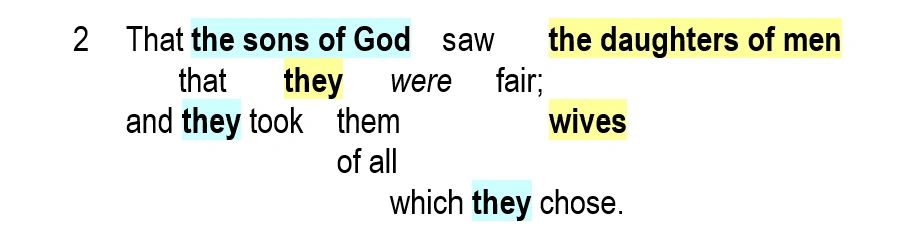
Certainly, “the sons of the God” in Genesis 6 were not humans, but angels who took “women” sexually and had offspring by them, despite the fact that angels were never authorized to interact with human women in such a manner. Human women were to be “wives” of human men, and each was to have sexual interaction only with the one man to whom she belonged. The offspring were of “mixed kind,” not just “angel and human,” but also a mix of “blatantly rebellious angel” and “blatantly rebellious human women.” Thus, the offspring, however “mighty,” were even more confirmed in their rebellion to the Creator than were their parents. These “offspring” and their antiGod effects warranted only destruction, and that is what they received from the transcendent Creator.
The term “the sons of the God” occurs only in Genesis 6:2, 4 and in Job 1:6 and 2:1. Both Job texts clearly refer to “angels” and cannot refer to “humans.” Both texts, Genesis 6 and Job 1-2 are some of the earliest texts of Scripture ever written and must have been placed in their present form by Moses (and the Spirit). Thus, Moses insured that the term “the sons of the God” occurred only in these two texts, providing an accurate identification in Genesis. “The sons of the God” were angel beings!
This fits perfectly with the text. God is the one who gave the actual terminology “the sons of the God” and “the daughters of the adam.” Just as in a great multitude of actions and interactions which humans may do but have not been designed or authorized to do, the angels could cohabit with human females, but the Creator’s design had never included such interaction, and He had never authorized it in any way to any degree. The contrast is between angel beings and human beings, a difference in kind which the Creator had designed never to be mixed, just as He has forbidden the “mixing” of human beings and animal beings. God designed the functions and acceptable interactions between the kinds of creatures that He brought into existence, and that design forbade any kind of sexual interaction between angels and humans or between animals and humans, or even between humans and humans when it involved any kind of violation of His design for human life and existence.