
A Correlation of Ephesians 4:26 and Psalm 4:4 – Did Paul Quote from the Septuagint?
by Kenneth F. Sheets
Anger is a powerful and destructive emotional state of mind. Whether called “wrath,” “upset,” “hurt feelings,” or whatever, anger acts as an extremely effective divider in relationships, even in relationships where division should not exist and even where anger exists only to a “minor degree.” Though anger is an emotion of God which He Himself built into man and other beings of His creation, the Creator experiences this and every other emotion perfectly, seeing and knowing everything, every situation, every condition, completely perfectly. When He created man, He designed him to be a finite expression of Himself in many ways, but He did not build into man the ability to know and perceive either completely or perfectly. Man was to perceive and assimilate information from the conditions around him and to experience various emotions which arise “naturally” as he correlates and evaluates that information, but man’s limitations would render many of his emotional responses, anger included, baseless and improper.
Anger, then, was built into man by the Creator, but like every other thing of creation, it was to be used completely within the criteria of His design, that is, anger was always to be perfectly reflective of God’s person and nature. Just as He had done with the entirety of His creation, the Creator had constructed man with boundaries, criteria, within which he was to function and interact, but He had also built man with the ability to exceed those boundaries, and man would do exactly that. Having rejected God’s design for their existence, humans would substitute their own design, the criteria of which were not in conformity to His design and which led them into lives characterized by the failure and destructive effects of anger, even where anger should never have existed. God had built into man the ability to control all of his emotions, sensing when they exceeded the Creator’s purpose and bringing them back into the criteria of right and proper, but man would not submit to the perfect will of the Creator.
The sad commentary of human experience, however, is filled with the results of anger unrestrained and used in total contradiction to the design of God. The beings of creation, humans especially, and all beings possessing some measure of authority, exist in a condition resultant from the first man’s choice to exceed the authority delegated to him by the Creator. Adam’s decision constituted a rejection of the person and authority of the very one who had brought him into existence, and every expression of anger, whenever it exceeds the criteria of God’s design, is no less a rejection of the Creator’s person and authority, and any such expression can never be justified.
The Apostle Paul knew well not only God’s design for anger but also its destructive effects when that design is violated. Any truly Godly individual of Paul’s day would have known all this, but then, as in the present day, the truly Godly were rare, and anger was deemed an “acceptable” emotional response by many. Using the Apostle’s letter to the assembly of believers at Ephesus, God issued a prohibition of any expression of anger outside His design: “Be ye angry, and sin not” (Ephesians 4:26). The Greek text of this verse appears to indicate that Paul was directly quoting from the Septuagint text of Psalm 4:4, but, for this “Hebrew of the Hebrews,” his thinking was not rooted in a “translation”; he thought in the actual Hebrew words of the holy men of God who had been borne along by the Spirit to write those Hebrew words.
The meaning of the Greek term translated “be ye angry” (orgizĕsthĕ) is clarified by its parallelism to the term “wrath” (pärorgismŏs), both Greek words built, obviously, upon the same root. Then, too, the second line places limits upon the extent of any “wrath” by the words “let not the sun go down.” The NT and OT texts of these two related passages are:
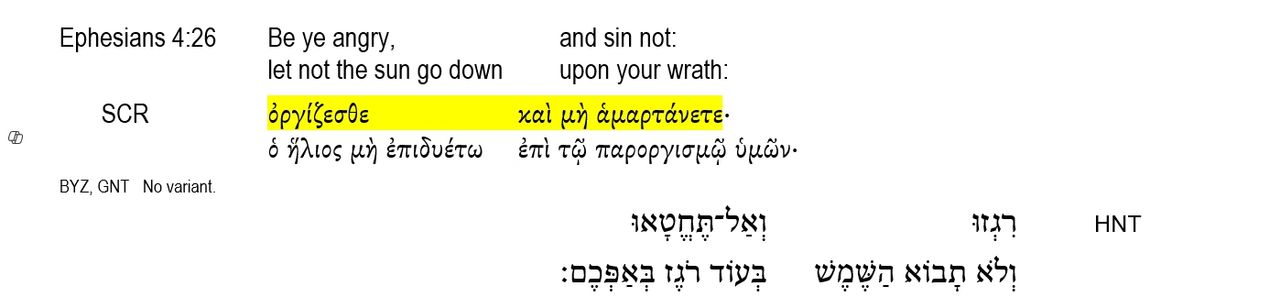
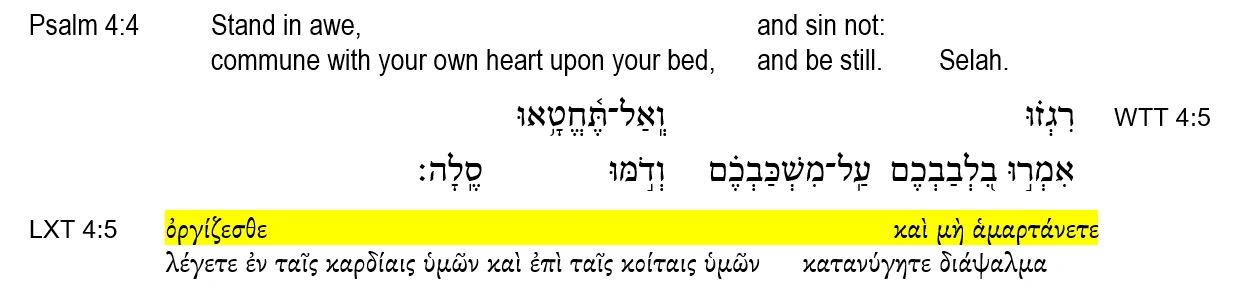
The correlation between “anger” and “wrath” initially seems to confirm the basic meaning of the first term to be that which typically comes to mind: a strong feeling of displeasure or hostility. Indeed, Paul’s term for “be angry” (orgidzō) is typically translated in this or some similar fashion associated with wrath or anger. The actual grammatical form he used is a present tense verb in the imperative mood. The present tense signifies continuity and the imperative mood signifies that it is an instruction, a “non-optional appeal to the will.” The verb, however, is not in the active voice, as though the subject is merely to “be angry”; it is in a form which indicates that it is to be understood in either the middle or the passive voice.
If the verb is passive, someone or something other than the subject is causing the action of orgizěsthě, and thus, this “outside agent” is the one responsible for the subject “being angry.” The subject of the verb is being influenced to be angry by circumstances outside his control, and he cannot be held accountable.
If the verb is middle, then the subject himself is causing the action of orgizesthe, that is, no outside agent or condition is causing him to be angry; he is doing it to himself. He himself is responsible for his anger, and thus, he is responsible to the Creator to ensure that his every expression of anger, or any other emotion, is in perfect conformity to the Creator’s design. He is, then, accountable to God for accurately evaluating the nature of his every sense of anger, or any other emotion, and for maintaining that sense of anger within the criteria of the Creator’s perfect design, doing all of this within the power of the Holy Spirit.
Anger, and all other emotional responses, were to be kept within the design of God, always being controlled in such a way that the person experiencing the emotion, whatever its nature, was always both cognizant and careful that every expression of his life was an accurate reflection of the God Who Exists. This was God’s design for the New Testament era, and all eras that had ever existed, and it has remained His design for every human of all time.
A question arises, however, when one compares the English text of Psalm 4:4 to either the English or the Greek text of Ephesians 4:26. David, the author of Psalm 4, wrote his original Hebrew text about 1,000 B.C., while the LXX was translated only about 250 to 150 B.C. Not only had 700 to 800 years elapsed before the LXX translation was done, but also a linguistic transfer from the Hebrew language to the Greek was necessitated. Any knowledgeable translator recognizes the potential difficulty encountered when trying to capture the “original meaning” of a term in one language with an “equivalent term” in another language. Beyond that difficulty, however, is another, and that is the transition from the firm, “believing,” ancient Hebrew mindset and understanding of David to that of the Jewish translators in Egypt, a transition which those translators did not handle well, as evidenced by the many apparent variants between the Hebrew and the LXX. Thus, if indeed a correlation exists between the wordings of Psalm 4:4 and Ephesians 4:26, then the key must lie in understanding the Hebrew text and the ancient meanings of the Greek words used to translate the Hebrew.
The Hebrew term that corresponds to Paul’s “be angry” (orgidzesthe) is translated by the words “stand in awe.” The Hebrew text uses the term rigzū, a qal imperative masculine plural of the verb rägăz, in which the qal stem signifies the basic active sense of the verb, the imperative aspect signifies an instruction, a “non-optional appeal to the will,” and the masculine plural signifies that the command applies to an audience of multiple hearers. Hebrew lexicons present the primary meaning of rägăz as “to quake, to tremble, to shake,” with derived meanings that include “shaking or trembling in anger or fear,” thus indicating its basic sense to signify some sort of “agitation growing out of deeply rooted emotion.” The association between the lexicon meanings and the basic sense is clear. When someone experiences an emotion that extends into the depths of the soul, especially an emotion triggered by a troubling or disconcerting circumstance, the body’s external response may be that of shaking, trembling, or some other expression of that deep-seated emotion.
Accordingly, ragaz would express the natural response of a person to the mighty evidences of the Creator, whether of His Presence or of His works. By extension, then, the word could accurately indicate the condition experienced when man, the finite being, considers the person and nature of God Who Exists, his infinite Creator. It does not, however, necessitate that the man actually “trembles” or “shakes,” since its uses extend even to inanimate objects. Rather, its thrust signifies a being’s emotional response that reaches into the deepest recesses of his soul, an emotion that involves the entirety of his being, the entirety of his intellect, emotion, and will, a depth of emotion captured by the English words “stand in awe.” By further extension, ragaz could also be applied to describe any emotion that totally engulfs the soul, one of which is the emotion of “anger,” and thus, it may accurately be translated by orgidzō, because anger involves the whole being of the person experiencing that emotion, involving the intellect, the emotion, the will, and even the physical body.
According to this analysis, as derived from the Hebrew ragaz, the Greek verb orgidzō does not necessitate an association with the emotion of anger or wrath, but at first glance, the lexicons do not allow such a disassociation, at least not until one examines the related Greek noun orgé. This common noun is usually translated “wrath” or “anger,” but more intensive analysis reveals that its basic sense relates to “natural impulse or propensity, one’s temper, temperament, disposition, nature.” Of course, one of the more common natural impulses or propensities of man is that of an angry or wrathful response to numerous stimuli. Anger is not, however, the only soul-engrossing natural emotional response of man. Many stimuli elicit other natural emotional responses, natural responses which cannot be avoided because they are built into man’s very being, not the least of which is the sense of awe which man experiences when confronted by the presence of the Almighty God.
Thus, in Ephesians 4:26, the Greek verb orgidzo, though it appears on the surface to be a quote from the LXX, is actually an accurate translation of its Hebrew original and does not primarily refer to “anger” or “wrath”; it includes any and all of those emotions that naturally stir and engulf the whole being of man, causing him to turn aside from the design of the Creator. In truth, “being angry” is but one of a whole host of emotional responses which can take control of an individual’s life, wreaking havoc in a life designed for blessing, and as Paul exhorted the Ephesians, these controlling emotions, and their causes, must not be allowed to persevere, but must be recognized and eliminated from their positions of influence even “before the sun goes down.” They cannot be allowed to linger in control of the subconscious during a time when the mind is to be resting at peace with the Creator and His Design for human life.
Indeed, some, perhaps many, in the Ephesian church would have understood Paul’s use of orgizesthe to refer only to “anger,” its primary sense in their culture and society. Though this narrowed use was not entirely accurate, it was not necessarily something bad, dependent upon whether or not those who received his words also recognized that Paul’s words were an expression of the design of God for life. If they saw the words as they actually existed, those individuals who meditated on the significance, truly seeking the leading of the Spirit, even without knowing the text of Psalm 4, would have begun to accurately extend their understanding to other expressions of emotion.
Without any explanation from Paul, some would have realized that if the Creator God intended the criteria of His design to govern in the realm of anger and all of its associated “feelings,” a realm greatly characterized by the “free-reign” of whatever the angry person did or thought to do in his “angry” state of mind, then God must also intend that His design be applied in such an overarching, transcending manner to every aspect of human life, including every other emotion with its associated “feelings.” In that day, just as in the present, many would have used their “stirred emotions,” their “anger,” as an excuse to violate God’s design, to do or say whatever their “feelings,” their “heart,” their inner person, “felt” moved to do. The Creator, however, had already warned that the heart was “deceitful and desperately wicked.” Thus, to allow even the “deepest feelings” of the heart to overrule the criteria of the Creator’s design was to reject Him and His Person. Indeed, in such cases, the violator was actually “not believing” God!
Those seeking to perceive the Creator as accurately as possible and to walk as completely as possible in His design would not have thought in terms of the “letter of the law,” that is, limiting the scope of Paul’s words to an exact, external application. They would have sought the heart of the God behind the words, much as He Himself had said through Jeremiah: “You will seek me and you will find me when you search for me with all your heart.” Obviously, God did not desire simply the “performance” of the criteria stated in His revelation as conditions of external legalistic conformity whereby the “doer” of a criterion in some way obligated the Creator to him, an obligation which conformed to the erroneous mindset of the “doer.” This was not “seeking Him with all the heart” and it did not bring change to the mind of the “doer,” just as conforming to the human concept of ceasing from anger has no real value if it is not rooted in a heart that has submitted itself to knowing and understanding the Creator simply because of who He is.