
by Kenneth F. Sheets
Proper Interpretation: Application to All Children of All Ages
Though the English translation of these two verses appears to indicate that the words are directed only to “sons,” that is, to male children, such a narrow interpretation and application would be grave error. In keeping with the statement in his purpose that a young man could develop knowledge and discretion (Proverbs 1:4), Solomon identified the person to whom these words of wisdom were primarily addressed. The words my son would apply to any male offspring, but the wisdom principles which God had Solomon to record were designed by the Creator to be applied to both male and female genders alike. Still further, though the focus of these verses might appear to be limited to children or youth, that is not the case. The Proverbs of Scripture are not “general principles” for life, as so many have wrongly represented them. Indeed, they are expressions of God’s design for life, that is, they are expressions of the criteria which are designed to cover every aspect of human existence. Though the “poetical” format in which they are written has led many to misunderstand not only their content but also their significance, the Proverbs of Scripture are those proverbs which bear the Name and authority of the Creator, and they “work” when applied as He designed. Their revelation, then, is needed by every human, male or female, because every human stands in need of the wisdom and understanding of God.
An Erroneous Interpretation: Separation Between the Parental Roles
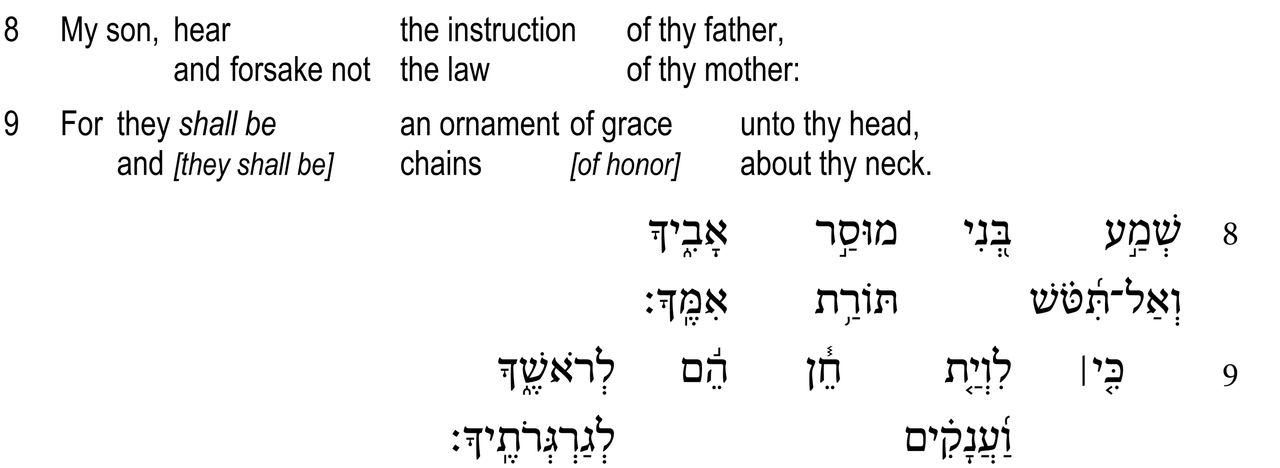
Solomon’s words in verse eight have been interpreted by some as defining the different roles of the father and mother in the parental relationship, that is, the father provides instruction (mūsär) to the children and the mother sets the law (tōräh), the rules, for the home. Accordingly, the parent roles are distinct, separate, and neither parent is to stray into the other’s realm of responsibility. Some preachers and Bible teachers have been known to “preach” long and hard to support this position, but in truth, such an understanding is unquestionably in error. This interpretation fails to consider the nature of the Hebrew poetical parallelism found so extensively in Proverbs. It also fails to correlate the passage with other revelation which establishes the father’s overall headship of the home.
The Design of God: Oneness in Parental Instruction
Recognition of the Hebrew poetic parallelism is crucial here. The two lines of verse eight exhibit synonymous parallelism, that is, both lines are true and express essentially the same thought, while using different words. Thus, the proper interpretation combines the two expressions to render an overall teaching: “My child, heed your parents!” Each line supports and clarifies this teaching.
When a believer meditates upon the relationships between the words of the two lines, several related principles become clear as well. This is the beauty of poetical portions of the Scriptures. God designed them to be easily memorized, so they could be remembered and passed from generation to generation. He also designed them to hold a wealth of wisdom and understanding in the form of life design criteria which would become clearer and more easily applied as one meditated upon them. When one evaluates verse eight from this proper perspective, it becomes clear that God’s intention is that the parental roles be coordinated and united in their relationship to the children. The parents not only discuss and coordinate their dealings with the children, but also, they support and enhance one another.
Further, just as the poetical parallelism does not allow the separation of parental roles, it does not allow separation of instruction from law. Though in English one word appears to be an action and the other an object, both are nouns and are focusing on the content of parental teaching. This interplay of words beautifully relates the mind of God regarding the role of parents in child training. Whereas the mother’s communication of the standards of law involves the action of directly instructing the offspring, and the instruction which the father communicates must rest upon some kind of standard, or law, the two words are closely related, just as the front and back of a book may look different, but they are only two sides of the same content, the same book. The words law and instruction, then, stand for the whole of direct parental influence upon a child’s life.
Some may argue that such an understanding is too broad to be correct, since parents might teach, either directly or by example, many things inconsistent with true Godliness. The answer lies in the fact that the Proverbs are Scripture and assume transmission of the Author’s design for life. It is never God’s intention that a philosophy of life incompatible with His person be a part of parental teaching. Parents are accountable to Him not only for what is “taught” directly, but also for what is “caught” from their example. God’s design is that the two be the same.
Another criticism of this understanding of the verse is that it does not distinguish the roles of the parents, i.e., what God wants each parent to do that is different from the role of the other. Actually, just as one would expect to find near the beginning of this volume of Proverbial wisdom, Solomon made clear the most basic, and perhaps the most important, role for each parent: they are to be as one in relation to their children. Though the content may vary according to gender of parent and child, the moral and spiritual basis is constant, a rock upon which the child may establish his or her life and experience the success of Godliness. This requires cooperation and coordination on the part of the parents, conditions which necessitate discussion, planning, evaluation, seeking of assistance, etc., by the parents together. God has no allowance for the man (or woman) whose pride so rules that he will not seek Godly wisdom and counsel in order to become a more Christlike parent. Such an attitude is presumptuous sin and God will judge it.
Related Principles
The principle of unity in the primary source of instruction in a child’s life relates to learning in other areas of life as well. Exposing the learner to erroneous and unGodly teaching is especially dangerous in view of the nature of the teacher-learner relationship. Parents are responsible for content of instruction given to their children and must guard against the influences of unGodliness. Likewise, anyone who places himself in the position of learner to someone else must recognize the dangers inherent in that arrangement, especially if the teacher and his teaching may contain elements inconsistent with the Person of God as revealed in the Scriptures. Secular institutions do not limit themselves to teaching “nonreligious” subject matter. Neither do “Bible” teaching institutions limit themselves to teaching the truth of Scripture. Inconsistencies and disunity will have an effect; only the fool fails to see the danger.
A related issue here is that God’s design for teaching and learning is that the learner does not have control over the instruction, neither the content, nor the amount, nor the timing, nor the methodology involved. These are concerns for which the teacher is accountable. The basic meanings of the words instruction and law carry within them the idea that these things are determined by the one providing the instruction and law. This is not to say that the teacher does not consider learners individually, because in order to be a successful teacher, one must recognize that God has made each learner similar to others in some ways, but totally unique in others. Any normal parent who has several children can attest to the differences between them. Further, God knows the tendency of simple ones and the young to take what seems “the easy way out” when given the opportunity to choose. Though “the easy way” may appear to simplify life at the time, it also often contributes to continuing in the way of the simple. Then, later in life, when wisdom and understanding are necessary to deal with more complex situations, they are not there and the person experiences failure in areas of life where God had intended success. Clearly, God’s intent is for the teacher to control the teaching.
The Learner’s Role: Receive and Apply
The overall poetical structure of this passage consists of two pairs of lines, each pair exhibiting synonymous parallelism, with synthetic parallelism between the pairs. The synthetic relationship of the combined truth of the second pair to the combined truth of the first pair gives the reason why a child should heed the instruction of his or her parents: the adoption of the parental teachings will bring blessing upon the life of the child. This is not to say that the child or learner will not experience difficulty and adversity in life. Rather, it is God’s insurance plan that he or she will live successfully, in accord with God’s design which brings His evident blessing.
The child’s role in all this is to hear and to forsake not. Both are commands and, therefore, are not optional or subject to question. The first expresses the command from the positive aspect, while the latter expresses it from the negative; the net effect is the same. The words hear and forsake are opposites in the context, but the word “not” reverses the sense of forsake, making the two expressions essentially synonymous. As commands, both expressions involve an appeal to the will. Intellect (the mind) is not to “evaluate” whether or not the command is to be obeyed or if some alternate course of action should be taken. Neither is sensibility (the emotion) to “feel” whether or not the command is to be applied. These words are not simply the words of fallible man, and they are not God’s “suggestion” or His “good idea.” They are the command of the Infinite LORD God, the Creator of all that exists. There is no room for questioning or “feeling.” The will must rule to carry out the command regardless of the input from intellect and sensibility.
This is not to say that every parental instruction or teaching of any kind is to be heeded. Again, the context involves instruction in Godly wisdom. However, the wisdom of God is related to the truth of God, and all that is truth is in keeping with God’s design for His creation. Thus, areas of instruction not normally associated with moral and spiritual teaching are included, such as: math, language, history, cooking, sewing, driving, social interaction, gardening, use of time wisely, health, etc., etc., etc. God has a design for every aspect of life; that design is truth; and that truth is to be communicated from parents to children, that is, from teachers to learners.
Further, in keeping with the nature of the child (or the one needing to learn), the lack of knowledge and experience on the part of the learner usually renders him or her incapable of recognizing the ultimate end and value of the instruction. Consequently, the learner is commanded to place himself (forcibly, if necessary) in the position of submission to the teacher. He is to hear, which goes far beyond the function of the ear, including the favorable reception and application of the content. He is to forsake not the content, i.e., it is not to be heard and then to be cast aside as if of no value, but is to be instilled into his life. The child or learner is to make himself “teachable.” Attitudes which motivate the learner to challenge or resist the Godly teacher are not of God, but are “earthly, sensual, devilish” (James 3:15) indications of spiritual immaturity, at best!
The Learner’s Blessing: Grace and Honor
Adoption of the content of the teaching into the life of the learner carries with it certain promises. These are related not only to the content, but also the “teachableness” of the learner. The information conveyed to the learner will most certainly have a beneficial effect, especially as others recognize the presence of wisdom and discernment in the learner’s life. Another way of saying the same thing, from a New Testament perspective, is that others will recognize the fruit of the Spirit in that person’s life. Just as the fruit of the Spirit in a man’s life is not the result of the work of the man, so the learner does not make himself worthy of grace and honor. These things are the natural, spiritual result of instilling the teachings of Godliness into one’s life. The learner applies the principles of God’s design to his life, and thus, God is free to shower His grace and honor upon him. Others will recognize the Source of this blessing, knowing that what they are witnessing is not some superficial, external show, but rather is truly the supernatural, intrinsic grace and honor of God working in that person’s life.
The instilled instruction will appear as an “ornament of grace” about his or her head. This ornament of grace has a twofold significance. First, it indicates the presence of the grace of some authority upon the wearer, signifying that the authority has seen fit to confer the grace and that the wearer has submitted to receive the grace. Secondly, it indicates the correctness of an expectation that the wearer will practice the content of that grace. Further, the instilled instruction appears as a “chain” of honor around the neck of the learner. This, too, carries a twofold significance. First, the chain signifies that the wearer has been deemed worthy of honor and is, thus, worthy to be honored. Secondly, it tells others that the wearer can be expected to act honorably.
God’s Design for Teaching: Understanding for Application
Some have interpreted these verses in such a way as to make instruction a totally one-sided matter, i.e., the teacher teaches and the learner learns, but interaction between the two is minimal or nonexistent. While at first glance this may seem to be God’s design, it is far from the truth. The teacher, whether in a parental or formal setting, must take into account the uniqueness, the individuality, of the learner. He must also recognize that the effectiveness of teaching is largely related to the teaching methods used. It is not enough to direct “knowledge” at the learner, regardless of the content. The teacher must ever be seeking to communicate understanding and discernment, along with the knowledge, to the end that the learner will be able to apply the teaching to his life. Moses reiterated God’s design for teaching just before the end of his life (Deuteronomy 6:4-9). Each generation was responsible to communicate to following generations the truths of His designs for human life, demonstrating that there was nothing in life, not even one moment, when God’s design does not apply.
That this is God’s design is clear in the Scriptures. Moses himself was aided by 70 elders to administer the Law of God (Numbers 11). The great scribe Ezra read the Law to the people, but he used others to help the people understand the sense of it (Nehemiah 8:1-12). The apostle Paul, having learned from the LORD Himself, preached and taught publicly and individually. The LORD Jesus Christ Himself used various teaching methods and innumerable teaching aids to communicate understanding of His plans and purpose for mankind. This is especially noteworthy in the Emmaus road incident, where the risen Christ “expounded” and “opened” (i.e., He thoroughly explained, showing them the application of) the Scriptures (Luke 24:27, 32). Note that He did not just remind them of what it said!
Herein lies the root of much of the unGodliness found in some Baptist churches and circles of churches. The pastors and teachers have adopted the philosophy that all they have to do is “faithfully preach the Word” from the pulpit and “that will eliminate any need for personal counseling” and the like. The teaching, given in the form of “preaching,” is totally one-sided, and the learner is responsible for figuring out how it applies to his life without any additional input from the “preacher.” The preacher’s door may be “open for help,” but the counsel is wooden and formal, often appearing unrelated to the need expressed, and fails to take into account the differences in understanding among individuals. Such practice may be a cover, whether intentional or unintentional, for ignorance and inadequacy on the part of the preacher, but whatever the reason, congregations need to be on guard against this mind-set.
Perhaps the most telling Scripture against this philosophy of ministry is Nehemiah 8:1-12, especially verse 12: “And all the people went their way to eat, and to drink, and to send portions, and to make great mirth, because they had understood the words that were declared unto them.” The Israelites who listened to the reading of the law that day over two thousand years ago were not unlike the people in churches today. The law of God was read “distinctly” and was indeed perfect, but the hearers were not. They differed one from another in many ways, not the least of which was their ability to see how the law applied to everyday life. They wanted to know, however, and when the Levites “gave the sense, and caused them to understand the reading” (verse 8), then they went away glad. The understanding of the Word of God, not just the hearing of it, brought them joy!
Both formal “preaching” and individualized “counseling” must be practiced, though not necessarily by the same person. In truth, any ministry which does not provide both has deviated from the design of God and is not Biblical, no matter what else it does. The understanding and application of this truth by churches searching for pastors (and other leaders) would preclude much heartache and difficulty. When evaluating pastoral candidates, it would cease to be a matter of “how he preaches” and would become “how he pastors.” Many a man has a “wonderful pulpit presence” which covers a “disastrous ministry practice.” Standards which focus on the “pulpit ability” of a man should never be adopted by a pulpit committee. For example, the evaluation of a man by watching a video of him preaching is unbelievably insufficient for determining his suitability for a pastorate. His overall pastoral philosophy, that is, what he truly believes about what a pastor is and does, must be the primary point of evaluation, because this will influence every aspect of his life and ministry. God summarized the principle in just a part of one of His proverbs: “For as he thinketh in his heart, so is he . . .” (Proverbs 23:7a). Thus, a man conducts his life according to what he truly believes, so a pastor who believes properly about his position will be self-motivated to fulfill every aspect of his pastoral responsibilities in both life and ministry.