
by Kenneth F. Sheets
Many verses of Scripture have suffered from inaccurate translations and interpretations, and Proverbs 18:24 is a prime example. A cursory examination of modern English versions clearly demonstrates the difficulty encountered by those trying to render the ancient Hebrew expressions of the text into English according to their understanding. In fact, some of the “most prestigious” modern versions[1] indicate by their translations that their translators totally missed what God was intending to communicate in this text. On the other hand, the King James and New King James versions indicate that their translators understood very well, and a few other older versions came very close.[2]
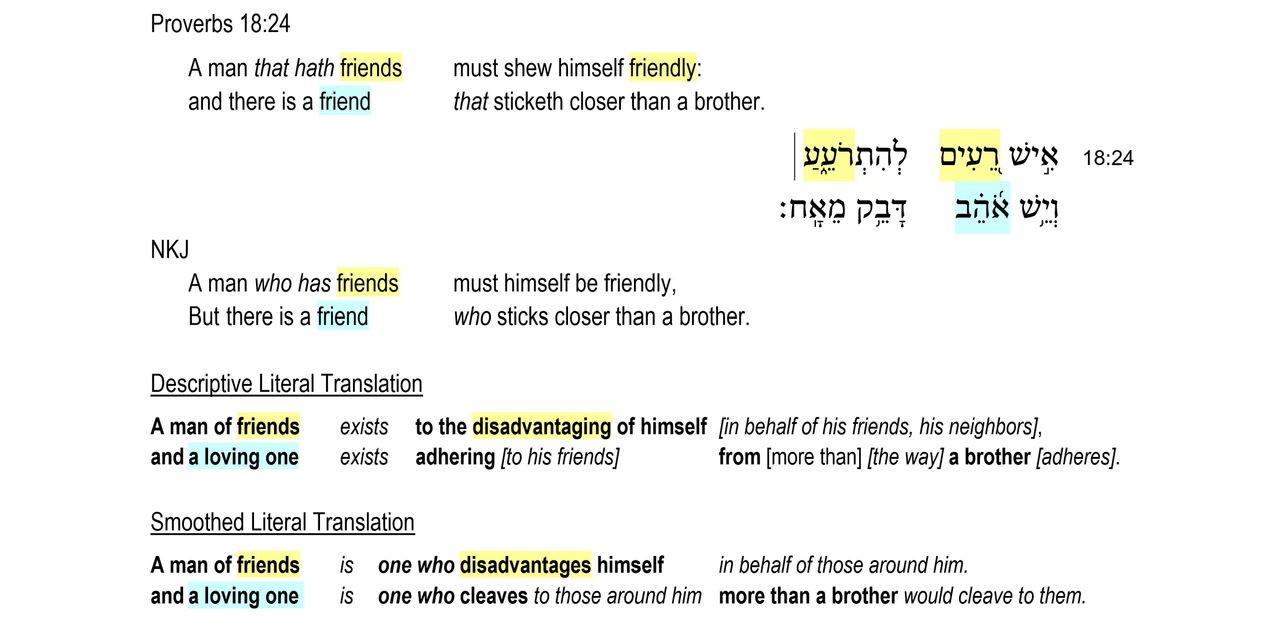
To some extent, this distinct dichotomy in translation quality may be the result of an obvious decrease in the ability of translators with regard to the Biblical languages, a decrease driven both by a focus on specialization in a single Biblical language and by a failure to recognize the identity relationship between who God is and what He says and does. In addition to these undermining influences on translation quality, the not-so-subtle prejudice, whether conscious or not, against the KJV (AV) has obviously moved some translators to compromise proper translation practice in order to arrive at any “possible” rendering which does not support the AV wording. The texts of the KJV and the Hebrew MT are as follow:
Translation and Interpretation Must Fit the Nature of the Text
The proverbs of Scripture are expressions of the perfect design criteria of God. Many, not understanding their actual nature, represent them as “general observations” or “principles” of life, or as something of a similar “non-absolute, non-promise” nature. Those who see or describe the proverbs of Scripture in any such manner are, however, revealing that they do not know the true nature of these proverbs, and thus, if they do not know the nature of the proverbs, then their translations and interpretations, their understanding of the significance which God built into the words, is skewed by the nature and extent of their error.
Accurate understanding of any text of Scripture, and most certainly, the Hebrew text of the Proverbs, requires first that the words be understood from the perspective which God intended when He gave them, constantly remembering that those Hebrew words and their parallelistic structures are perfect expressions of His design for human existence. Then, too, because no Person of the infinite, transcendent Creator-God can be separated from any other Person, these proverbs are no less the words of Christ than they are the words of the Father or the Spirit, or any other text of Scripture. Thus, the words of the Proverbs describe the timeless criteria of Christlikeness and are no less binding upon believers than any other words of any other part of Scripture. Though they are expressed in ancient Hebrew terminology and form, not the least aspect of which is the parallelistic structure so obvious in this verse, they carry the mark and authority of the Name of God.
An interpreter of the Hebrew text, and especially one attempting to accurately transfer its meaning and significance into another language, must keep in mind that no expression of God can violate or misrepresent His Person in any way,[3] and He cannot change His criteria, because they are expressions of who He is, and as such, they existed in Him before the creation. Many who prepared the lexicons so widely used in Biblical language studies did not accept this premise, thus making their lexical conclusions and presentations questionable to the degree that the perspectives of the writer deviated from that which is right and consistent with the design of God. Stated differently, the error in their foundation is manifested in that which they built upon it, and the more intensively one properly handles the Biblical languages, the more obvious the lexical errors become. Certainly, the same sort of error exists in grammatical and syntactical studies as well.
Analysis Notes and Their Significance
The KJV translators recognized the ancient Hebrew synonymous parallelism of the verse and properly sought to convey in their English rendering all that the Creator had invested in both the words and the construction. Most modern interpreters and translators, having learned only of the existence of ancient Hebrew parallelistic writing but never having learned its nature and significance, and the fact that it is a device of God and not of man, handle these “poetic” Scriptures with little or no sense of even considering the meaning God invested in their structure. Then, lacking an accurate sense of the words before them, their only resource for understanding is whatever their finite human minds can perceive of the “surface content” of the words, even if they “know Hebrew.” They may acknowledge a text as “Hebrew poetry,” but their lack of knowledge of God’s purpose and design leaves their understanding totally insufficient for comprehending the full significance of the words as God intended them to be understood.
On the other hand, the KJV and NKJV translators indicated not only their ability to evaluate the parallelistic structures but also their recognition of the value of conveying those structures into their translations.[4] This makes these two translations the most valuable for interpreting the English text of Proverbs 18:24. For English-thinking readers, a strict “literal” translation, as the one given above, would have required the insertion of multiple italicized words to prevent the reader from misunderstanding and misapplying the ancient Hebrew writer’s intent. Thus, to minimize the number of italicized words, the English translators chose to render the Hebrew text in a manner not completely “literal,” but in words which accurately reflected some of the author’s actual wording structure while conveying his intended meaning.[5]
“A man that hath friends”
The phrase translated “a man that hath friends” is a construct-absolute in Hebrew and, as the KJV translators indicated by their italicized words, is literally “a man of friends.” This phrase functions grammatically as the subject of an understood verb of “existence,” a “being” verb,[6] which must be supplied. The word “man”(iysh) refers to an individual of either gender, and the word “friends” (réngiym) refers to those with whom one is “friendly,” that is, friends, neighbors, associates, those individuals with whom one is “in contact,” those with whom one interacts in life. These are people who will be affected by their contact with the “man of friends” as they experience that person’s expression of God and His design. The true “man of friends” purposes to interact according to the design of the Creator, because he knows that every life he touches will receive from him a representation, whether tangible or intangible, of the design of God, because God has already enabled him to give it.[7]
“must shew himself friendly”
The phrase translated “must shew himself friendly” is a grammatical combination of the understood verb of existence (“exists”) and an infinitive. The infinitive is a Hebrew hithpael infinitive construct of the verb rängăng which is derived from the noun răng, the common Hebrew word for “evil,” for “that which violates the criteria of God’s perfect design.”[8] The basic meaning of this verb is “to do evil,” but, in its contrasting relationship to “good” and because good is defined as that which conforms to the criteria of God’s design and thus brings success and blessedness to the doer, it is more accurately defined as that which does not conform to the criteria of God’s design and thus does not bring success and blessedness to the doer. Stated differently, “good” is that which is to one’s advantage, that which is constructive in the doer’s life, and “evil” is that which is to one’s disadvantage, that which is destructive.
This concept of “good” and “evil,” of course, relates the doing of “evil” to the absolute design of God, but the concept also extends, humanly speaking, into the realm of relative good and evil as individual persons perceive them. Thus, “good” is whatever a person thinks is to his advantage or seems to benefit his existence, and “evil” is whatever a person thinks is not to his advantage or seems to not benefit his existence.
Grammatically, the infinitive construct functions as an adverbial phrase expressing the Creator-designed result of the existence of “a man of friends.” This is indicated by the preposition “to” (the Hebrew lämĕd), which is prefixed to the infinitive to clarify its purpose/result function, and the hithpăél stem which gives it a reflexive sense. Because God is the one who inscribed these words and these forms, every aspect is significant for perceiving His intended meaning.
The combination conveys the meaning that the subject, “a man of friends,” exists in a condition of life wherein he “makes himself suffer evil,” that is, he “inconveniences himself” for the sake of others. This does not mean that he does things to himself which are in any way “evil” in the sight of God; indeed, he would not be a true “friend,” a “man of friends,” if he were to violate the design of God in order to be a friend. This is an individual who is “friendly” in full accord with the design of God. He, or she, “loves” all those with whom he has contact, always seeking the fulfillment of the Creator’s perfect design in each and every one, knowing that the Creator’s design is the absolute best condition of life for every person who exists. He also knows that he is a representative of the Creator, not only in the content of his interaction but also in the very manner in which he presents that content. His representation of God must be accurate, regardless of the cost to himself.
Thus, the verb “to do evil,” does not here involve “sin,” but rather, the idea of “disadvantaging oneself,” of foregoing one’s own advantage, one’s own personal profit, in order to provide for someone else that which the other person needs. Such a friend is a true friend, not because the receiver or any human thinks him to be so, but because he is a friend according to the Creator’s design for friendship, that is, he is one who is sensitive to the needs of others and gives of himself to meet those needs. Such a friend seeks not that which he can accrue to himself or even to his “family”; instead, he seeks to recognize that which God has placed in his hand in order for him to place it in the hands of someone else.
Such a friend assembles with other believers, he “comes to church,” not to be blessed or receive a blessing, but to bless and to be a blessing to others. Indeed, a friend according to God’s design is always seeking the perfect balance of receiving and giving: he gives of himself in order to receive, in order to be able to give to others. Whatever the realm of the receiving and giving, and whether or not the giving precedes the receiving, the one who walks with God sees with the mind of Christ, the very One who gave Himself to meet the need that no man could meet in any other way.
“there is a friend”
The phrase translated “there is a friend” is actually a single Hebrew word combined with an understood verb of existence as in the first line. This word is a qal active participle, masculine, singular, of the verb “to love” (ähăb) and would thus be translated “loving,” but here it is functioning as a substantive[9] and is literally translated “a loving one,” “one who is actively loving”some person or thing. God set this participle in a synonymous parallelism with the noun phrase “a man of friends” in a manner that makes each term provide insight into the term with which it is parallel in the other line. Accordingly, the terms “a man of friends” and “a loving one” are two ways of describing one and the same individual, that is, a “person of friends” is a “person who loves” those around him. The relationship is clear in the following layout:

“that sticketh closer than a brother”
The phrase translated “that sticketh closer than a brother” is actually a single Hebrew word combined with an adverbial prepositional phrase. This word is a qal active participle,[10] masculine, singular, of the verb “to cleave, hold in close proximity” (däbăq/däbéq) and would thus be translated “cleaving, adhering, holding in close proximity.” Here it is functioning to indicate the continuing state in which “a loving one” exists. The prepositional phrase which modifies this participle is literally “from a brother,” that is, “from a very close relative.” This is the comparative use of “from” (min) and thus signifies that the “cleaving, adhering” of “a loving one” is greater in some way than the “cleaving, adhering” of a “brother” (ähk), a close relative who might be expected to cleave closely. God set this participle and its modifier in a synonymous parallelism with infinitive phrase “to the disadvantaging of himself” in a manner that makes each phrase provide insight into the term with which it is parallel in the other line. Accordingly, the terms “to the disadvantaging of himself” and “adhering more than a brother” are two ways of describing the continuing state of existence of “a man of friends, a loving one.”
Thus, the two lines of the proverb are synonymous with one another, both saying the same thing but using different words, with each line clarifying the text and significance of the other. Stated in a composite manner: a truly loving individual is constantly making himself act as a friend to those around him in ways to his own disadvantage but which demonstrate a care, an adhering, to those around him even more than their own brethren would express. The relationship is clear in the following layout:

Such a person, a person who seeks to walk in the design of the Creator in his every relationship, will exhibit true care and genuine concern for those around him. Indeed, this person’s care is based not upon any criterion of man, but upon the very Person of God, and, thus, he seeks to meet the real needs of those around him, mimicking as best he can the character of the Lord Jesus Christ in his every interaction. Those receiving that which the man bestows, in whatever form, recognize that his “cleaving,” his maintenance of perfect propriety in the relationship, is even above that which direct family relationship would provide. Of course, when each individual in the “friendship” is a believer and each is seeking to be “a truly loving person of friends” in God’s design, then the quality of their relationship far exceeds that which is normally encountered or experienced in temporal human existence.
God’s Design for Friendship Goes Both Ways
Thus, a “friend” is someone, a contact, in behalf of whom one is willing forego his own personal advantage, to suffer some sort of personal loss, in order to contribute to the betterment or advantage of the “friend.” God’s design, however, never pertains to only one person or thing in any interrelationship in His creation, especially between persons. His design for any one person to be loving and friendly toward others is likewise an expression of His design for a reciprocal reaction in the one loved or befriended. Thus, every expression of His design, though it appears to be directed at only a single individual or one thing in a relationship is nonetheless an expression of His design for a commensurate response or reaction in the other in such a way that each is helping the other to conform to His design, and each is accountable to Him for the proper fulfillment of his part in whatever matter is at hand.
[1] Including the ESV 2011, NAS 1977, NIV 2011, ASV 1901, CJB 1998, DBY 1890, DRA 1899, ERV 1885, NAB 2011, RSV 1952, NLT 2007, NJB 1985, NIRV 1998, and TNK 1985, to name a few.
[2] KJV 1611/1769, NKJ 1982, and MEV 2014; other older versions include GNV 1599, WEB 1833, JPS 1917, YLT 1898.
[3] He is the God “who cannot lie,” a concept He expressed in the Greek text of Titus 1:2 by using an adjective, “unfalse” (äpseudés), a non-verbal grammatical modifier, thus indicating that He cannot exist “false” in any way or to any degree. This in itself would preclude any change in Him or in any expression of Himself, whether in word or activity, but were that insufficient, He says, “I change not.”
[4] This is not to say that the entirety of God’s intended meaning was conveyed in any translation.
[5] This is a primary difficulty for anyone involved in converting communications from one language to another.
[6] The term “verb of existence” is typically expressed in English as “a being verb,” but substitution of proper “exist” forms in the place of “be” forms conveys more accurately both the Hebrew and the English concept involved.
[7] Proverbs 3:27 is another verse of Scripture which is seldom understood accurately. A summary understanding is: When God has enabled one to meet the need of another, that which the one “holds in his hand” actually belongs to the person in need, all governed by the propriety of God’s overarching design for everyone involved.
[8] This word is directly juxtaposed with “good” in Genesis 2 and 3.
[9] Subtantives are words, phrases, or clauses that act essentially as nouns grammatically.
[10] Important Note: This word is incorrectly identified as an adjective in BibleWorks 10 pop-up definition. In this paper, it is identified as a participle, thus indicating duration of the “cleaving,” but the form could be qal perfect 3ms, thus signifying the continuation of “cleaving” after it began. The effect of both is the same.